Science1 distinct publisher3 min readPublished
Trump signed the order at Johnson Space Center on Aug. 28, and what it actually creates is a study group with four months to work out who a NASA-run academy's graduates would serve and who would pay for them.
The Scientist · Science desk

Compiled by The ScientistSomething wrong?How this is made
The roster is the most informative part of the document. Jared Isaacman, who runs a civilian science agency, chairs the commission, and three of the four named members sit outside NASA entirely: the secretary of defense, the national security adviser, and the director of the Office of Management and Budget [3][22]. That is a group assembled to decide whether a school can be paid for and whether it fits national security planning. Curriculum is left to the same body [9], which means the substantive question stays open, namely how much of the teaching would concern military uses of space and how much exploration and science [10]. The order's own description of the goal, a "professional corps of civically grounded leaders prepared to advance American interests within the space domain" [6], does not settle it either way.
Counting forward from the Aug. 28 signing, a 120-day report falls due on or about Dec. 26, 2026 [20]. What arrives then is a feasibility case built on four months of study, not a campus.
The line this touches is old. American space policy has kept civilian efforts like NASA separate from military ones since the 1950s, imperfectly but deliberately [14], which makes the arrangement roughly seven decades old [21]. A NASA-led federal academy would be the first nonmilitary service academy the government has run [8]. The comparison Trump reached for was West Point, the Air Force Academy and the Naval Academy [5], institutions that exist to commission officers, while the order describes the effort as NASA-led, and NASA is not part of the military [7]. A space policy expert writing in The Conversation reads the two framings as contradictory [18]. Former NASA leaders and members of Congress have already raised the military relationship as a concern [17].
The narrow question that decides what the institution actually is has not been answered: whether graduates would incur an obligation to serve in the Space Force, and how much military-specific training they would receive [15]. Answer yes and a civil science agency is administering an accession pipeline regardless of the org chart. Answer no and this is a federally run technical college with a borrowed brand.
The order leaves open almost everything an academy needs before it needs cadets: where it goes, how students are selected, what degrees it grants [16]. Trump's first term ran a comparable sequence in space, with Artemis established in 2017, a stated case for a military space branch in 2018, and the Space Force standing up in 2019 [19]. The 120-day clock is the opening move of that same shape, and the civilian character of the school will be whatever survives the appropriations argument at the end of it.
Ranked by verification strength, evidence, and original report placement.
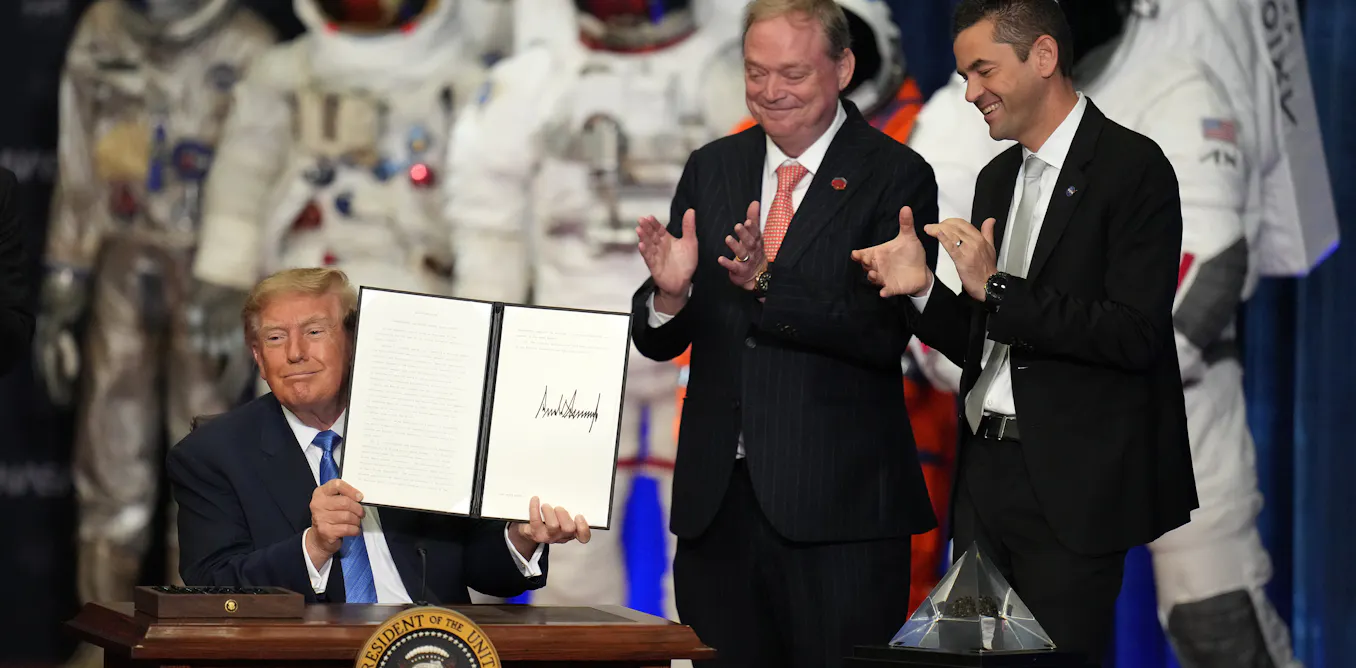
During a visit to NASA's Johnson Space Center in Houston on Aug. 28, 2026, President Donald Trump signed an executive order to create a United States Space Academy.
The executive order does not create a space academy outright; it establishes a commission that must gather information and give a report within 120 days on the feasibility of a U.S. Space Academy.
The commission will be led by NASA administrator Jared Isaacman and will include, among others, the secretary of defense, the national security adviser and the director of the Office of Management and Budget.
In his remarks in Texas, Trump stated that the U.S. Space Academy will "serve both the United States Space Force as well as NASA and the civilian spaceflight industry."
Trump said the school would be comparable to the other service academies such as West Point, the U.S. Air Force Academy and the U.S. Naval Academy.
The order says the academy would "develop a professional corps of civically grounded leaders prepared to advance American interests within the space domain."
Distinct publishers with included, body-backed reporting in this cluster.
Follow any of these and your For You feed starts watching them — no settings page required.
science
Trump orders a presidential commission to design the first U.S. Space Academy1 distinct publisher
invest
Isaacman owes the president a space academy plan within 120 days1 distinct publisher
science
Four Congressional Space Medals of Honor close out the first crewed SLS and Orion flight1 distinct publisher
invest
SpaceX carried NASA's whole $4.3bn Roman telescope on a single Falcon Heavy1 distinct publisher
Evidence-backed comparisons of source perspectives and observed adoption signals. Read the methodology
Which Builder, Operator, and Investor concerns the observed source mix emphasized—not a truth score.
Evidence, demonstrated adoption, hype gap, incentives, and confidence are assessed independently, each on its own current evidence. How these are measured.
Primary texts quoted, secondary details unnamed
The spine of this story is checkable: The Conversation quotes the order's own mission language and Trump's Houston remarks, and those documents exist independently of the essay. What does not hold up as well is everything around them — the $1 billion-a-year price tag comes from an unnamed member of Congress, and the former NASA leaders said to be uneasy about military entanglement are never identified.
A commission, not a campus
Nothing has been taken up because nothing has been built. As of the signing there is a signature, a chair, a member list and a deadline — no site, no curriculum, no cadets, no dollars. The Conversation is explicit that Congress has to both authorize and fund the institution before it can exist, and there is no sign in this reporting that it has begun to.
"Space Academy" describes a study group
The distance here is between two words and one document. Trump likened the school to West Point and said it would serve the Space Force, NASA and the commercial industry; what he signed obliges four officials to write a report by late December. The Conversation notes outlets running headlines asking "A West Point for Space?" — that is the inflation in miniature. The overstatement belongs to the announcement, not to this reporting, which deflates it deliberately.
Announcement and analysis come from opposite sides
The enthusiastic version comes from a president standing inside a NASA center describing his own initiative, slotted into a record that already contains Artemis and the Space Force. The skeptical version comes from an academic with nothing riding on the appropriation. Worth noting who was handed the pen afterward: three of the four named commissioners answer to defense, national security and budget offices, not to NASA — which shapes what a feasibility report is likely to find feasible.
One account, days after the event
We are working from a single essay published five days after the signing. Its reliance on a public order keeps the basics solid, but there is no second account to test the cost estimate against, no confirmation from Isaacman or the other named commissioners, and no independent version of the reported discontent among former NASA leadership. Confidence in what the order says is high; confidence in what it will cost or provoke is not.