Invest1 publisher3 min readPublished Updated
Storm's reductio: if the DOJ theory catches him, it catches OpenAI and Google
Roman Storm says the theory that convicted him would also reach Google and OpenAI. It is a post, not a brief, and the count he was convicted on is the one his analogy fits worst.
The Investor · Invest desk
Drafted by a language model from the sources cited here and checked against its claim ledger before publication. How we use AISend a correction
What happened
- In a post published on August 14, 2026, Roman Storm argued that the Department of Justice's theory of holding a software developer responsible when third parties misuse a neutral tool should, if applied consistently, also ensnare Google and OpenAI.
- Storm is a co-founder of Tornado Cash, a privacy-focused, non-custodial cryptocurrency mixing service.
- Storm was convicted in August 2025 of one count of conspiracy to operate an unlicensed money-transmitting business after a multi-week trial in the Southern District of New York, in the case United States v. Roman Storm.
- Prosecutors alleged that Tornado Cash facilitated the movement of more than $1 billion in criminal proceeds, including funds linked to North Korean cyber operations.
- The jury hung on the more serious charges of money laundering conspiracy and sanctions violations, leaving Storm exposed to a maximum of five years in prison on the remaining count.
Compiled by The InvestorSomething wrong?How this is made
Why it matters
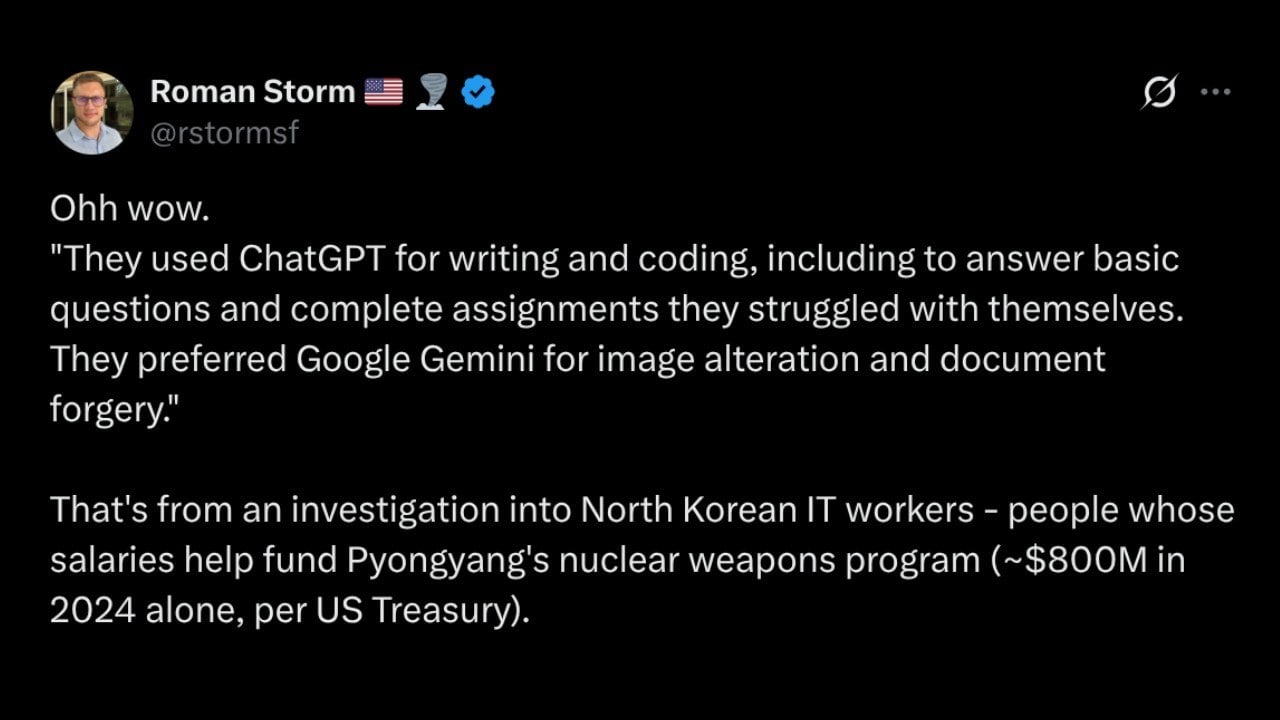
Roman Storm, convicted in August 2025 in the Southern District of New York on one count of conspiracy to operate an unlicensed money-transmitting business [3], published a post on August 14, 2026 arguing that the theory behind that conviction would, applied consistently, also reach Google and OpenAI [1]. The argument matters to anyone shipping general-purpose infrastructure because it tests where knowledge of misuse stops being a fact about your users and becomes an element of your offense.
Storm's hook is symmetry. He quoted reporting on North Korean IT workers whose salaries help finance the regime's weapons programs, workers who routinely used OpenAI's ChatGPT for writing, coding and technical assignments and preferred Google's Gemini for image alteration and document forgery [7]. Both companies, he wrote, have long been aware of that misuse and continue to offer the services and collect subscription revenue [8]. Prosecutors in his own case alleged that Tornado Cash, the non-custodial mixer he co-founded [2], facilitated the movement of more than $1 billion in criminal proceeds, including funds linked to North Korean cyber operations [4]. Storm has maintained throughout that he wrote open-source code, never controlled user funds and never directed illicit activity [6].
He then made the reductio operational: issue sweeping subpoenas to the AI companies' employees, scour internal messages for any indication of knowledge of DPRK use, and seek indictments under the International Emergency Economic Powers Act, where exposure runs to twenty years [10]. Jailing those founders is absurd, he wrote, and "if that logic is absurd for Google and OpenAI, it's absurd for Roman Storm. You prosecute the criminal, not the toolmaker" [9]. Twenty years is four times the five-year maximum Storm now faces on the surviving count [14].
The gap between those two numbers is the tell. The jury hung on the money laundering conspiracy and sanctions violation charges and convicted only on the money transmission count [5][3]. The part of the government's case Storm's analogy attacks hardest, the sanctions and facilitation theory, is the part the jury could not agree on, while the count that stuck concerns the business he is alleged to have operated rather than what strangers did with his code [15]. A court asked to rule on the toolmaker question would be reaching past the verdict actually entered [15].
That is also the constraint on the argument: it is a post, not a brief. The reporting describes an August 14 statement in public and records no filing containing it and no enforcement action against either AI company on this theory [16]. The substantive dispute stays open on both sides. Storm's supporters read the partial conviction as a dangerous precedent for open-source and privacy-enhancing software [11]; others argue that developers who design and promote services with clear knowledge of substantial criminal exploitation cross a legal threshold [12]. The Digital Asset Market CLARITY Act would draw the line by statute, protecting code authors from liability for third-party misuse, and its prospects remain uncertain [13].
Three things to watch. Whether Storm's reductio migrates from social media into an appellate filing where a court has to answer it [16]. What happens to the hung counts, since that is where the facilitation theory actually lives [15]. And whether the CLARITY Act's protection for code authors survives, because absent a statute the liability perimeter for neutral infrastructure gets set case by case [13].