Science1 publisher2 min readPublished
A new study reads Cycle 26's strength from the moment Cycle 25's sunspots switch off
Sandra Chapman reports in The Astrophysical Journal that solar maxima end in a sharp sunspot cutoff whose count predicts the next cycle, and her own forecast for Cycle 26 follows the drop she expects in 2028.
The Scientist · Science desk
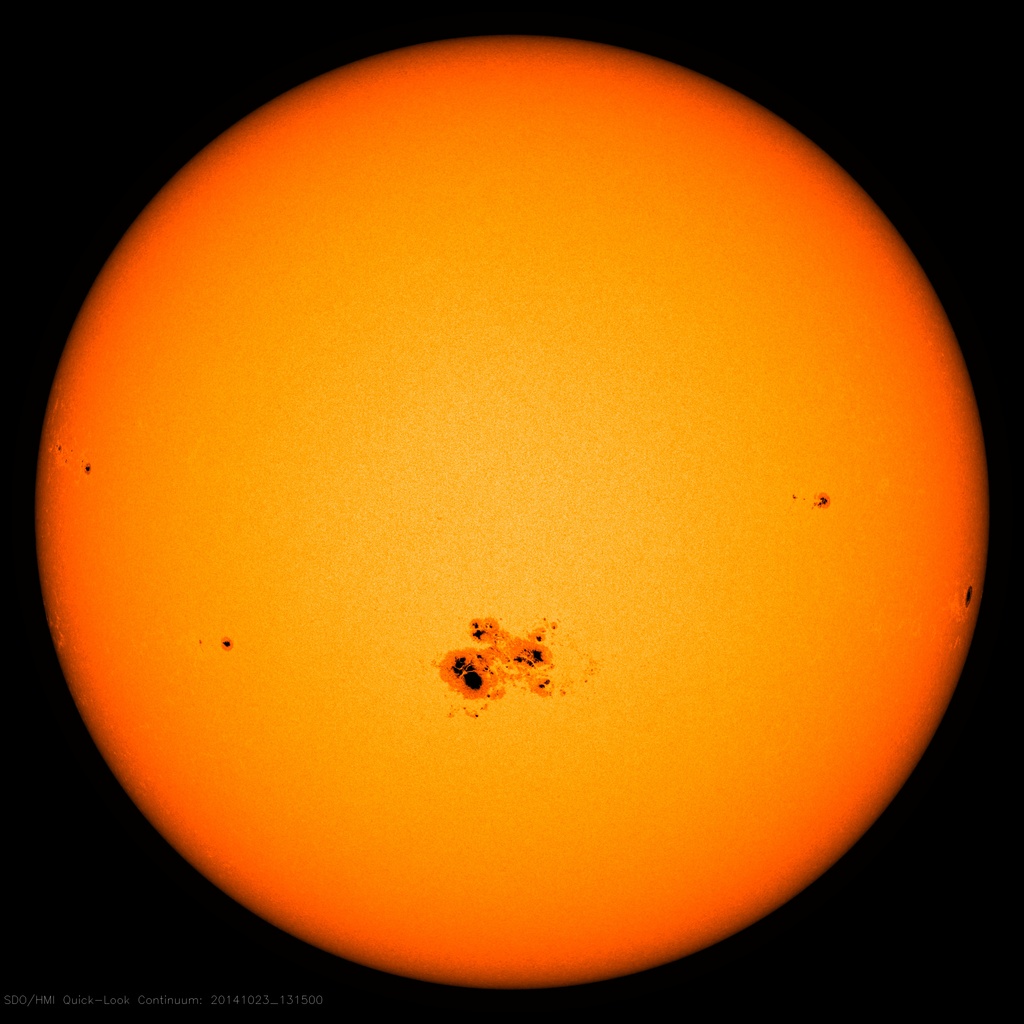
What happened
- Sandra Chapman, writing in The Astrophysical Journal, reports that solar maxima do not fall away smoothly but end at a sharp cutoff point where the sunspot number drops significantly.
- The sunspot count measured at that cutoff correlates with the strength of the next solar maximum, giving the declining phase of one cycle a predictive role for the following one.
- Chapman expects the next switch-off in 2028, taking Cycle 24 as the guide, and will have a firm prediction for Cycle 26 once that cutoff has been observed.
Compiled by The ScientistSomething wrong?How this is made
Why it matters
- capability A single count taken in the quiet stretch after a maximum would give planners an amplitude estimate for the following cycle about seven years before the maximum it describes can confirm it.
- constraint Validation arrives one cycle at a time, so anyone who wants replication before trusting the precursor is signing up for a wait measured in decades.
- decision Sunspot monitoring through 2028 decides whether the forecast is testable at all, since a gap in coverage at the cutoff would cost the model its one scheduled test.
Chapman's precursor is one number taken at one identifiable moment: the sunspot count at the point where a maximum switches off [4][5]. The information sits in the quiet stretch after the peak, which is what the paper's title says it is looking at, "A New Declining Phase Precursor and an Early Prediction of Cycle 26 Maximum" [11]. A scalar read at a dated moment gives a paper a deadline as well as a claim.
Cycle 25 began in 2019, is past its peak, and will keep declining until around 2030 [7]. Eleven years from 2019 is 2030, so the cycle is keeping to the pattern recognised in the 1800s [12]. Chapman expects the switch-off in 2028, using Cycle 24 as the guide [9]. The cutoff would fall about two years before activity bottoms out [13], and about seven years before the mid-2030s, when the resulting prediction can be set against an observed maximum [10][14].
The call she makes now, that Cycle 26 will be somewhat weaker than Cycle 25 [8], comes from the weaker of her two correlations, the one between one maximum's overall strength and the next [6]. A two-way directional guess is right half the time by chance [15]. The forecast that can fail in an informative way is the numeric one she issues after the cutoff [9].
Amplitude has stayed the hard part of solar-cycle prediction after centuries of observation [2]. What this method predicts is the height of the next maximum: one number covering an eleven-year stretch [16]. Solar activity can have significant effects on technological infrastructure [3], and an estimate at that resolution tells a planner how busy the coming decade is likely to be. Storm timing sits outside it.
The sample is small by construction. The eleven-year pattern has been recognised since the 1800s [1], which at eleven years a cycle puts the run of reasonably observed cycles on the order of sixteen [18]. The phys.org account of the study does not say how many of them entered the fit [17]. A correlation across that many points can look convincing and still turn on a few of them, and adding one point takes eleven years [1].
What to watch
- Whether the sunspot count drops sharply in 2028 on Cycle 24's schedule, and what value it lands on.
- The numeric Cycle 26 maximum Chapman publishes after the cutoff, and how far it sits from her provisional weaker-than-25 call.
- Independent reanalysis of the historical sunspot record for the same cutoff-to-next-maximum relationship.