Science2 publishers2 min readPublished
Sediment traps 1,000 meters down credit cyanobacteria with two-thirds of exported carbon
A multi-year sediment-trap record from the South China Sea points most of the deep carbon flux at the ocean's smallest photosynthesizers. The authors say models of ocean carbon sequestration may need rebuilding.
The Scientist · Science desk
What happened
- Scientists have held that relatively large phytoplankton export carbon to the deep ocean more efficiently than tiny cyanobacteria, and a new AGU Advances paper by Jingjing Zhang and colleagues disputes it.
- The team set sediment traps at 1,000 meters in the South China Sea and paired the catch with multiple years of observations of the phytoplankton communities living at the surface above them.
- About two-thirds of the sequestered carbon came from cyanobacteria, the small prokaryotic phytoplankton; size-based reasoning would have favored the eukaryotic microalgae.
- The reason the authors give is transit loss: much of the carbon from microalgae is lost on the way to the deep ocean, while carbon from cyanobacteria is not.
- Amino acid carbon isotope signatures in the material collected at 1,000 meters let the researchers assign the trapped carbon to particular phytoplankton groups at the surface.
Compiled by The ScientistSomething wrong?How this is made
Why it matters
- decision A modeler who sets export efficiency by cell size has to decide whether to carry a taxon-specific loss term, because at this station the size ordering does not predict what reached the trap.
- constraint One trap depth in one marginal sea sets a test a global model should pass at low latitudes; it does not settle the high-latitude, bloom-driven case.
- precedent If the authors' latitude comparison holds up, published contrasts between large-cell polar seas and cyanobacteria-rich gyres need rereading for which organisms carried the flux, not only how much arrived.
- exposure Projections that read a community shift toward smaller cells as a weakening pump inherit the size assumption this record contradicts at low latitudes.
The design's useful feature is a mismatch between two time series. At the surface, carbon production and phytoplankton community structure varied considerably from season to season along with nutrient availability [11]. The material caught at 1,000 meters did not: its export efficiency and its origin held roughly steady across those swings [12]. Export driven by eukaryotic blooms should track the blooms.
The trap record covers what reached 1,000 meters. The description of carbon staying put for hundreds or thousands of years applies to the pump as a whole [1], and the evidence here is multiple years of paired surface and trap sampling in a single marginal sea [5].
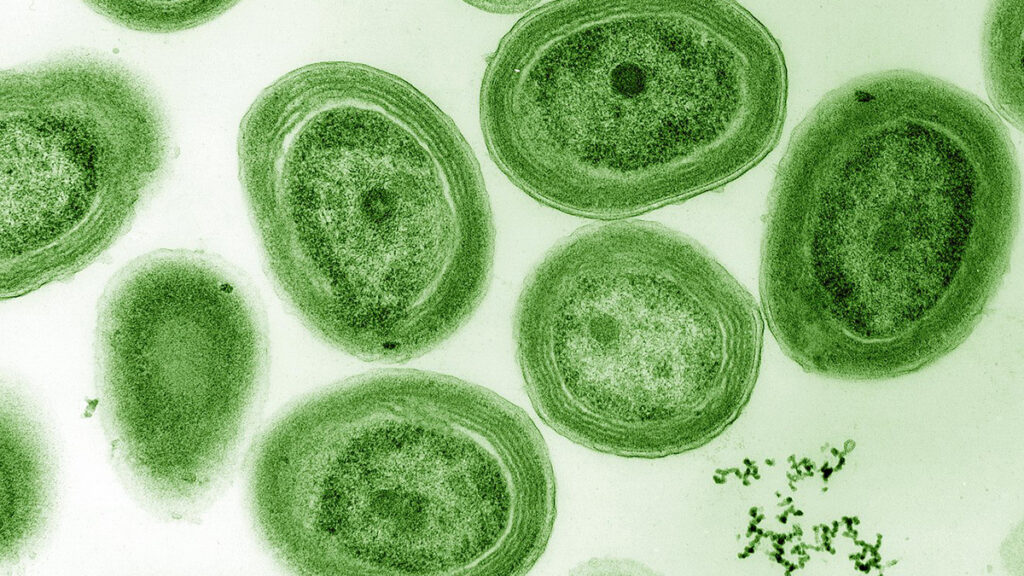
Two-thirds cyanobacterial leaves roughly one-third eukaryotic, so at this site the small prokaryotic cells put about twice as much carbon into the trap as the microalgae did [16]. Zhang and colleagues attribute that to aggregation and ballasting: cyanobacterial carbon ends up inside larger clumps that also contain minerals. Those clumps sink more efficiently and limit microbial degradation of the organic matter they carry [13]. Cyanobacteria are tiny, often unicellular prokaryotes, named for the blue-green color of large colonies [7].
The authors push the result past their own station. It may explain, they note, why high-latitude systems dominated by large phytoplankton do not always sequester organic carbon more efficiently than low-latitude oligotrophic gyres rich in cyanobacteria [14]. That comparison is an inference from one trap record; the measurements come from the South China Sea [5].
The implication the authors claim is about how sequestration models are constructed and about how the pump will shift in response to climate change [9]. Carbon inventories, accounting and offset crediting do not come up in either published account [18]. And there is only one account: phys.org republished the Eos research spotlight written by Nathaniel Scharping [15]. The paper is titled "Cyanobacteria Sustain Deep Ocean Carbon Sequestration Despite Eukaryotic Loss" [4].
What to watch
- Whether traps at other depths and in high-latitude waters reproduce the roughly two-thirds cyanobacterial share, since high-latitude blooms are where the large-cell assumption came from.
- Whether the aggregation-and-ballasting explanation gets direct measurement of clump mineral content and sinking speed, instead of resting on isotope attribution at one depth.
- Whether ocean carbon models take up taxon-specific loss terms, and how far global export estimates move when they do.