Science1 distinct publisher3 min readPublished
A 2026 National Academies report proposes a center to integrate and translate paleoenvironmental records of extreme events. The methods it would pool differ enough in precision that the pool cannot be read as one dataset.
The Scientist · Science desk

Compiled by The ScientistSomething wrong?How this is made
What makes Marble Canyon the field's showcase is also what makes it a poor template for a synthesis center. A single group worked a single archive type on a single reach of one river, over decades of method development, before the numbers were fit to enter a dam safety file [4][7]. A center chartered to integrate, synthesise and translate does not get decades per archive, and the proposed structure spreads the work across academic, government and industry working groups rather than concentrating it the way Baker's students and collaborators concentrated theirs [15][4].
Consider what a flood frequency estimate needs for each event: a magnitude and an age. In the slackwater case those arrive from two different instruments, a hydraulic model back-calculating discharge from the stage the sediment records, and a radiocarbon date on the deposit itself [4]. Both carry error, and a return period is a count of events over an elapsed span, so error in either term moves the exceedance probability an engineer designs to. Pool records of unequal precision and the tail of the curve is set by whichever record claims the largest and oldest flood, which is not necessarily the record whose provenance you would want to defend in a design review. The maturity spread is real: the report acknowledges that not every method's output can go directly into a formal hazard assessment the way slackwater analyses did [11].
The timeline is worth doing as arithmetic. From the 1992 Marble Canyon workshop to the 2026 report is 34 years [17], with the Wilhelm et al. survey of worldwide method diversity landing 27 years in, seven years before the report [18]. Across that span, slackwater stratigraphy is the example the Eos piece reaches for when it needs a method that made the full trip into engineering practice [11][16]. Tree-ring flood rings, boulder berms, stalagmite detrital layers and documentary archives are all in the field's toolkit now [9]; they are not all in Reclamation's files.
The report and the Eos piece point at opposite failure modes. The report's finding is underuse: long records that risk managers are not drawing on [14]. The Eos opinion piece, published under the title "Prioritizing Quality Before Synthesis in Paleoenvironmental Hazard Science," calls the report welcome while putting the emphasis on the other risk, records entering practice before their uncertainties are documented [16]. Both can be true at once, and each implies a different first cheque: outreach and translation in one case, provenance metadata and dating protocols in the other.
The thing this doesn't tell you is what fraction of published paleoflood records would survive an admission standard, because neither the report nor the opinion piece, as excerpted, puts a number on it. And the Marble Canyon result, floods roughly double the gauged maximum recurring more often than assumed, is evidence that short instrumental records understate rare events [5][8]. That finding stays local to Marble Canyon and does not transfer as a coefficient to another basin.
Ranked by verification strength, evidence, and original report placement.
The approaches vary considerably in the precision and accuracy of the estimates they produce, and not all have matured to the point where their outputs can be directly incorporated into formal hazard assessments in the way Baker's analyses of slackwater deposits were.
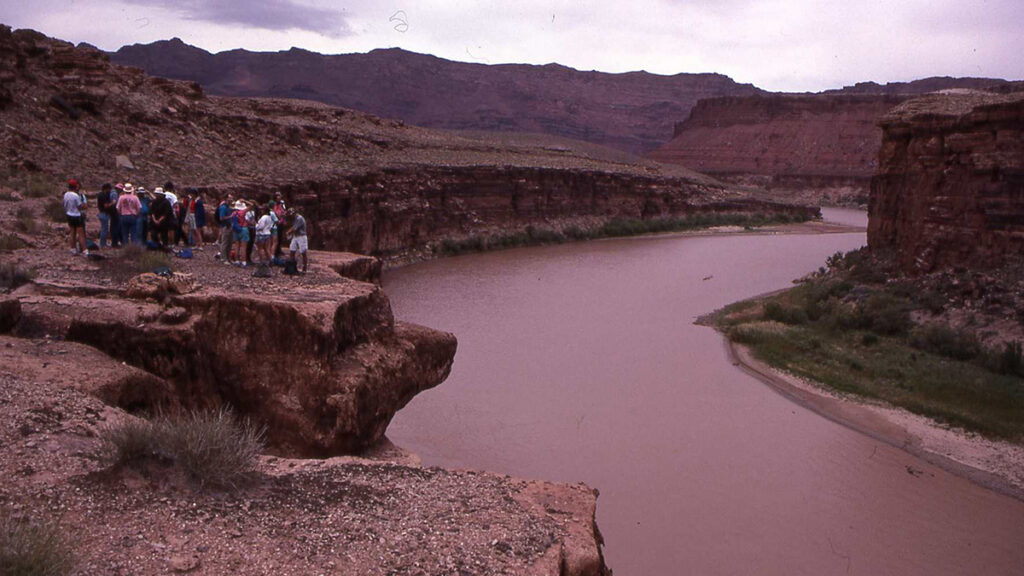
The First International Workshop on Paleoflood Hydrology was held in May 1992 at the edge of Marble Canyon in northern Arizona, organized by Vic Baker of the University of Arizona.
At Marble Canyon the Colorado River has cut into Permian sandstone to form cliffs rising hundreds of feet above the water, where sediment deposits mark the high-water lines of floods that predate any stream gauges.
Baker and colleagues studied slackwater deposits, fine-grained sediments emplaced by floodwaters in sheltered alcoves and tributary mouths.
Over the course of decades, Baker with collaborators and students developed methods to read the Marble Canyon deposits, using hydraulic models to back-calculate past flood discharge and radiocarbon dates to pinpoint when floods occurred.
Their analyses revealed floods nearly twice the size of those captured by the instrumental record, recurring far more frequently than engineers had assumed (Greenbaum et al., 2014).
Distinct publishers with included, body-backed reporting in this cluster.
1 article · August 28, 2026
Follow any of these and your For You feed starts watching them — no settings page required.
science
A century of malaria surveys catches warming pushing West Africa past the transmission ceiling1 distinct publisher
science
One 320-metre impact explains Deimos's dust blanket, and predicts what a sampler would grab1 distinct publisher
science
First stellar stream found outside our galaxy turns a faint arc into a dark-matter scale1 distinct publisher
science
One oblique hit, two Deimos mysteries, and a moon weaker than anyone budgeted for1 distinct publisher
Evidence-backed comparisons of source perspectives and observed adoption signals. Read the methodology
Which Builder, Operator, and Investor concerns the observed source mix emphasized—not a truth score.
Evidence, demonstrated adoption, hype gap, incentives, and confidence are assessed independently, each on its own current evidence. How these are measured.
One column, three citations, no second voice
Everything in this story arrives through a single Eos opinion piece, which is thinner sourcing than the subject deserves — but the piece does not float free. Its load points are pinned to citable work: Greenbaum and colleagues for the doubled Marble Canyon discharges, Wilhelm and colleagues for the sprawl of methods, Reinders and Muñoz for the claim that high-error estimates make flood frequency analysis worse, and a direct quotation of the National Academies mandate. What no one has supplied is the other side of the room: no report author, no Reclamation engineer, no advocate of synthesis-first answering the charge.
One agency, one river, one method
Thirty-four years of a discipline resolve here into a single operational fact: Reclamation using Marble Canyon slackwater records in Colorado River dam-safety work. That is genuine uptake, and it is also the whole of it. The proposed center exists as a recommendation; the wider method zoo — flood rings, cave deposits, boulder berms — has produced records that, on the piece's own reading, mostly sit below the precision an assessment will accept. Uptake by the field's founding technique is not uptake by the field.
A deflationary piece, still doing its own arithmetic
Unusually, the overstatement risk here runs against the story rather than with it: Eos is arguing that a proposed synthesis center would pool records too uneven to be read as one dataset, which is the opposite of a promotional move. The gap that remains is inside the correction. The 20% error threshold is presented as a settled line when it is one practitioner's rounding, and 'most records fall short' is a sweeping census delivered without the census. Mildly overstated, in the direction of a lone expert's confidence.
A field commenting on the institution built for it
The only voice in this story writes in the first person from inside paleoflood hydrology, assessing a National Academies proposal that would organize, coordinate and channel attention toward that same discipline. That does not make the argument wrong — the quality-threshold objection is the kind of thing only a practitioner would raise — but 'fund record quality, not a coordinating body' is also a claim on where money goes. The piece is candid enough to name the underlying problem itself, noting how disconnected the incentives and timelines of academia, government and industry are, which is exactly the friction its own recommendation would have to survive.
Credible account, uncorroborated everywhere
We would stand behind the descriptive spine — the 1992 workshop, the slackwater method, Reclamation's use of it, the report's title and quoted mandate. Confidence stops short of high because a single opinion column carries all of it, the National Academies report is identified by year alone with no publication date or authorship, the Reclamation account comes with no agency document behind it, and the piece's second objection about site specificity is cut off before it lands.