Science1 publisher2 min readPublished
A zeolite and bamboo-biochar concrete gained 7.48% compressive strength in a six-mix comparison
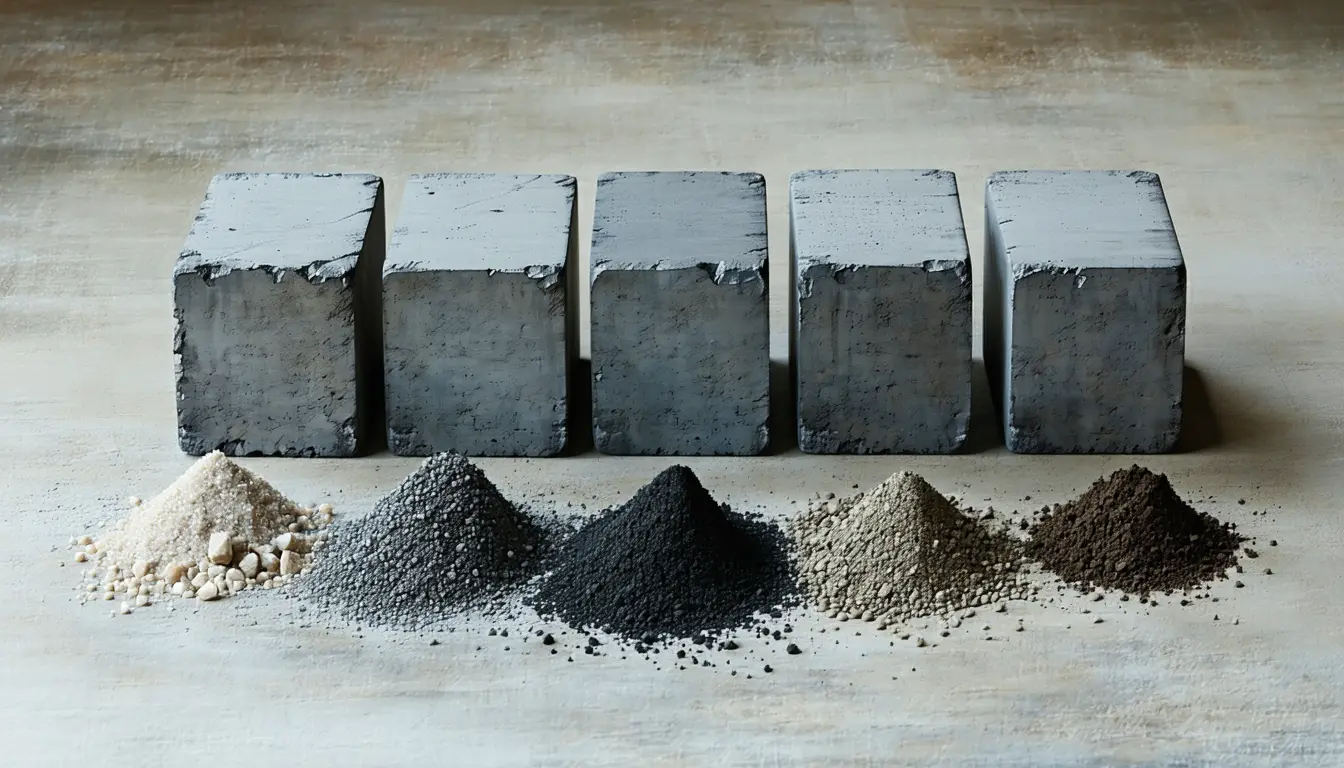
The winning mix replaced half its fine aggregate with zeolite and 1% of its cement with bamboo biochar, and it also took up 1.2 grams of CO2 a day inside a carbonation chamber. The strength figure is the one a second batch can settle.
The Scientist · Science desk
What happened
- A team at Mepco Schlenk Engineering College in India mixed M35 grade concrete with zeolite replacing 25% or 50% of the fine aggregate and bamboo biochar replacing 0.5%, 1% or 1.5% of the cement.
- The best performer, 50% zeolite with 1% biochar, reached 38.49 MPa in compression, about 7.48% above the conventional mix, and 4.39 MPa in split tension, a 15% gain.
- Placed inside a carbonation chamber, the same mix captured about 1.2 grams of CO2 a day, and after seven days the gas had penetrated 15 mm into the material.
Compiled by The ScientistSomething wrong?How this is made
Why it matters
- capability For a mix designer the interesting part is the substitution: half the fine aggregate and 1% of the cement came out, and the measured strength went up.
- constraint Because uptake happens in a penetrating surface layer, the honest unit for it is grams per square metre of exposed face; carbon accounting done per cubic metre of concrete poured would overstate what a structure can absorb.
- contradiction The release is headlined as concrete that pulls CO2 from the air, while the 1.2 grams a day was measured inside a carbonation chamber, and those are not the same setting.
Carbonation moves through concrete as a front, and the front is where the chemistry happens. Seven days into the chamber test, the CO2 had reached 15 mm into the specimen [12]. So the absorbing part of the material is its outer skin, and the depth the gas reaches, not the volume of the element, sets how much any given piece can take up.
At 1.2 grams a day [11], a specimen holding that rate for a year would take up roughly 0.44 kilograms [4]. The release does not report the specimen's dimensions or the CO2 concentration inside the chamber [17], so the number cannot be converted into kilograms per cubic metre of pavement.
The strength side is more checkable. Work back from the percentages and the control appears where the grade says it should: 38.49 MPa divided by 1.0748 puts the conventional mix at 35.81 MPa in compression [1], and 4.39 divided by 1.15 puts its split tensile strength at 3.82 MPa [2]. The programme used M35 grade concrete, the sort specified for infrastructure carrying moderate traffic [4], and a control testing at 35.81 MPa is behaving like an M35 control. The gain in absolute terms is 2.68 MPa [5].
Two zeolite levels and three biochar levels define six combinations [3], and ZB5 was the one that came out best [7]. That makes 7.48% the largest margin among six comparisons, each reported as a single figure [8]. Water absorption and impact resistance were measured as well [6]. Before I treated the margin as a property of the mix rather than of the batch, I would want ZB5 cast again on its own against a control from the same pour, with the spread across specimens reported.
Both additives were picked for large pore volume and high specific surface area [3]. Srinivasan Revathi's group at Mepco Schlenk Engineering College in India attributes the strength gain to zeolite's alumina-silicate structure interacting with the hardness of the bamboo biochar, which they say produces a denser and more durable cement-based matrix [10][2]. The same porosity, plus the biochar's carbon content, is what they credit for the CO2 uptake [13].
"We are not just creating a stronger concrete, but we are transforming a common building material into an active tool for environmental remediation," Revathi, the corresponding author, said of the work [14].
The uses the group suggests are concrete pavements, highway parapet walls and sewer pipelines, picked for settings where CO2 concentrations are relatively high [16]. The findings appear in Carbon Research [1]. The authors describe the material as a proof of concept and say more testing is needed before it could be widely adopted [15].
What to watch
- An independent batch of ZB5 cast against a same-pour control, with replicate counts and the spread across specimens reported.
- Uptake tracked over months instead of seven days, to show how far the daily rate falls as the carbonated shell thickens.
- Durability data for reinforced ZB5 elements, since the suggested uses include parapet walls and sewer pipelines.