Science1 publisher2 min readPublished
Scientific American essay challenges the Tetris Company's claim with Golomb's 1953 tetrominoes
Scientific American essay says the Tetris Company's rights claim rests on a 2012 ruling crediting Pajitnov with shapes Golomb described in 1953. The dating looks solid, but the essay leaves open how much weight it carries against a game copyright.
The Scientist · Science desk
What happened
- After the Trump administration released a Tetris clone called Build the Wall, TTC wrote on X, "We take copyright infringement very seriously."
- The White House took the game down four days later and gave no explanation.
- The essay says TTC claims exclusive rights to the pieces it calls "Tetris" pieces, and to any electronic puzzle built on falling shapes.
Compiled by The ScientistSomething wrong?How this is made
Why it matters
- contradiction By the essay's dating, the shapes were in the mathematical record 59 years before a federal court, as the essay tells it, assigned them to TTC's founders, so the ruling's premise and the priority history conflict.
- exposure A claim covering any electronic puzzle with falling shapes puts every developer in that genre inside the scope of TTC's warnings, including games far removed from a direct clone.
- constraint The essay cites no later decision revisiting Xio, so its historical objection gives developers an argument to make but no holding to rely on.
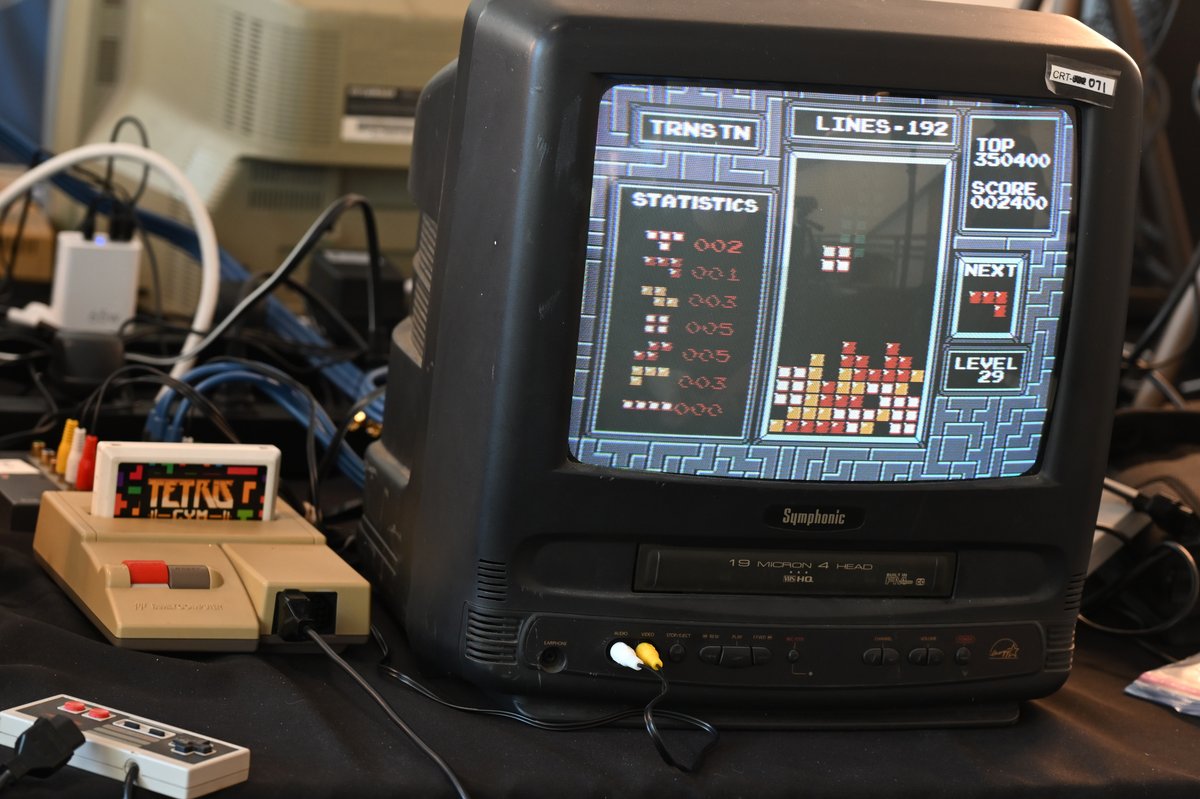
The shapes at the centre of the dispute have a date. According to a Scientific American essay, Caltech mathematician Solomon Golomb first described tetrominoes in a 1953 talk at the Harvard Mathematics Club, and they were later popularized in Scientific American itself [8]. The essay describes the 2012 case this way: a federal judge decreed that forms made of four equal-sized squares, each joined to at least one other square along an edge, were copyrighted and belonged to Russian engineer Alexei Pajitnov and entrepreneur Henk Rogers, organized together as TTC [5][6].
Golomb's talk came 59 years before Tetris Holding, LLC v. Xio Interactive, Inc. [1]. The essay says Pajitnov did not design the pieces and that they are not unique to Tetris. It calls TTC's claim to own them "dubious" [7][4].
In the essay's own account, the game is Pajitnov's and the pieces are Golomb's. Pajitnov, it says, "adapted Golomb's geometric discoveries for the nascent digital world" [9]. He did the work in a state artificial-intelligence research lab that, according to the essay, the KGB tightly controlled [10]. The Soviet system did not recognize a freedom to publish, so the game spread as samizdat on floppy disks [11].
It reached Hungary, where British software entrepreneur Robert Stein saw its commercial potential. From there, rights to various versions moved, under sometimes competing claims, through the Robert Maxwell group, Atari, Sega and finally Nintendo, which made Tetris the Game Boy's "killer app" [12]. By then the Soviet technology export agency ELORG, run by Nikolai Belikov, controlled the game, and Western sales filled the Communist Party's coffers [13].
I think the priority argument holds as history. Its legal weight is less clear. The essay summarizes the Xio holding without quoting the opinion, and it does not explain how a 1953 mathematical description would bear on a copyright in a video game's pieces [6]. Golomb's priority settles who described the shapes first. What the court protected in 2012 is a separate question, and the essay's answer is an argument about the ruling's premise [5][7].
The Build the Wall episode has the same gap between sequence and cause [1]. A warning post followed by a removal four days later fits a threat that worked. It also fits a decision made for unrelated reasons. The essay says it is unknown whether TTC's post prompted the removal [3].
What to watch
- A developer contesting a TTC demand in court, which would make a judge weigh Golomb's 1953 description against the Xio holding.
- Any statement from the White House or TTC on why Build the Wall was taken down.
- A TTC response to the essay's argument that Pajitnov did not design the tetrominoes.