Science1 publisher3 min readPublished
Hurricane Nolo puts Hawaii under a third hurricane watch in one year for the first time
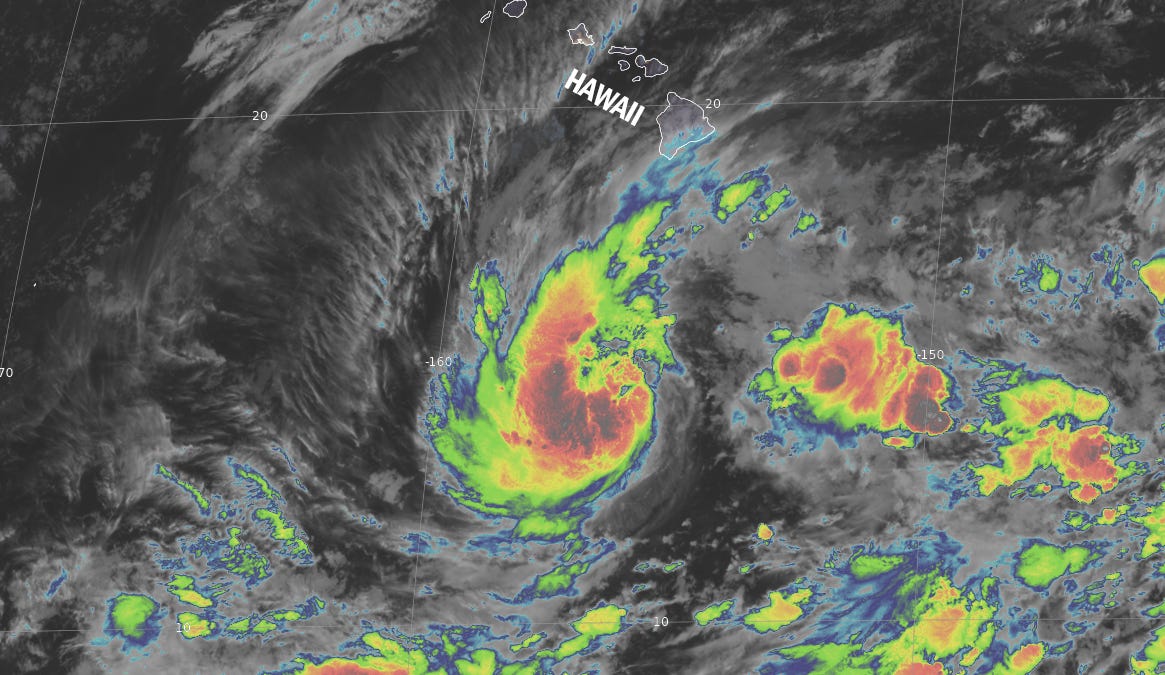
Hurricane Nolo has put Hawaii under a third hurricane watch this year, a first on record. Up to 35 inches of rain could still fall on parts of the Big Island, even though the storm is forecast to pass about 150 miles south.
The Scientist · Science desk
What happened
- Hurricane Lala dumped 40 inches of rain on the Big Island in August, devastating many of the areas now in line for Nolo's heaviest downpours.
- In early September, Hurricane Lowell struck Kauai and Niihau, the westernmost islands in the Hawaiian chain.
- As of Friday morning, Nolo sat about 200 miles south of the Big Island and was moving slowly northward.
- High pressure building to the north is expected to turn Nolo sharply west as a Category 3 storm on Saturday morning.
Compiled by The ScientistSomething wrong?How this is made
Why it matters
- contradiction The record Scientific American leads with, three storms within 50 miles, needs Nolo about 100 miles closer than its forecast track, so on current evidence the only first that holds is the watch count.
- exposure Areas Lala devastated in August are forecast to face mudslides again from Nolo, so an offshore track still leaves them exposed.
- constraint Seasonal El Niño outlooks can warn Hawaii that the eastern Pacific will be busy; the 2015 season shows they cannot tell planners how many storms will reach the islands.
Hawaii's claims to a record this season rest on different measures. The watch count is settled: no earlier year had brought the islands three hurricane watches [1]. The proximity records depend on the radius. Meteorologist Michael Lowry wrote that only six hurricanes have ever come within 50 miles of the islands, that two have done so this year, and that Nolo would be the third [16]. "This amounts to three decades worth of hurricane threats to Hawaii in one year," Lowry wrote [17]. Phil Klotzbach, citing NOAA data, counts storms within 100 miles, and by that measure 1957, an El Niño year, is the only year with three [c13, c15].
Nolo is expected to stay about 150 miles south of the island [15]. That is 100 miles outside Lowry's radius and 50 miles outside Klotzbach's [18]. For the 50-mile first that Scientific American raised at the top of its account, the storm would have to come within a third of its forecast distance [c2, c18]. The exact track is uncertain [6]. If Nolo did come inside 100 miles, 2026 would be only the second year, after 1957, with three hurricanes that close [15].
Any of these counts is rare, because conditions near Hawaii usually suppress hurricanes. The water around the islands is usually too cold to support the convection that fuels tropical cyclones [10]. Systems that do approach are often torn apart by wind shear, winds blowing in different directions at different heights [10]. El Niño shifts a pool of warm equatorial water eastward and tends to weaken that shear in the eastern Pacific. This year that basin has been full of hurricanes, while the Atlantic has been notably quiet [11].
The El Niño link is about odds. The 2015 season was exceptionally active because of a strong El Niño, but only one storm came particularly close to the islands, which are a small target in a large ocean [12]. The years either side of it, 2014 and 2016, each had two hurricanes within 100 miles [14]. Scientific American puts this season down to an exceptionally strong El Niño and "a dose of bad luck" [3]. I think both parts belong in the explanation. Warm water and weaker shear explain a busy eastern Pacific; where the tracks happened to run explains how many storms reached Hawaii [c11, c12]. The account does not say how many years the NOAA record covers.
The rain hazard sits apart from the records. Nolo is forecast to bring torrential rain and devastating mudslides again, even without a direct landfall [c6, c7]. Its forecast maximum of 35 inches is seven-eighths of the 40 inches Lala dumped in August [19], and much of it is expected on the areas Lala devastated [8].
What to watch
- Nolo's position after its forecast westward turn on Saturday: inside 100 miles would tie 1957, and inside 50 miles would set the record Lowry described.
- Measured rainfall on the Big Island against the 35-inch forecast, and whether mudslides recur in the areas Lala hit in August.