Science1 publisher2 min readPublished
An Oxford mathematician tests the Parthenon's curve against the eye's detection limit
Alain Goriely sets the stylobate's six-centimetre rise beside published curve-detection thresholds. Up close, he argues, the platform looks curved; at the distances where a sag would matter, the eye cannot see the curve at all.
The Scientist · Science desk
What happened
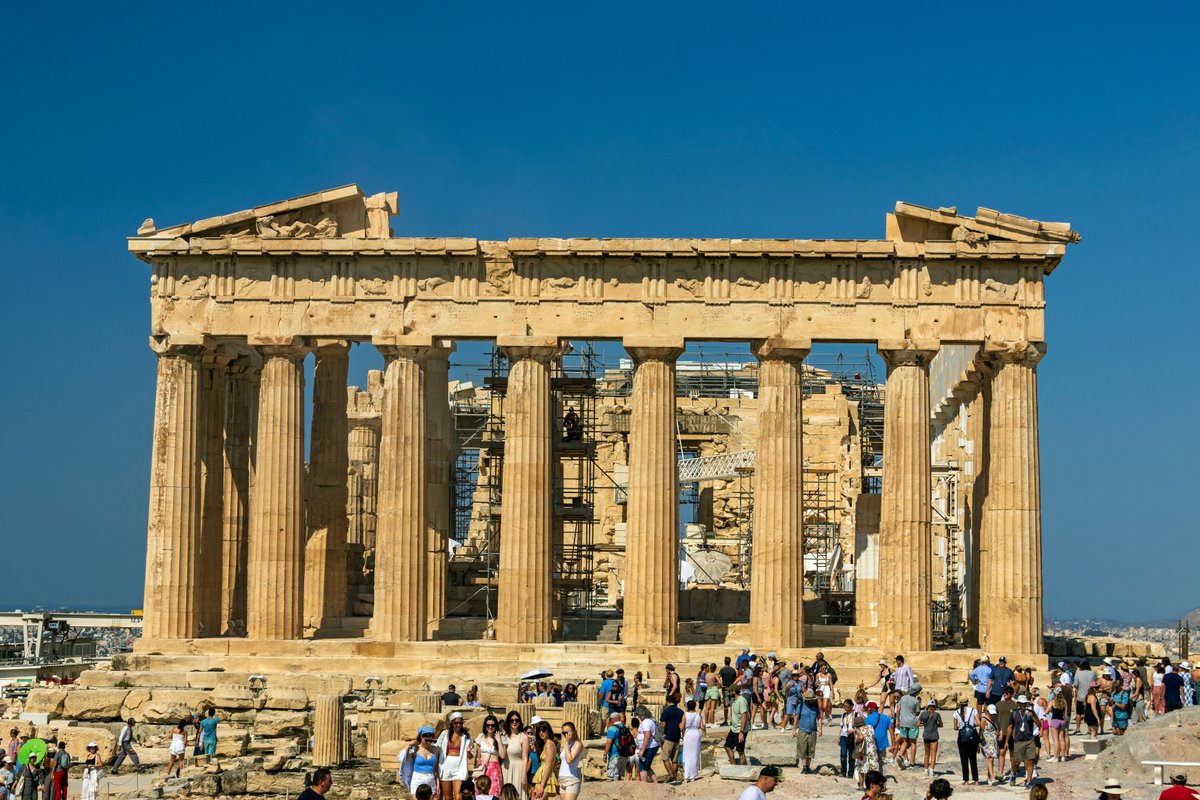
- Applied mathematician Alain Goriely argues in Royal Society Open Science that the curve built into the Parthenon's stylobate cannot be producing the straightening optical illusion long attributed to it.
- Published perception work puts the eye's limit at roughly 1.5 to 5 centimetres of deviation from a straight line at 25 metres, and the stylobate's curve tops out at six centimetres of change.
- That 25-metre threshold was established for a single high-contrast line on a flat surface, and Goriely argues the Parthenon's three-dimensional foreground and background obscure the curve even at that range.
- He also rejects the idea that the columns' inward tilt and central bulge offset the curve, because the columns stand far too close to perpendicular to the stylobate to do it.
- Architectural historian Mark Wilson Jones points instead to an exact 2:1 relationship between the width of the stylobate and the height of columns plus entablature. He says the sweetness of that proportion depends on the curve.
Compiled by The ScientistSomething wrong?How this is made
Why it matters
- contradiction Goriely treats the perceptual failure as fatal to the illusion reading. Wilson Jones holds that ancient builders could act on several partial explanations at once. The two are really arguing about whether an intention has to work to count as one.
- constraint The visitor experience that sells the illusion story undermines it. If the curve is plainly visible from close range, the platform is not being seen as straight, and the popular explanation loses the observation it rests on.
- precedent Other Greek refinements, the columns' lean and their central swelling among them, are routinely explained as corrections for the eye. Each of those claims can now be checked against a measured detection threshold instead of asserted.
The distance half of the case is the stronger one. Beyond about 25 metres, on the perception research Goriely cites, the average eye can no longer see the curve at all [7]. The illusion account has the curve cancelling an apparent sag in the platform [3], so the correction would have to be delivered from close in. From close in, the platform looks curved [6].
Assume for a moment that the detection limit is fixed in visual angle instead of in centimetres. At 100 metres, four times the test distance, the same band becomes roughly 6 to 20 centimetres of deviation, and the stylobate's entire rise sits at its lower edge [22]. Those figures are scaled from published thresholds. No one has measured this on the Acropolis.
Goriely, an applied mathematician at the University of Oxford, said, "We're not that easily fooled in the real three-dimensional world by visual illusion" [10]. He is also unimpressed by the demonstration visitors are usually given. "People sometimes are brought to the corner of the Parthenon, and that really amplifies the curvature," he said [11]. "But if it appears straight, why is it curved?" [12]
The illusions that genuinely do bend a straight line work by crossing it: in the Hering and Wundt figures, intersecting lines at a certain angle make a straight line look curved [13]. Goriely says better drainage, or a plain preference for the shape among the builders, carries more weight than the illusion [16].
On the perceptual question I think he is right, with one condition: the thresholds he borrows were established for an idealised stimulus, and nobody has run the test on a colonnade in daylight.
Perception limits tell you what the curve could have delivered to a viewer. Whether fifth-century builders thought they were delivering it is a separate question. Mark Wilson Jones, an architectural historian and visiting professor at the University of Cambridge, does not want the illusion theory discarded [24]. "In classical antiquity, as in most traditional cultures, partial explanations could operate at the same time, overlapping and reinforcing each other in ways that are not entirely logical to us," he said [19]. "The Greeks may have convinced themselves or suspended their disbelief... They didn't have modern methods to prove or disprove theories such as this" [20].
What to watch
- A psychophysics test of curve detection on a real colonnade in daylight, rather than a single high-contrast line on a flat surface, would settle the threshold Goriely borrows.
- Measured evidence for the drainage explanation, such as runoff paths across the stylobate, would separate Goriely's preferred accounts from each other.
- A reply showing the 2:1 stylobate-to-height proportion requires the curve as a matter of measurement would give the shape a non-optical reason to exist.