Science1 publisher2 min readPublished
USC-led commentary traces Africa's water disputes to uncertainty about drought supply
Essam Heggy and co-authors argue in Nature Sustainability that uncertain drought supply, more than shortage, drives disputes over Africa's 63 shared basins. They want reproducible hydrological models to give negotiators common numbers, a remedy the commentary argues for but does not test.
The Scientist · Science desk
What happened
- USC's Essam Heggy and four co-authors published a Nature Sustainability commentary titled "African water research beyond the narratives of conflict and scarcity."
- The authors argue that African water conflicts come less from absolute shortage than from uncertainty about how much water droughts will leave and how supply may change.
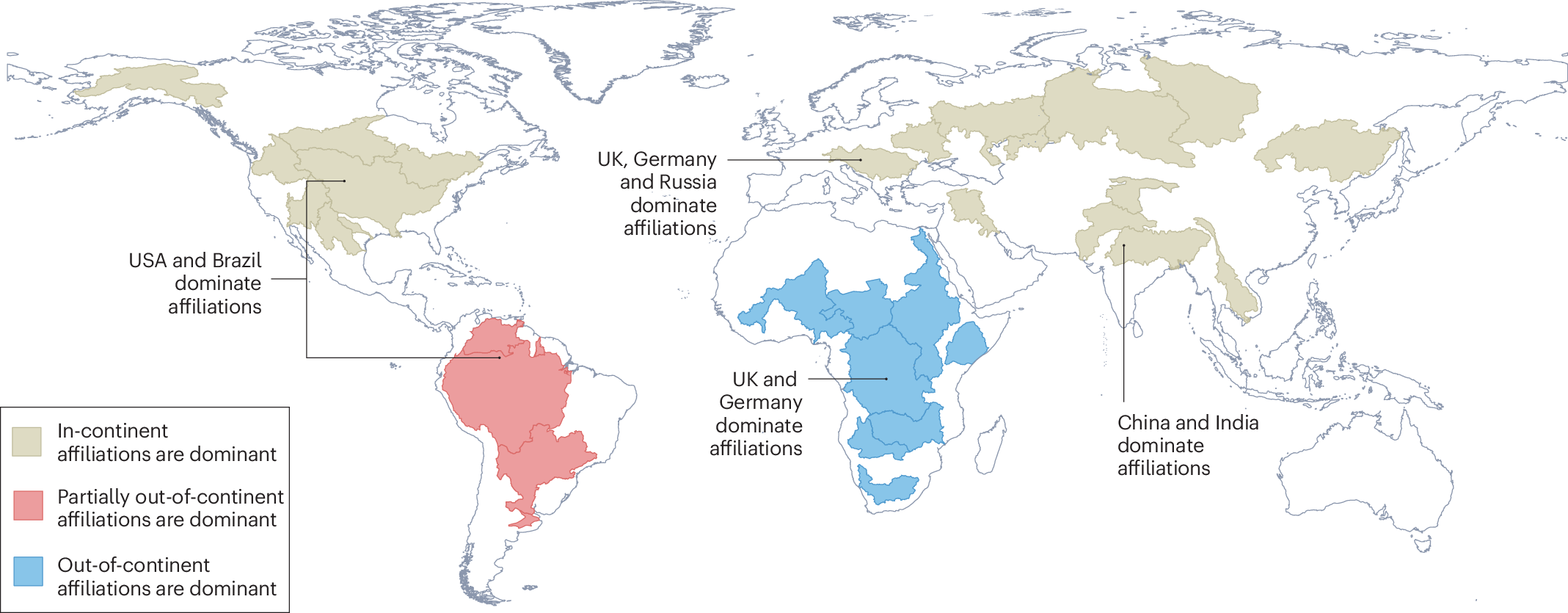
- Africa has 63 transboundary river basins, among them the Congo, Niger and Zambezi, and together they support more than 1 billion people.
- Robust, reproducible research on these shared basins is underrepresented in prominent scientific journals, according to the authors.
- Heggy says the solution starts with open data and reproducible numerical models of how the basins behave.
Compiled by The ScientistSomething wrong?How this is made
Why it matters
- exposure Governments that cannot find peer-reviewed local research may turn to private consultants or interest groups whose agendas may not match the public interest, the authors warn.
- constraint By the authors' account, guidance built for immediate needs can leave long-term changes in climate, water, hydropower availability and basin dynamics out of the planning.
- precedent If major journals answer the call for more visibility and support, reproducible basin studies would become a public reference that consultants' advice could be checked against.
Heggy describes the condition as an "uncertainty crisis" [11]. In his account, states share finite water and hydropower but lack reliable, commonly accepted estimates of volume and future variability, so each side can perceive the unknown as an existential threat [11]. The Nile is the authors' central case. Ethiopia, Sudan and Egypt draw on the river for different and often competing needs, with upstream countries pursuing hydropower and downstream communities depending on reliable flows [6].
Numerical and hydroclimatic models simulate how water moves through a basin and how much hydropower it can sustainably generate under different climate and management scenarios [13]. The authors argue that by quantifying availability, flow patterns, drought conditions and the effects of infrastructure choices, the models make an uncertain resource measurable [13]. Heggy and collaborators have already used this approach to examine how prolonged drought could affect the operation of major dams and the distribution of water and hydropower [7]. The commentary's claim is that such evidence could give governments and international organizations a shared foundation for managing transboundary water and resolving disputes [4].
Reproducibility has a narrow meaning. A second team with the same data and code should get the same output. That guarantees the calculation and leaves the inputs open: rainfall projections, reservoir operating rules, demand assumptions. Two governments can rerun one model perfectly and still reject each other's scenarios. Drought variability cannot be modeled away either, so the best a basin model can offer is a range of plausible flows with probabilities attached. In my view that agreed range is the useful product, because negotiators have less to fight over in a shared range than in rival point estimates.
A shared model also has to be trusted by states whose own agencies did not build it. The author team spans hydrology and politics: Jongeun You is a political scientist at Northern Michigan University, Abotalib Z. Abotalib works at Egypt's National Authority for Remote Sensing and Space Sciences, Sara S. Fouad is at the Technical University of Munich, and Mohamed Ramah is a Ph.D. student at the Catholic University of Louvain [2].
The published account does not include a count behind the underrepresentation claim [8], or a comparison of basins where states share accepted estimates with basins where they do not. That comparison would be the direct test of the thesis. The diagnosis comes from researchers who model these systems. Heggy studies groundwater, drought and extreme flooding across North Africa and the Middle East using remote sensing and environmental modeling [14].
What to watch
- Whether major journals publish more reproducible African basin studies with open code and data, the visibility the authors ask for.
- Whether Nile riparian states or a basin body adopt a jointly run, openly published hydrological model in talks over dam operations during drought.
- A comparative study of basins with and without commonly accepted supply estimates, the direct test of the uncertainty thesis.