Science1 publisher3 min readPublished
Rising AfD vote shares precede slower EV and rooftop solar uptake in 10,700 German municipalities
Freiburg researchers report in Nature Sustainability that after a municipality's AfD vote rose, its adoption of electric cars and solar panels ran relatively slower. In their surveys the political gap is much wider for cars than for panels.
The Scientist · Science desk
What happened
- Researchers at the University of Freiburg's Climate Action Research Lab combined official photovoltaic and registered electric-vehicle data with election results and socioeconomic data from more than 10,700 German municipalities.
- Both technologies are less widespread on average in municipalities where support for Alternative for Germany is strong.
- Within the same municipalities over time, an increase in the AfD's vote share was followed by relatively slower adoption of both technologies, which continued to spread at a reduced rate.
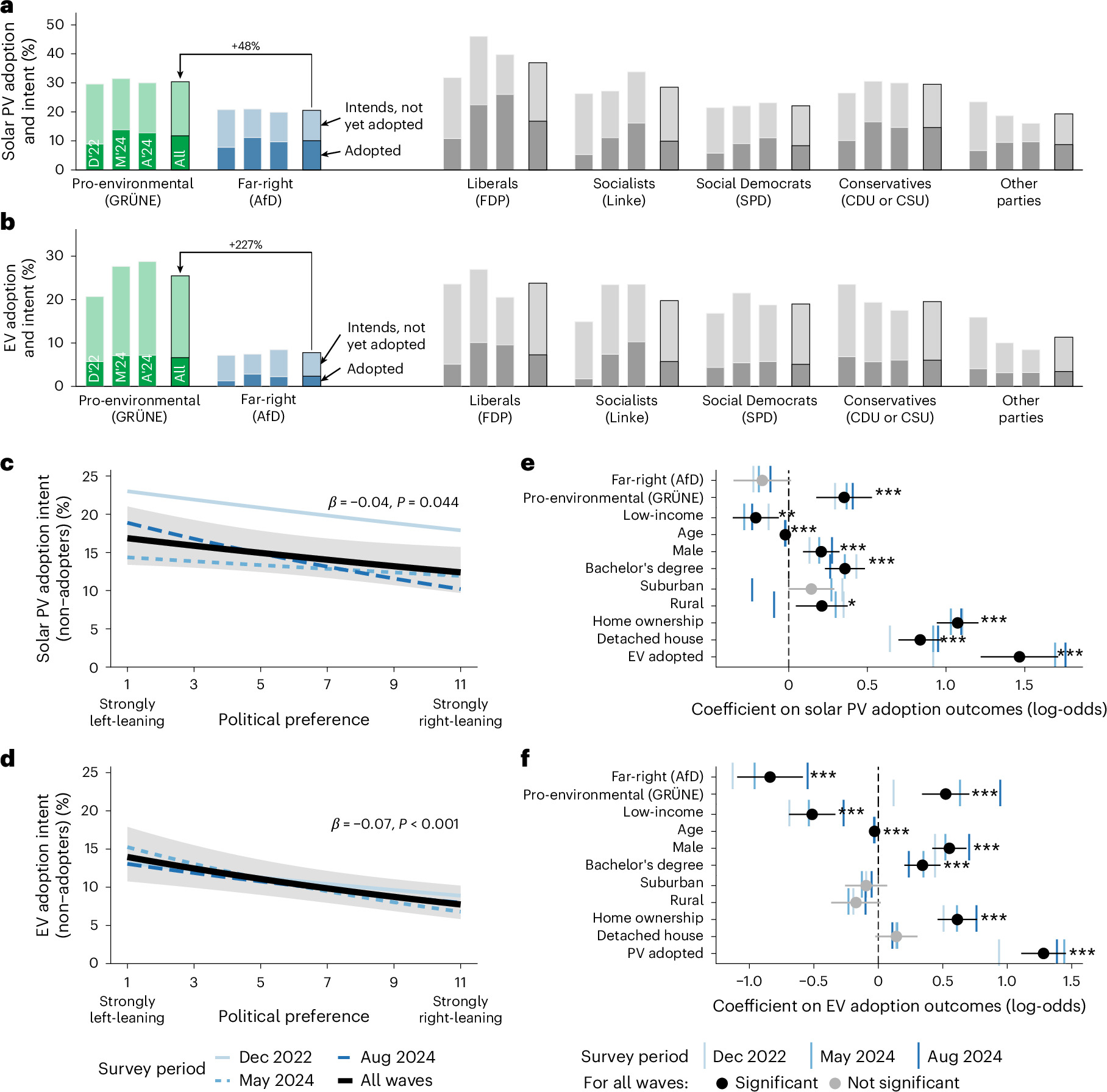
- Three surveys with around 8,000 participants recorded party preference, political self-placement, income, education, and whether respondents owned or intended to buy each technology.
- Green Party supporters were 227% more likely than AfD supporters to say they already owned an electric car or planned to buy one.
Compiled by The ScientistSomething wrong?How this is made
Why it matters
- constraint Support schemes priced on a national average buy less installed hardware per euro where uptake runs slower, and under this result the slower places are identifiable in advance from local election returns.
- decision Anyone designing incentives has grounds to treat cars and panels as separate problems: the political gap in stated demand is large for electric cars and small and statistically shaky for rooftop solar.
- contradiction The municipal counts show solar less widespread where the AfD is strong, while the survey's AfD-solar gap missed significance, so the panel-level solar pattern may be driven by something other than voters' stated preferences.
- precedent If part of the difference is how long a product has been on sale, then the next technology entering the mass market should be expected to polarize the same way, and the oldest ones least.
Comparing one German municipality with another mostly measures what made them different to begin with. Sebastian Reining and colleagues instead tracked change inside the same municipalities over time, taking income, urbanization and infrastructure into account [13]. Inside a single municipality, a trend has to come from something that moves at the same time as the vote, and what the study reports is a sequence: the AfD share rises, and adoption then runs relatively slower [2].
Moritz Wussow, who directs the Climate Action Research Lab at the University of Freiburg, chose careful words for it. "We also demonstrate that changes in political support are linked to the subsequent rate of technology adoption. Political polarization can therefore influence how quickly the energy transition reaches different segments of society," Wussow said [4]. The release does not report how much slower, and its percentage figures come from the surveys [16].
The two technologies separate in the survey data. The further right respondents placed themselves, the less willing they were on average to buy either an electric car or a photovoltaic system, and the association was stronger for cars [5]. For panels, AfD supporters' probability of owning or planning to buy came out 18 percent below a reference group with no preference for either the AfD or the Greens, a difference the researchers report as not statistically significant, while Green supporters came out 35 percent above that same reference group [7][8]. Take both at face value and Green supporters sit about 65 percent above AfD supporters on panels: 1.35 divided by 0.82 [1]. Treat the insignificant half as zero and the gap is 35 percent [2]. The car gap is three and a half to six and a half times either figure [3].
The researchers leave open why cars polarize more than panels [9]. They offer two possibilities: that cars are perceived more strongly as an expression of social and political identity, and that photovoltaic systems have been established longer in the mass market [9]. Those two have different futures. If market age is part of it, I would expect the electric-car gap to narrow as the cars become unremarkable, while an identity effect would persist on that schedule.
The municipal panel and the surveys count different things. One is hardware, taken from official installation and registration records combined with election results [12]. The other is what survey respondents said they owned or intended to buy, alongside their party preference, income and education [14]. The two point the same way, and the survey still cannot show that the municipal slowdown runs through individual buyers' ideology, because they are not the same individuals. Benedikt Kau, a co-author, said: "Political polarization does not mean that these technologies fail to gain any acceptance at all in certain segments of the population" [10]. He also said that "the rate of adoption is crucial. If technologies are adopted at different rates in municipalities with different political environments, that can lead to significant differences in the long term" [11].
"By combining different empirical approaches, we can study the role of political ideology much more precisely than by simply comparing regions with different characteristics," Kau said [15].
What to watch
- The paper itself: how large the within-municipality slowdown is per percentage point of AfD gain, and whether it survives controls for local economic shocks that move with the vote.
- Whether the electric-car gap narrows in later election cycles as the technology ages into the mass market, the direction the authors' own market-age explanation implies.
- Whether the same pattern appears in another country's party system, or is specific to the AfD's German base.