Product1 distinct publisher3 min readPublished
Elroy Air flew spare parts and water jugs out of a busy Louisiana rotorcraft field while controllers sequenced it among crewed traffic, which is a harder thing to arrange than the aircraft, and the FAA administrator put his name to it.
The Product Desk · Product desk

Compiled by The Product DeskSomething wrong?How this is made
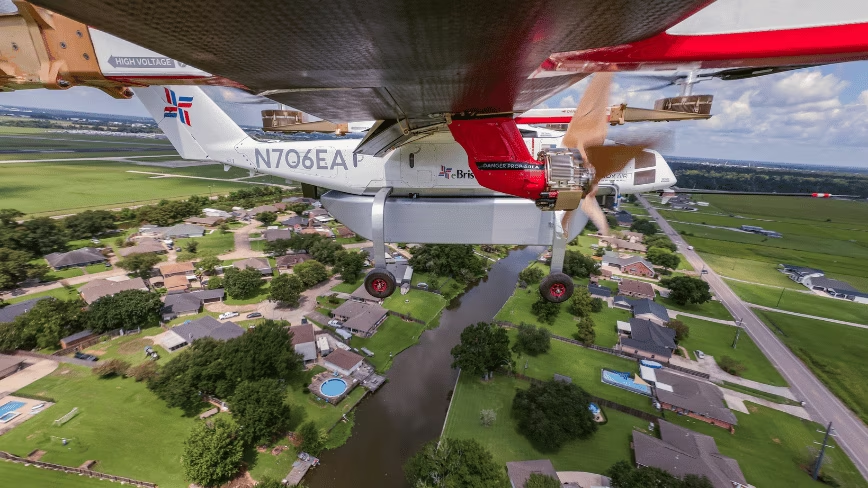
The interesting workload at Houma-Terrebonne belonged to the controller. Elroy Air's account is that air traffic control handled the aircraft alongside everything else in the pattern [4], at a field the company describes as one of the busiest rotorcraft airports in the country [3]. What the account does not include is a count of operations or any description of how separation was handled [23]. So treat the milestone as narrow and real: a single airframe at a single field, for a week, with the tower taking it.
The demonstration itself flew a toolbox of spare parts, jerry cans of water, food and medical supplies on a route that went over people's houses [5]. The claim here is about duty cycle. As the reporting reads it, the point is the dull repetitive work that today costs a helicopter and a pilot [6]. Bristow Group, which ran the week alongside Elroy and serves Gulf of Mexico energy platforms [7], is the operator that argument is written for.
Set against that is what a slide deck would say instead. Elroy says its commercial demand pipeline exceeds 1,400 aircraft and more than $5bn in potential revenue [13], which implies roughly $3.6m per aircraft [19]. The company's own filing language says that pipeline consists of non-binding letters of intent and memorandums of understanding, that there is no assurance any will convert, and that investors should not treat the figure as an indicator of future revenue [14]. The caveat exists because Elroy is going public through a merger with Inflection Point Acquisition Corp VII, with a draft registration statement submitted to the SEC [15]. The contracted demand you can point at is smaller and duller: a $46m multi-year Army contract in August for an autonomous VTOL aircraft carrying modular payloads [17].
The dates repay lining up. Elroy joined the programme in March 2026 through Louisiana's application [11] and flew in late August, about five months later [20]. Kratos Defense and Security Solutions, which holds exclusive US manufacturing rights and is expanding a Sacramento facility, plans the first production aircraft for late 2026 [16]. By the company's own calendar, airspace access is running ahead of the assembly line [16][20].
For anyone who would have to schedule an aircraft like this, the permissions that gate it don't line up the way a vendor video suggests. Airworthiness covers whether the airframe can lift and land the load. Airspace covers whether the regulator and the tower will take it in a live pattern. Demand covers whether a customer actually signs something binding. The Houma week moved the second, with FAA Administrator Bryan Bedford saying the flights showed how such aircraft could expand cargo delivery to communities nationwide [8] and a Louisiana transport official, Josh Duplantis, saying he watched a disciplined, safe operation [9]. The programme's July flights carried transplant organs with pilots aboard [12], so the August delta is the empty seat. The third permission is where the disclaimer sits [14]. That leaves the airworthiness and demand boxes unfilled, and the record so far behind them is thin: a $46m Army contract, a production run not due until late 2026, and a pipeline the company itself won't call revenue.
Ranked by verification strength, evidence, and original report placement.
Elroy Air said on Wednesday it had completed the first uncrewed autonomous flights under a federal programme that exists to fold self-flying aircraft into American airspace.
Elroy Air's Chaparral is a hybrid-electric design that takes off vertically, carries more than 500lb of cargo, has a range of 450 miles, and needs no runway and no charging infrastructure.
The flights ran for a week in late August at Houma-Terrebonne Airport, which the company describes as one of the busiest rotorcraft airports in the country.
Air traffic control handled the aircraft alongside everything else in the pattern.
The cargo was deliberately mundane: packages, medical supplies, a toolbox of spare parts, food, and jerry cans of water, and the route took the aircraft over people's houses.
The publisher's reading is that Elroy Air is not proving the aircraft can lift something exotic but that it can do the dull, repetitive work that currently costs a helicopter and a pilot.
Distinct publishers with included, body-backed reporting in this cluster.
1 article · September 3, 2026
Follow any of these and your For You feed starts watching them — no settings page required.
product
Uber buys drone exposure rather than drones, and one number now carries the deal3 distinct publishers
invest
Amazon takes Prime Air to nearly 500 towns: scale arrives, with a five-pound ceiling1 distinct publisher
science
Drone delivery stopped being a demo: thousands of tethered pod drops a day in Arkansas and Texas1 distinct publisher
invest
Amazon puts Prime Air in nearly 500 cities, and the arithmetic does not tidy up1 distinct publisher
Evidence-backed comparisons of source perspectives and observed adoption signals. Read the methodology
Which Builder, Operator, and Investor concerns the observed source mix emphasized—not a truth score.
Evidence, demonstrated adoption, hype gap, incentives, and confidence are assessed independently, each on its own current evidence. How these are measured.
One outlet, one announcement, two named officials
Strip out what Elroy Air said about itself and what remains is two attributed quotes — Bryan Bedford's and Josh Duplantis's — plus the reporter's own contextual comparisons. That is more than a press release usually earns, because a sitting FAA administrator and a state transport official both put their names to the week. It is still one publisher relaying one company's account of an event no journalist appears to have watched, with the cargo capacity, range and 'busiest rotorcraft airport' descriptors all coming from the party with a registration statement in progress.
A week at one field, nothing in service
Seven days, one airport, one airframe, no production aircraft ever delivered and no date for scheduled service. What lifts this above a demo flight is that it happened inside live traffic with an incumbent helicopter operator and a state agency in the room, and that the surrounding freight lane is genuinely moving — Zipline is already flying clinical deliveries, DoorDash cleared its own operation in July. Real use here belongs to other people's aircraft; Elroy Air has a rehearsal and a pipeline of letters.
The company oversells; the coverage doesn't
The overstatement is the issuer's, not the reporter's. A firm with no delivered aircraft is circulating a $5bn, 1,400-airframe demand figure — about $3.6m a copy — that its own filing says must not be read as revenue, and calling itself the programme's only purpose-built heavy-payload cargo drone. Against that, five months from joining the programme to a week of flights is fast, and controllers absorbing an uncrewed aircraft into a helicopter pattern is a genuinely harder achievement than the flying. The Next Web pulls the gap down by printing the caveat in full; it leaves it open by never quantifying the controller integration it correctly identifies as the real news.
Everyone quoted wants this to look good
Count the interests aligned behind a week of water jugs. Elroy Air is mid-merger with Inflection Point Acquisition Corp VII and needs a milestone; Kratos holds exclusive US build rights and is pouring concrete in Sacramento; Lockheed Martin Ventures, Shield Capital and Marlinspike Partners are on the cap table; the Army has $46m in the airframe; Louisiana sponsored the application and its own official supplied the safety verdict; and the FAA administrator is executing an executive order literally titled Unleashing American Drone Dominance. Nobody in the story is positioned to say the week went badly.
Solid on paper trail, thin on the flying
We are fairly sure what was announced, who is financing it and what the filing says, because those are documents and named quotes. We are much less sure what actually happened at Houma: a week is a duration, not a record, and the one operational fact that matters most arrives without a sortie count, a separation standard or a second witness. Nor does anything here indicate what certification would require. Another account of the same week — from the tower, Bristow or the FAA — would move this number substantially in either direction.