Invest1 distinct publisher3 min readPublished
A Democratic think tank wants the word dropped, Sunrise has moved its organising to fighting authoritarianism, and the 6 in 10 Democrats who still call climate a very big problem are being asked to rank it lower.
The Investor · Invest desk

Compiled by The InvestorSomething wrong?How this is made
Policy durability is an asset somebody has to maintain, and the maintenance is rhetorical long before it is legislative: a credit or a mandate outlives a hostile Congress because a constituency makes repeal expensive to attempt. The Searchlight Institute's advice runs the other way, telling Democrats to stop naming the thing on the grounds that voters do not rank it [2]. Advice that cheap to follow is worth reading as an allocation decision rather than a messaging tweak.
Sunrise is the countable case. From its 2017 founding to last October's switch is roughly eight years of list, staff and primary-season leverage repointed at a different target [3][15], and its executive director, Aru Shiney-Ajay, frames that as displacement rather than apostasy, saying people are increasingly freaked out about other issues [4]. Fine. But the candidates who would have been squeezed on climate in a primary are being squeezed on something else now, and the squeeze was the mechanism.
Massachusetts supplies the price check. Ed Markey is 33 years older than the challenger he faces Tuesday [14], and according to the veteran state strategist Mary Anne Marsh the phrase that was in every sentence six years ago is absent now, because the contest is about who is best to fight [8]. An author who still owns his authorship and will not run on it is quoting a spread, not a value.
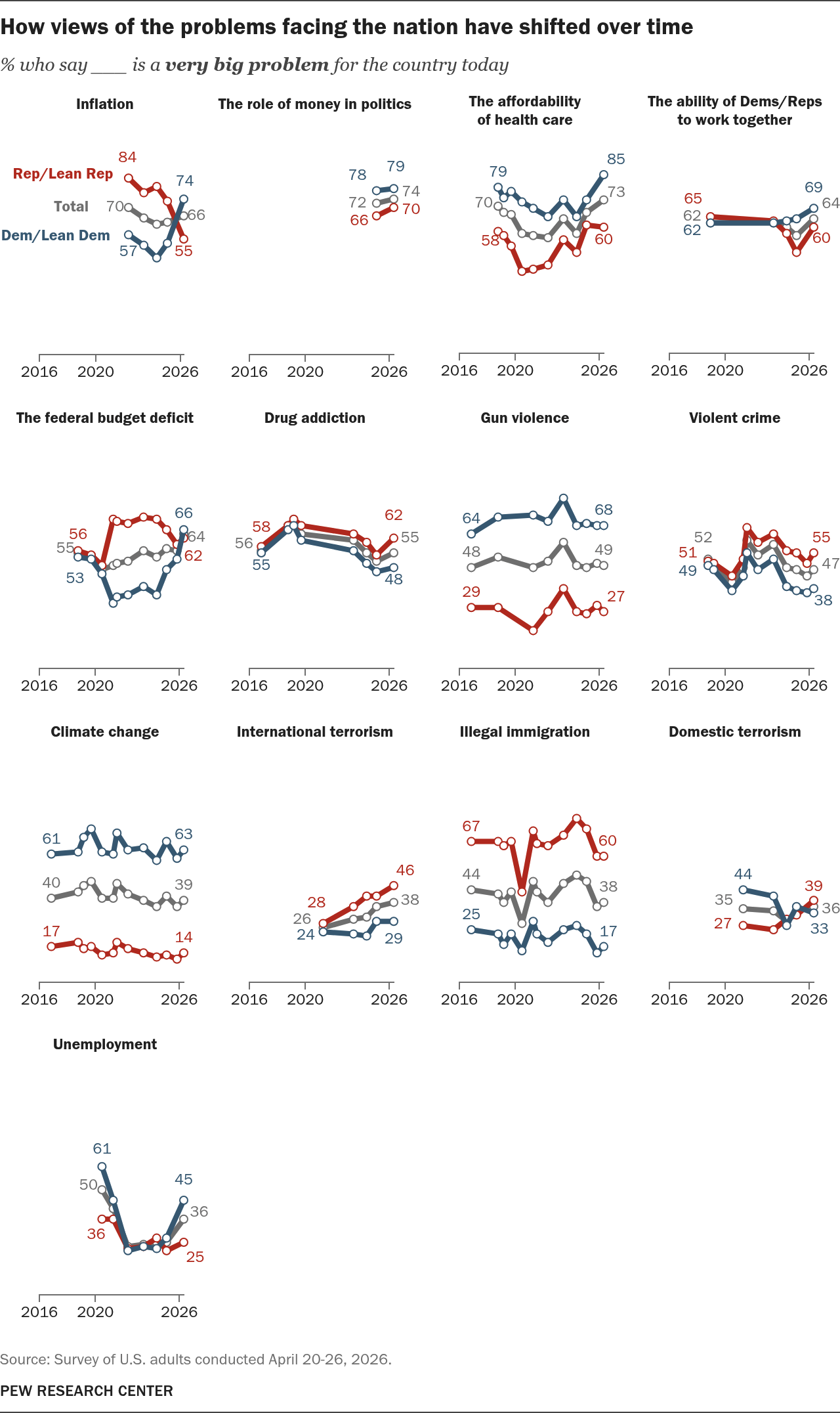
The counter-case has numbers too, or rather the more interesting version of it does. About 6 in 10 Democrats told Pew in April that climate is a very big problem, roughly what the same question returned in 2016, which is ten years of flat conviction sitting underneath a decade of reordering [16] in which inflation, healthcare affordability and the role of money in politics keep going first [6]. Sheldon Whitehouse calls the silence a strategic blunder and argues the issue has moved from the science department into the economics department, into home insurance and property values [9]. Advocates expect it back at the centre if the House flips in November and climate-driven disasters dominate the winter [11].
Trump calls the science a hoax, falsely, and his party has scoffed at the Green New Deal for years [12], so the variable was never their appetite; it was the cost the other side imposes. This is probably wrong, but the version I would defend is that the floor weakens on either November outcome, because a winning majority whose message omitted the word has no mandate to spend on it and a losing one has no constituency demanding it back.
Here's how it could go otherwise. Hushing is vocabulary only, and Whitehouse's insurance-and-property-value framing carries the same appropriations under a name that polls better [9]. Salience returns on the schedule the advocates expect, and the winter does the organising [11]. Or affordability anger, which McKenzie Wilson of Blue Rose Research describes as a level not seen in years [13], becomes the vehicle rather than the competitor in a debate that affordability has already dominated all year [18].
What would prove me wrong is dull: credits and mandates surviving a full budget cycle untouched while nobody says the word out loud, which would mean the defence never lived in the rhetoric in the first place.
Ranked by verification strength, evidence, and original report placement.
The Searchlight Institute, a Democratic think tank, urged the party to stop mentioning climate change because it is not a priority for voters.
The Sunrise Movement, founded in 2017 to mobilise young voters over climate issues, announced in October that it was shifting to a broader fight against "fascism".
Sunrise executive director Aru Shiney-Ajay said it has felt less like people care less about climate and more like people are increasingly freaked out about other issues.
About 6 in 10 Democrats say climate change is "a very big problem" for the country, according to a Pew Research Center poll from April, roughly the same share as in 2016.
Climate has often taken a back seat to other issues in Democratic voters' priorities, such as inflation, healthcare affordability and the role of money in politics.
In Tuesday's Massachusetts Democratic primary for U.S. Senate, incumbent Ed Markey, 80, faces U.S. Rep. Seth Moulton, 47; Markey still talks about sponsoring the Green New Deal but his campaign is more focused on other issues.
Distinct publishers with included, body-backed reporting in this cluster.
Follow any of these and your For You feed starts watching them — no settings page required.
invest
Three windfall bills and a $495bn pot: tax risk overtakes price in energy positions1 distinct publisher
invest
The carried-interest fight is worth $16.3 billion, which is to say almost nothing1 distinct publisher
invest
Meta's $17 billion settlement puts a cash number on the tech backlash1 distinct publisher
product
Pew's under-30 numbers turn AI hostility into a positioning constraint1 distinct publisher
Evidence-backed comparisons of source perspectives and observed adoption signals. Read the methodology
Which Builder, Operator, and Investor concerns the observed source mix emphasized—not a truth score.
Evidence, demonstrated adoption, hype gap, incentives, and confidence are assessed independently, each on its own current evidence. How these are measured.
Strong on the record, thin at the edges
The spine of this is on-the-record and checkable: a named state strategist, a sitting senator, Sunrise's executive director, an analyst at a Democratic data firm, a titled think-tank paper. The edges are where it thins. The coinage that gives the story its frame belongs to unnamed "researchers", the November expectation to unnamed "advocates", and the record-heat forecast to "scientists" with no agency or outlook attached. The Pew share is the only quantity in the piece and it arrives secondhand, without question wording.
Three instances, no tally
The retreat is visible in exactly three places: a think tank's memo, one movement's mission change, and one incumbent's campaign emphasis. That is a pattern worth noticing, not a count. Nobody in this reporting has surveyed how many Democratic campaigns actually dropped the phrase, and the one measurement offered — conviction flat since 2016 — describes voters rather than the candidates doing the hushing.
The label outruns the count
"Climate hushing" is a better phrase than the underlying evidence is a phenomenon — a coinage credited to nobody in particular, carrying three examples and one flat poll line. The overstatement is modest and largely in the framing, because the reporting hands you its own counterweight: six in ten Democrats say the same thing they said in 2016, which is the shape of a re-ranked issue, not an abandoned one.
Everyone quoted is selling a strategy
Line up the speakers and the interests are unmistakable. A think tank's product is the advice it is being quoted for. A movement that changed its mission has a reason to call the change prescient. A Democratic data firm's business is being the authoritative read on the electorate. A senator whose public identity is climate has every reason to call retreat a blunder, and a Massachusetts strategist is describing a primary in her own market. Fortune labels each affiliation plainly, which is the mitigation — but no genuinely disinterested voice appears anywhere in the piece.
Uncontested because unchecked
Nothing here is disputed, and that is a function of having one account rather than agreement among several. The checkable specifics — ages, founding year, paper title, quotes — are the kind of thing a wire-style report gets right, so the descriptive layer holds. The interpretive layer does not settle: whether hushing is a strategy or a symptom, and whether it reverses in November, are questions this reporting raises and cannot close.