Science1 publisher2 min readPublished
Ordinary Rainfall Triggered Taiwan's Record Matai'an Landslide, Not the Later Dam-Breach Flood
The Landslides paper on the Matai'an dam breach traces the failing slope back before 1985 and through a magnitude 7.4 earthquake. Taiwan relocated 8,524 people before the dam gave way, and 24 still died.
The Scientist · Science desk
What happened
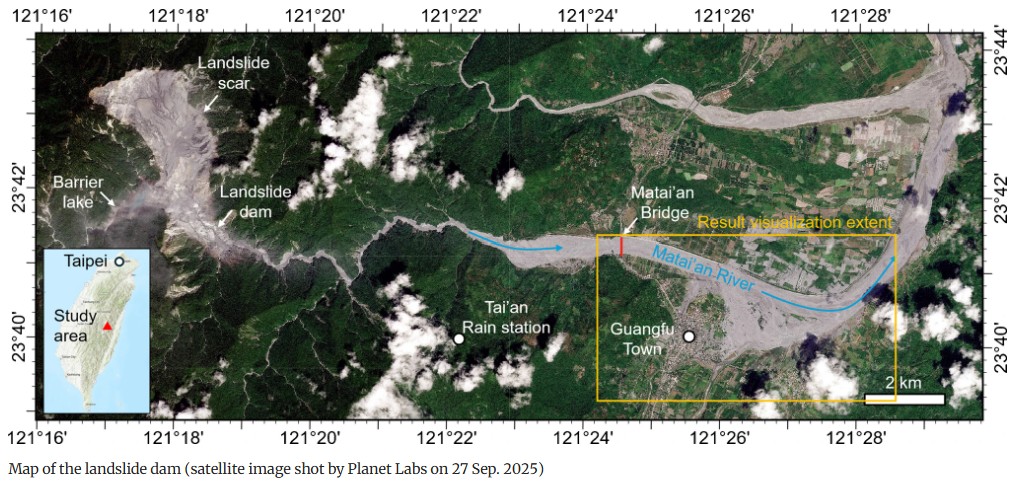
- A landslide dam on the Matai'an River in Hualien County, Taiwan, catastrophically breached on 23 September 2025, releasing a flood that left 24 people dead or missing and 156 injured.
- The landslide that built the dam, triggered by Tropical Storm Wipha on 19 July 2025, is the largest ever recorded in Taiwan.
- He et al., writing in the journal Landslides, show that the slope which failed had been unstable even before 1985.
- Typhoon Ragasa dropped more than 700 mm of rain at the site, and that rain triggered the breach of the dam.
- Taiwanese authorities knew the dam was a risk and ordered an evacuation, with records suggesting 8,524 people were relocated before it gave way.
Compiled by The ScientistSomething wrong?How this is made
Why it matters
- constraint Rain totals would not have singled out this slope: the storm that collapsed it delivered 573 mm in three days, inside Taiwan's normal range, so detection had to rest on ground movement instead.
- capability Sixty-six days between the slide and the breach is the working window for any intervention, and drawdown, spillway cutting or staged evacuation all have to fit inside it.
- decision With 0.28 per cent of the exposed population killed after an order that moved thousands, the lever left in Hualien is compliance with evacuation.
- precedent This was the favourable case for early warning, so proposals modelled on it should be measured against catchments with no defined trigger and weaker emergency management.
The rain that collapsed the slope came to 573 mm over three days, which the Landslide Blog at Eos, summarising the paper, calls not a particularly exceptional level for Taiwan [7]. The precursors were in the ground: He et al. date instability on that slope to before 1985 [4], name the M=7.4 Hualien earthquake of 3 February 2024 as a possible further destabilisation [5], and record renewed movement with a large tension crack during Typhoon Kong-rey in November 2024 [6].
The earthquake link is hedged in the source and should stay hedged: the wording is that the slope "may have been further destabilised" [5]. About 17 months separate that earthquake from the failure [7]. The post's account of the pre-1985 movement comes from the paper's reconstruction and does not say the instability had been logged in a hazard inventory before July 2025 [19]. He et al. published in Landslides under a Creative Commons licence [18].
Wipha's failure on 19 July put 285.90 million cubic metres into the valley and left a barrier 200 m high [8][3]. Summer rain, including Typhoon Podul in August, filled the impoundment to 67 million cubic metres [9]. Sixty-six days passed between the slide and the breach [1].
Then the dam went in two pulses. The first peak came at 15:38 and the second at 16:24, 46 minutes later [11][3], the second about 41 per cent larger than the first [2]. Both peak figures in the post are cubic metres and carry no time interval [11]; read as cubic metres per second, the larger one would empty a 67 million cubic metre lake in roughly two hours [5]. The flood damaged or destroyed 1,606 buildings [12].
Records cited in the post put the relocation at 8,524 people [13]. Add the 24 dead and missing and the exposed population is 8,548, so the fatalities are 0.28 per cent of it, about one in 356 [4]. Those who died probably ignored the evacuation order, according to the post, which concludes that "the loss of life does not indicate a failure by the authorities" [15][14].
So the detection and the warning worked here, and what failed was compliance. The post's argument is that surveillance over a much larger area, for an event with no clearly defined trigger, with flooding reaching much further and in a country with a less developed emergency management system, is "infinitely harder" [16]. Its closing line is that "the focus should be on vulnerability and resilience rather than on magic bullet warning systems" [17].
What to watch
- Whether Taiwan's post-event review puts the slope's pre-1985 movement record into a published hazard inventory for the Central Mountains.
- Whether the two-peak hydrograph is reproduced from independent gauge data, given that the published peak flows appear without a time unit.
- Whether other typhoon-season landslide dams in Hualien get drawdown or spillway works inside a filling window as short as 66 days.