Science1 publisher3 min readPublished
SKA-Low prototype confirms its sunflower antenna layout loses sensitivity at 125 MHz
SKA Observatory engineers found a sensitivity dip at 125 MHz on the 256-antenna AAVS3 prototype and ruled its sunflower layout out of the final telescope. The modified spiral that replaces it drops the repeating 2.4-meter spacings and has so far been checked only in simulation.
The Scientist · Science desk
What happened
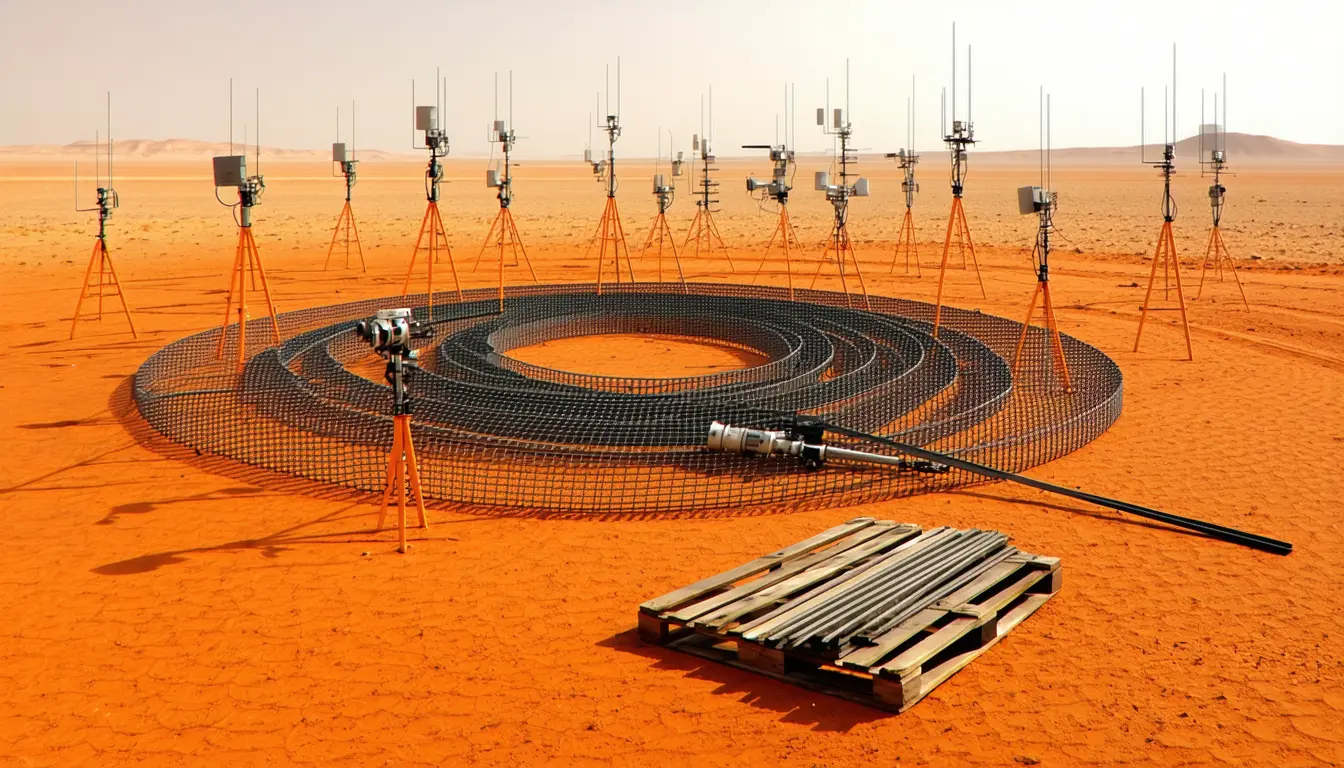
- The SKA Observatory built its AAVS3 prototype station with a sunflower-spiral Vogel layout to test, on the real sky, a design meant to cut interference between neighboring antennas.
- Simulations run during construction predicted a sensitivity loss directly overhead near 125 MHz, traced to antenna spacings of about 2.4 meters that repeat through the spiral.
- Images taken as the galactic plane passed overhead showed the same 125 MHz dip, which the team attributes to the layout itself and not to equipment or method.
- Engineers ruled the original layout out of the finished telescope and, after further simulations, moved to a modified design called Perturbed Vogel.
Compiled by The ScientistSomething wrong?How this is made
Why it matters
- constraint A layout picked to limit coupling below 150 MHz produced its own loss at 125 MHz, so SKA-Low's station geometry has to be tuned against two low-frequency problems at once.
- exposure The design headed for SKA-Low's stations rests on simulation alone so far, and any flaw of the 125 MHz kind would only show up once a station is built to it and observed.
- capability A calibration that pairs the sun with a sky model and antenna response profiles works at night, giving station teams a route that is less exposed to an unpredictable sun.
The problem was the spiral's regularity. A Vogel layout is meant to reduce interference between neighboring antennas while keeping the station's collecting power [5]. It also repeats the same spacings across the whole station. The older AAVS2 station used a scattered, pseudo-random pattern, chosen to avoid unwanted signal artifacts, and it showed no such dip [3][10].
What I like about this experiment is the order of events. The prediction came first, from simulations run while AAVS3 was still being built [9]. The team, led by Shin'ichiro Asayama of the SKA Observatory, then ran the 256-antenna station both as a beamformer and as an imaging array. They pointed it at the sun, bright radio sources, the galactic plane and several pulsars [6][7]. A dip that shows up exactly where a model said it would, on a source as broad as the galactic plane, is hard to blame on a loose cable. The team concluded the loss is built into the geometry [11]. The AAVS2 comparison is between two separate prototype stations, and the phys.org summary does not say how deep the dip was.
The dip also falls in an awkward part of the band. Mutual coupling, the interference between antennas placed too close together, grows stronger below about 150 MHz [4]. The spiral was proposed to deal with that. The loss it introduced sits at 125 MHz, inside the same band [1].
Calibration produced a second, quieter result. The team built two schemes. One uses the sun as a known reference. The fuller one adds a sky-brightness model and detailed antenna response profiles, and it also works at night [8]. At 230 MHz, night measurements with the fuller scheme closely matched predictions. Daytime measurements missed by more, most likely because unusually high solar activity made the sun's brightness harder to predict, according to the team [12].
The thing this doesn't tell you is whether the replacement works on the sky. The "Perturbed Vogel" layout keeps antennas spaced to limit interference and removes the repeating pattern [13]. Testing it falls outside this study [14]. Simulation called the 125 MHz dip correctly before observation confirmed it [9][11]. I think that record justifies some confidence in the simulated fix. It is still a model result until a station built to it is pointed overhead at the galactic plane.
The choice has to hold at scale. Each station's antennas combine like a single large dish, so their arrangement shapes what the telescope can detect. The finished SKA-Low will link 512 stations across an area about 75 km wide [2], observing between 50 and 350 MHz from Western Australia [1]. The AAVS3 work, together with lessons from AAVS2, has shaped the observatory's testing process and supported the AA0.5 milestone, the first stations to come online [15].
What to watch
- On-sky results from a station built to the Perturbed Vogel layout, especially overhead sensitivity near 125 MHz.
- Sensitivity and calibration results from the first AA0.5 stations, and which layout they use.
- Daytime 230 MHz measurements under quieter solar conditions, which would test whether solar activity explains the gaps.