Science1 distinct publisher3 min readPublished
Enhanced rock weathering's problem has always been rate rather than chemistry, and a Nature Biotechnology result attacks the rate directly. The 2.6-fold gain was measured on kilograms of mineral in a flow reactor.
The Scientist · Science desk

Compiled by The ScientistSomething wrong?How this is made
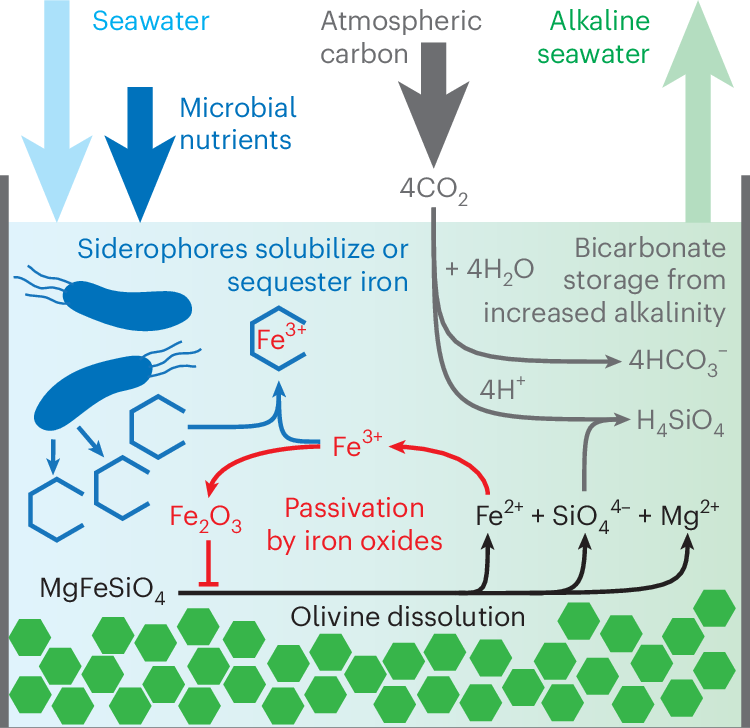
The 2.6 is a rate multiplier on olivine dissolution, measured at steady state in a vessel with seawater running over the mineral, and that framing matters more than the size of the number [8]. If dissolution stays first-order and iron passivation stays the step that limits it, 2.6 times faster means the same extent of dissolution in 1/2.6 of the time, about 38 percent of it, or a 62 percent cut in required contact time [18]. The condition attached to that arithmetic is doing real work. De-rusting is the specific bottleneck the siderophores attack [9][10], and once something else becomes limiting, more siderophore buys less.
The negative result underneath the study is the more instructive part. In custom bioreactors, the team found that even a small amount of iron-containing mineral completely shut down siderophore production in natural bacteria [11]. Neil Dalvie's account is that wild cells stop making siderophores the moment they have enough iron to grow, which is exactly what would happen inside any vessel packed with iron-bearing rock, so the engineering removed a feedback loop rather than improving a molecule [12]. Building the strain took roughly a month; the validation took the design thinking [13]. Dalvie and Amogh Jalihal settled on a steady-state measurement with bacteria and seawater flowing continuously over the minerals [14], which is the right call, because a closed batch confounds how fast a mineral dissolves with how much dissolved product has piled up in the water.
Geologic time is the wrong denominator for reading the result. The natural cycle runs over hundreds of thousands of years [2], and 2.6 applied to a hundred thousand of them still leaves roughly 38,500 [19]. What the factor actually applies to is residence time in an engineered vessel fed with pumped seawater, and that is a different cost structure from the enhanced weathering route the industry has been pursuing, which is scattering crushed silicate rock on agricultural land or into water [3].
What the GEN account does not carry is a cost per tonne of CO2 or a throughput figure for the pilot reactors, which held several kilograms of olivine [20][15]. The publication frames the field's obstacle as economic viability at industrial scale rather than chemistry [4], and a factor of 2.6 moves an economic answer only when the rest of the balance sheet is visible: pumping, containment, feedstock grinding, and the carbon cost of all three. Pamela Silver calls the approach easily applicable and risk-free [16]. That reads as a claim about mineral chemistry, because a contained reactor and an engineered marine bacterium implemented at "many places" raise different questions, and the bioreactor experiments were not built to test either. The kinetic result looks well controlled to me, which is why I would rather see the cost sheet from the pilot rigs than another multiplier.
Ranked by verification strength, evidence, and original report placement.
In customized bioreactors with a continuous flow of seawater, the engineered bacterium sped up weathering of the silicate mineral olivine by 2.6-fold, boosting the amount of CO2 removed from air.
Rock weathering is a major regulator of Earth's atmospheric CO2 levels and climate, and has run faster during warm periods with higher atmospheric CO2.
The natural rock weathering cycle occurs over hundreds of thousands of years.
Enhanced rock weathering companies scatter crushed silicate rocks on agricultural surfaces or into water to pull excess CO2 out of the atmosphere.
GEN reports that the enhanced rock weathering strategy is generally safe and environmentally friendly but still too slow to affect the global carbon balance or to be economically viable at industrial scale.
The study "Engineered bacterial siderophore production accelerates rock weathering for carbon removal" was published in Nature Biotechnology by a collaborative team at the Wyss Institute at Harvard University, the Harvard Medical School department of systems biology, and the Stanford Doerr School of Sustainability.
Distinct publishers with included, body-backed reporting in this cluster.
Follow any of these and your For You feed starts watching them — no settings page required.
science
Engineered marine bacteria weather olivine 2.6 times faster in a seawater tank2 distinct publishers
product
Engineered ocean bacterium strips the rust that stalls carbon-capturing olivine1 distinct publisher
science
Cornell's engineered bacterium strips 75% of the magnesium out of olivine in 15 days1 distinct publisher
science
Church's lab frees 14 codons by rewriting the ribosome's lock instead of the genome2 distinct publishers
Evidence-backed comparisons of source perspectives and observed adoption signals. Read the methodology
Which Builder, Operator, and Investor concerns the observed source mix emphasized—not a truth score.
Evidence, demonstrated adoption, hype gap, incentives, and confidence are assessed independently, each on its own current evidence. How these are measured.
One peer-reviewed paper, one outlet retelling it
The core measurement has the best kind of backing available here — a Nature Biotechnology paper, a stated mechanism, and a measurement design its authors can defend — but the only account of it we hold is GEN's, and GEN tracks the Wyss Institute's framing and quotes closely enough to add no independent check. The 2.6-fold figure arrives without controls, duration, or error bars; the Life Cycle Analysis is named and then left empty of numbers.
Kilograms of sand, half a gram a day
Real hardware exists and it runs on real seawater, which puts this above a slide deck: benchtop eVOLVERs, then pilot vessels holding several kilograms of olivine drawn down at 0.5 g of CO2 daily. That is also the ceiling. No field trial, no customer, no company, no second site — and GEN's own framing concedes that enhanced rock weathering broadly remains too slow to matter to the global carbon balance.
"Industrial scales" in the headline, grams in the reactor
The distance between GEN's headline — marine bacteria decarbonizing the atmosphere at industrial scales — and the disclosed output of half a gram of CO2 a day is the whole story of this gap. Silver's 'risk-free' also does heavy lifting for an engineered marine organism whose behaviour outside a flow reactor is never discussed. The underlying science is not overstated; the framing around it is, and GEN's own closing line about needing more scale-up work quietly agrees.
The safety claim comes from the lab that built it
Nobody here is hiding a commercial position, because none is disclosed — no startup, no offtake deal, no credit buyer. What shapes the telling instead is career and institutional interest: every normative line reaching readers is a quote from the principal investigator or the first author, whose next tranche of work is already funded by a fellowship in exactly this area, and GEN's retelling runs on an institute's promotional arc, from mechanism to promise.
Firm on the measurement, thin on everything downstream
I would defend the mechanism and the 2.6-fold number at the confidence a peer-reviewed paper earns. I would defend almost nothing beyond the reactor wall: with one outlet, no independent geochemistry, no LCA numbers and no economics, any judgement about field behaviour or cost here would be invention rather than assessment.