Science1 publisher3 min readPublished
Cornell's engineered bacterium strips 75% of the magnesium out of olivine in 15 days
A modified Gluconobacter oxydans releases nickel and cobalt from ultramafic rock while parking carbon in magnesium oxalate, which holds two carbons per magnesium. It is still flask-scale work.
The Scientist · Science desk
Drafted by a language model from the sources cited here and checked against its claim ledger before publication. How we use AISend a correction
What happened
- A study published Aug. 5 in Scientific Reports by Cornell researchers found that an engineered strain of Gluconobacter oxydans accelerated the weathering (natural breakdown) of ultramafic minerals high in magnesium and iron.
- The engineered bacteria extracted up to 75% of the magnesium contained in olivine samples over just 15 days.
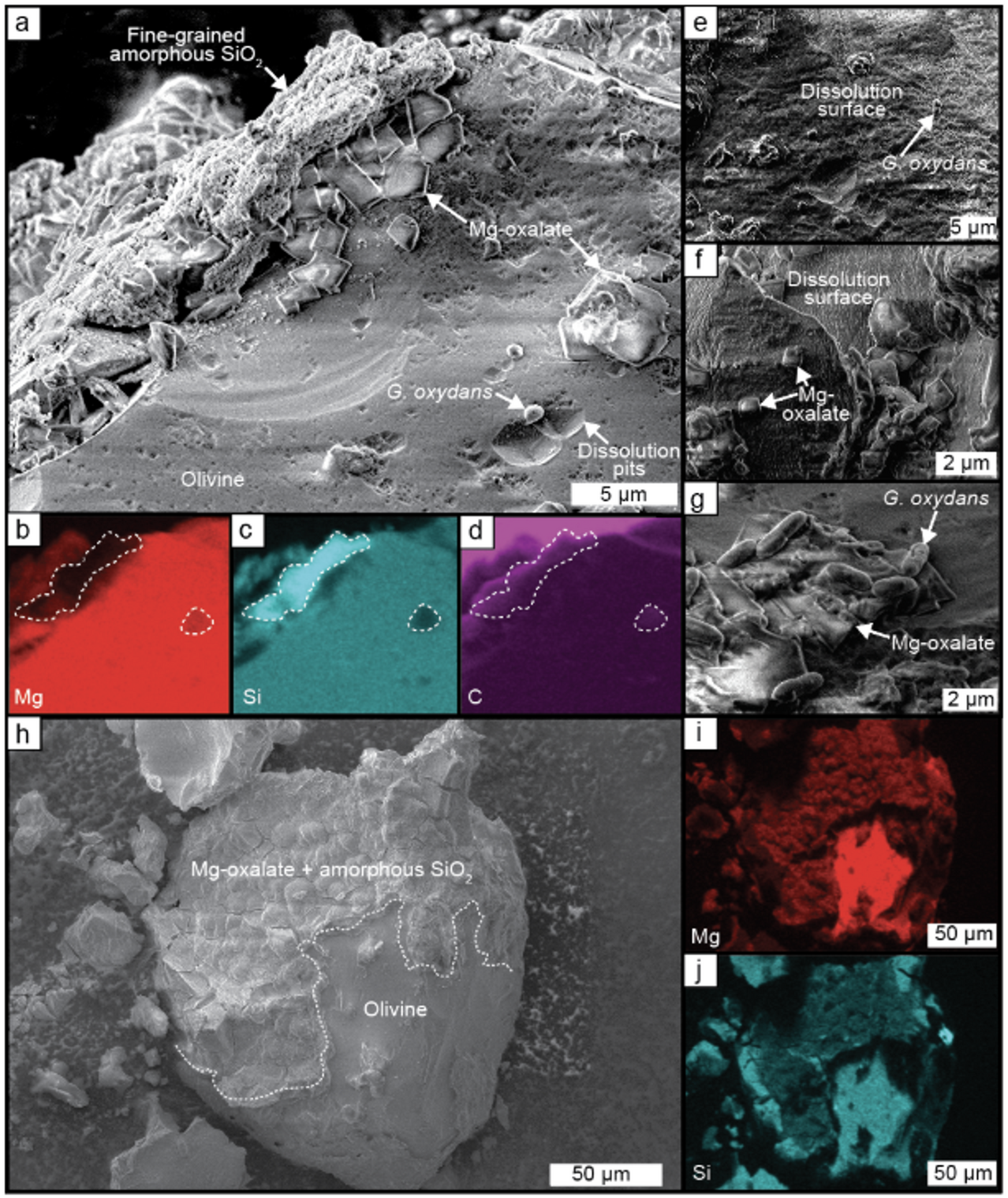
- The process converted dissolved magnesium into magnesium oxalate, described as an underexplored mineral capable of storing twice as much carbon per magnesium atom as the more commonly studied mineral magnesite, because each magnesium atom can bind two carbon atoms.
- Geoscientists have long recognized that weathering of silicate rocks naturally removes carbon dioxide from the atmosphere, as rainwater and groundwater slowly dissolve minerals such as olivine and released magnesium reacts with CO2 to form stable carbon-bearing minerals.
- The paper, "Bioleaching of Olivine and Enstatite With Formation of Mg-Oxalate Mediated by Engineered Gluconobacter Oxydans," was led by first author Jacob D. Klug, a postdoctoral researcher in Cornell's Department of Earth and Atmospheric Sciences.
Compiled by The ScientistSomething wrong?How this is made
Why it matters
Cornell researchers reported on Aug. 5 in Scientific Reports that an engineered strain of the bacterium Gluconobacter oxydans accelerated the weathering of ultramafic minerals rich in magnesium and iron, extracting up to 75% of the magnesium in olivine samples over 15 days while releasing nickel and cobalt [1] [2] [6]. The same reaction converted dissolved magnesium into magnesium oxalate, a mineral that binds two carbon atoms per magnesium atom rather than one [3] [7].
Both halves of that sentence bear on cost. Enhanced weathering as currently practiced is priced against the kinetics of rainwater and groundwater slowly dissolving silicate rock, the natural process that geoscientists have long credited with pulling carbon dioxide out of the atmosphere [4]. An average of roughly five percentage points of magnesium liberated per day, in a flask, is a different regime [11]. And because magnesium oxalate carries twice the theoretical carbon per magnesium as conventional magnesium carbonate, a given quantity of stored carbon requires roughly half as much magnesium dissolved [12].
The mechanism matters for whether this scales. The team, whose paper was led by postdoctoral researcher Jacob D. Klug, engineered G. oxydans to produce an acid-rich biolixiviant and then benchmarked it against synthetic organic acids and against a cell-free solution containing only the compounds the bacteria excrete [5] [9] [10]. Direct contact between cells and mineral surfaces dissolved substantially more rock than the acidic byproducts alone [13]. The researchers found evidence that the bacteria promoted oxidation of iron inside the minerals, which let the microbes keep producing acid and sustain weathering for longer [14]. In other words, this is not a chemical leach you can decant into a tank; the organism has to sit on the rock.
Buz Barstow, the Cornell associate professor of biological and environmental engineering who led the strain engineering, framed the goal as acceleration rather than invention: engineering bacteria to speed up something already happening rather than making something happen that does not occur naturally [8] [15]. Senior author Esteban Gazel said coupling sequestration with battery-metal extraction has the potential to improve the economics of large-scale carbon removal by targeting unconventional sources [16] [17]. That is the claim operators should test, because it is the only one that changes a project model: two revenue lines from one crushed feedstock.
Klug noted that magnesium oxalate was not the expected product; carbon mineralization work usually targets magnesite, the pathway common in nature [18]. The oxalate formed at room temperature and low pH [7].
What to watch. The experiments were run in laboratory flasks, and the team's stated near-term target is ultramafic mine tailings, which are already crushed fine and still contain recoverable critical minerals [19] [20]. Tailings are the right first venue precisely because someone else already paid for the comminution. Two gaps sit in front of any economics claim: the announcement reports no cost figures, no energy or feedstock inputs for growing the bacteria, and nothing on how long magnesium oxalate stays put [21]. Permanence is the product being sold in carbon removal, and an understudied oxalate at low pH is not yet a durability argument [3]. Watch for a tailings-scale trial that reports grams of carbon fixed per gram of sugar fed, and for stability data on the oxalate.