Science2 publishers2 min readPublished
One-sided photon interactions pushed a light beam upstream through a quantum fluid of light
Yi Hu's group at Nankai University sent a narrow beam against the flow of a broader optical fluid. The swimmer felt attraction while the fluid pushed back, and the net force pointed upstream.
The Scientist · Science desk
What happened
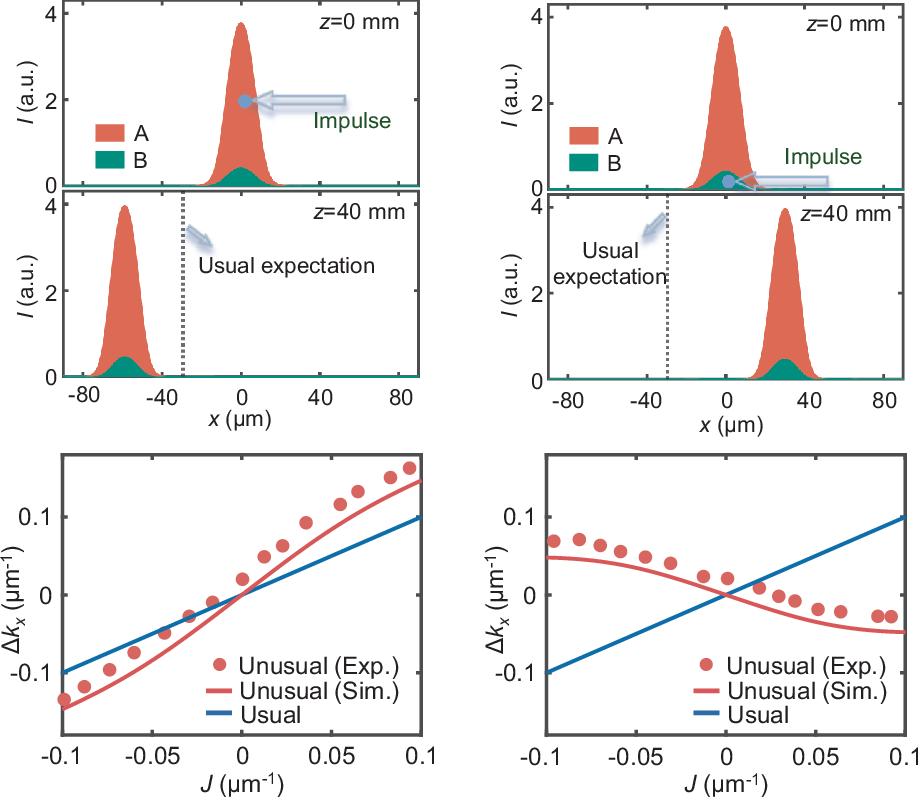
- Physicists sent two timed laser beams through a nonlinear crystal. The broad beam stood in for a fluid and the narrow one for a swimmer, and tilting the fluid beam set its flow direction and speed.
- The narrow beam reshaped the fluid as it passed, leaving a higher intensity on one side than the other. That asymmetric distribution produced the force that carried it against the flow.
- In the usual reciprocal setup, run as a direct comparison, the same narrow beam moved downstream instead.
- Sweeping fluid speed and density showed the upstream motion was strongest at intermediate values of both, between the highest and lowest settings the team tried.
- Earlier upstream motion came from vortex shedding, whose net recoil momentum still obeys Newton's third law. Phys.org reports this is the first demonstration to use non-reciprocal interactions.
Compiled by The ScientistSomething wrong?How this is made
Why it matters
- capability Designers of quantum-light hardware gain a way to bias where light goes without adding an energy-consuming element; Albert said such steering could eventually be useful inside devices for communications or quantum information processing.
- constraint The platform was an optical analog of a quantum fluid, so anyone working with ultracold atoms or liquid helium gets a hypothesis to test here.
- precedent New Scientist frames the work as a possible new type of active matter in a quantum system. The swimmer consumes no energy at all.
According to New Scientist, the swimmer experienced an attractive interaction with the river of light, while the river experienced a repulsive force on the swimmer [7]. Hu said the net effect of that mismatch was an upstream force on the swimmer [8]. The crystal sat under an electric voltage that made the photons interact, and the swimmer beam was shaped into a single solitary wave [4].
Siyu Li and colleagues describe the same asymmetry from the fluid's side. "The swimmer tends to reshape the fluid, passing through it asymmetrically, which in turn exerts on the swimmer a force opposite to the fluid flow direction. Such a counterintuitive process stems from the nonreciprocity of their mutual interactions, which results in an inverted recoil compared to that in equilibrium systems," they wrote in Physical Review A [9][1].
The experiment measures a reversal of direction between the two settings [24]. Alongside the bench work, the team ran a theoretical scattering analysis and computer simulations [12].
Phys.org notes that action-reaction symmetry survives plenty of non-equilibrium situations and breaks when the interactions are non-reciprocal. That is the point at which internal interactions can be converted into net momentum [18]. Mathias Albert at Cote d'Azur University in France told New Scientist that earlier upstream motion in quantum fluids of light always relied on tiny vortices created behind the swimmer. The recoil from creating them pushed it along [14].
This was an optical analog of a quantum fluid [17]. Neither account gives a momentum budget for the crystal and the pump light. The non-reciprocity they report is the one between the two beams [25].
"This question is very much in the air at the moment, with several groups exploring how the concepts of active matter can be combined with quantum fluids and photonic systems," Albert said [15]. The comparison class in that field is systems where objects consume energy to move, such as bacterial mixtures and flocks of birds [22]. The beam here consumed none and still showed behavior of the active kind [21]. "For me, the biggest takeaway is that active behaviour does not necessarily require an intrinsically active particle or swimmer," Hu said [19].
What to watch
- Hu says the team wants more complex experiments with tighter control of the swimmer, or several swimmers in the same fluid at once.
- Whether the same non-reciprocal route produces upstream motion in atomic gases or engineered quantum materials, as the authors suggest testing.
- An independent replication that reaches upstream motion without any vortices behind the swimmer.