Product1 publisher3 min readPublished
Nanjing University's cathode still holds 87.8 percent of its capacity after those 100 cycles, which is a genuine cell-level result and a very short record, and the report attaches no cost figure to the cheap-sodium case.
The Product Desk · Product desk

Compiled by The Product DeskSomething wrong?How this is made
The person this eventually lands on is not a battery chemist. It is whoever gets a deck next year with "sodium-ion, 206 Wh/kg" on slide four and has to decide whether that number is allowed into a specification.
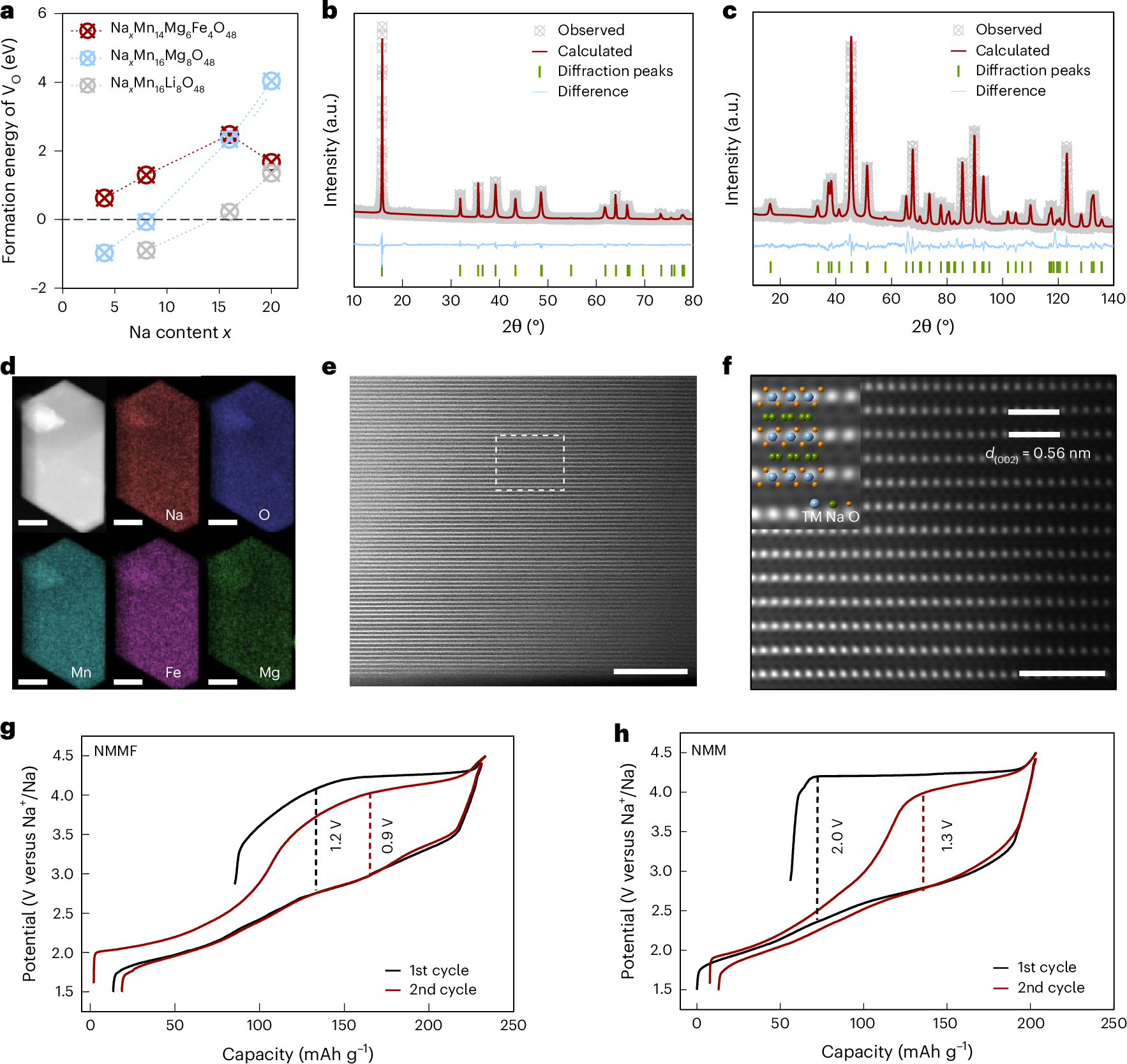
Start with where the number was taken. The researchers quote 206 Wh/kg for a pouch cell [5], not for a cathode in a half-cell, which is the more honest place to measure and the reason this result is worth reading at all. The mechanism is iron sitting in the layered oxide as a redox mediator [2]: Fe4+ takes electrons from the lattice oxygen on charge and Fe2+ hands them back on discharge, so the oxidized oxygen returns close to where it started [3]. Reported reversibility of lattice-oxygen redox goes from 75 percent to 99 percent with the iron in place [4]. Without it, using oxygen to store energy is what cracks the cathode in the first place [7].
Now the arithmetic that a spec has to survive. Holding 87.8 percent after 100 cycles [6] is 12.2 points of capacity gone, an average of 0.122 points per cycle [12]. Draw that straight out to the 80 percent mark and you land near 164 cycles [13]. Fade is not linear, so treat that as a sketch of how far the evidence reaches rather than a forecast. Put it in duty terms instead: at one cycle a day, 100 cycles is a bit over three months of operation [14].
What the report does not contain matters as much. There is no faster-rate cycling, no cost per kWh, and no side-by-side against lithium iron phosphate [11]. The cheap-sodium case is still made in materials terms only, with iron and manganese named among the cheapest earth-abundant transition metals and the removal of cobalt or nickel given as the route to viability in grid storage and lower-cost EVs [9], sodium itself being the more abundant and cheaper element [8]. No price attaches to any of that here.
There is a tension inside the source. The same write-up that quotes 206 Wh/kg also says sodium-ion cells carry more weight and less energy per kilogram than top-tier lithium cells, which is why it points them at stationary duty such as wind and solar farm buffers [10]. The energy density figure travels well in a slide. The siting advice tends to get left behind, and it is the part that tells you which product line this belongs to.
A grid worth keeping for the next battery claim that crosses your desk. One axis is whether the headline energy density was measured at the cell or at the electrode material. The other is whether cycle life is quoted in hundreds or in thousands. This work sits in the cell-level, hundreds box [5][6]. Anything you can sign a warranty against sits in the cell-level, thousands box. Material-level results in the hundreds box are chemistry news and nothing more. The expensive mistake is taking a cell-level energy density from the hundreds column and modelling it as though the cycle life came from the thousands column, because the Wh/kg figure transfers into your spreadsheet cleanly and the durability does not.
The researchers themselves call this initial findings and a pathway toward stable high-energy sodium cells [15]. That is the right size for it: a question to put to a sodium-ion vendor in a couple of years, not a line item you move this quarter.
Ranked by verification strength, evidence, and original report placement.
Researchers from Nanjing University developed an iron-mediated strategy to address structural degradation in high-energy sodium-ion battery cathodes.
The team embedded iron ions into a newly designed layered oxide cathode, where the iron acts as an atomic redox mediator, described as an atomic-scale electron shuttle, regulating electron transfer.
During charging Fe4+ captures electrons from the lattice oxygen, and during discharging Fe2+ donates them back, allowing the oxidized oxygen to almost completely return to its original chemical state.
The researchers wrote that with iron mediation the reversibility of lattice-oxygen redox improves from 75 percent to 99 percent.
The researchers state that the lattice-oxygen-activated cathode enables a sodium-ion pouch cell to achieve an energy density of 206 Wh kg-1.
The pouch cell operated stably for 100 cycles at 50 mA g-1 with a capacity retention of 87.8 percent.
Follow any of these and your For You feed starts watching them — no settings page required.
Evidence-backed comparisons of source perspectives and observed adoption signals. Read the methodology
Which Builder, Operator, and Investor concerns the observed source mix emphasized—not a truth score.
Evidence, demonstrated adoption, hype gap, incentives, and confidence are assessed independently, each on its own current evidence. How these are measured.
One paper, one outlet
The figures are specific and directly quoted — 206 Wh/kg, 87.8 percent after 100 cycles, reversibility from 75 to 99 percent — which is more than most lab write-ups offer. What they hang from is thinner: Interesting Engineering names no journal, no publication date, and no author, so a reader cannot reach the study. It counts for something that the measurement came from a pouch cell rather than a coin-cell extrapolation, though nobody outside the Nanjing group has been asked to look at it.
Lab cell only
There is nothing here to measure. One pouch cell in a university lab, no manufacturer, no pilot, no order, no price. Interesting Engineering closes on commercialization and widespread adoption without naming a partner or a production line, so the only adoption-shaped fact on the record is the test itself.
Commercial framing on a three-month record
The distance is between the metrics and the language wrapped around them. A 99 percent reversibility figure and 206 Wh/kg are stated as achieved, while the durability behind them is 100 cycles at a slow 50 mA/g — roughly three months of daily use — and the 0.122-point-per-cycle fade is only observed inside that window. Straight-line arithmetic puts 80 percent retention near 164 cycles, which is worth knowing as a scale marker rather than a prediction. Talk of accelerating commercialization of affordable sodium-ion technology outruns all of it, in a piece that never prices anything.
Authors supply the only reading
Both direct quotes come from the study paper, and the interpretation around them is the research group's: iron mediation as a viable path, a template for other cathodes. No external electrochemist, cell manufacturer, or sceptic is asked whether 100 cycles supports that conclusion. Interesting Engineering then adds its own commercial gloss about grid storage and cheaper EVs rather than testing it. No conflict is disclosed and none is implied; what is missing is friction, and its absence decides which numbers reached the headline.
Plausible, unverifiable
The chemistry described is unremarkable enough to be credible, and the measurements are probably accurate as reported. Confidence stops there. A single outlet relaying an unnamed paper leaves no way to check the cathode composition, the cell's loading and mass basis for 206 Wh/kg, or whether 87.8 percent was the best of several cells. The 164-cycle number that follows from constant fade is arithmetic and should not be read as a lifetime estimate, since degradation curves rarely stay straight.
product
US grid storage nears 52GW, and arbitrage is now writing the evening price curve1 publisher
product
Half of severe alopecia patients on upadacitinib hit 80% scalp coverage by week 241 publisher
product
MIT's magnet trick makes correlated microwave signals without the cryostat1 publisher
product
LLNL closes a 20 percent gap in diamond melting, and stakes a fusion gain claim on it1 publisher
Publishers with included, body-backed reporting in this cluster.
1 article · September 7, 2026