Science1 publisher3 min readPublished
There is no optimal spike: 143 biological piercers map a ridge, not a peak
A survey of fangs, spines, stingers and tusks finds durability and penetration trading off across a broad zone, not a single best shape. And the zone moves when you change the weighting.
The Scientist · Science desk
Drafted by a language model from the sources cited here and checked against its claim ledger before publication. How we use AISend a correction
What happened
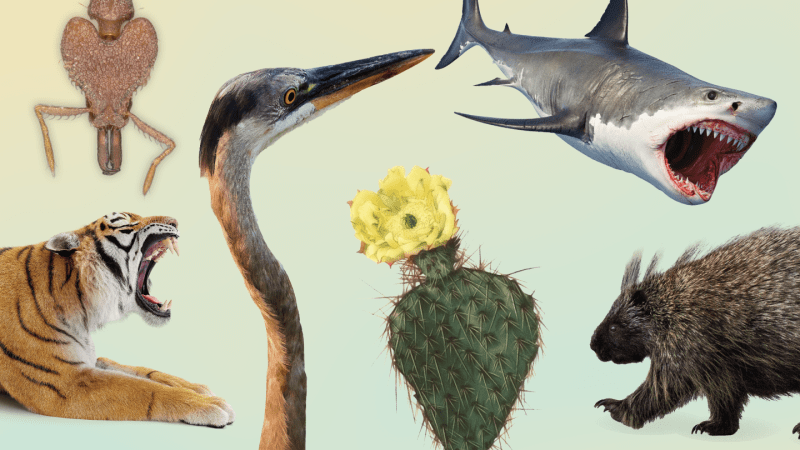
- Researchers measured the shape of 143 biological puncture tools, ranging from elephant tusks to the reproductive organs male bedbugs use to pierce females when mating.
- The findings were reported in the July 8 issue of Science Advances.
- The tools all reflect a balance between durability and puncturing prowess, but nature has not settled on one winning shape.
- The team sampled spikes from the animal and plant kingdoms, including the love darts hermaphroditic snails lance their mates with and the needlelike ovipositors parasitic wasps use to lay eggs inside other creatures.
- Each tool was characterized by taper (how elongated and slender it is) and roundness (the shape of its cross section); a cactus spine is highly tapered with a circular cross section, while a shark tooth is less tapered and flattened.
Compiled by The ScientistSomething wrong?How this is made
Why it matters
A team measured the shape of 143 biological puncture tools, from elephant tusks down to the reproductive organs male bedbugs use to pierce females when mating, and reported in the July 8 *Science Advances* that all of them sit somewhere on the same trade-off between durability and puncturing prowess [1][2][3]. The relevant consequence is negative: nature never settled on one winning shape [3], which is a problem for any bioinspired needle program that expects to copy the winner.
The sample was drawn from both the animal and plant kingdoms and includes the obscure end of the catalogue: the "love darts" hermaphroditic snails lance their mates with, and the needlelike ovipositors parasitic wasps use to lay eggs inside other animals [4]. Each tool was reduced to two numbers. Taper describes how elongated and slender it is, and roundness describes the cross section: slice a cactus spine and you get a circle, while a shark tooth is flattened and less tapered [5].
The mechanics came from simulation, not from the specimens. The group modelled 25 idealized piercer shapes and calculated, for each, the energy needed to create a puncture and how easily the tool broke [6]. The result is the trade-off in explicit form: highly tapered and flatter tools puncture more easily, and break more easily [7]. Combining both effects produced a high-performance region running from low taper and low roundness across to high roundness and moderate taper [8]. That is a ridge, not a point.
Then the real tools went on the map. Some landed on or near the high-performance region and others were clear outliers [9]. The important caveat is in the weighting: the map treated puncture efficiency and durability as equally important, and when the researchers changed the weighting, the region shifted to cover many of the tools that had been outliers [10]. Four of the 143 were too stubby to plot at all [11], leaving 139 on the chart [12].
Two attempts to explain the scatter failed. Replaceable tools such as cactus spines, which you would expect to be free of durability constraints, did not cluster in any one part of the map, and the study does not establish how or why durability demands vary between tools [13]. Grouping by job also mostly did not hold: harpoons, graspers and defensive structures did not cluster tightly, and love darts were spread across the map despite being used for exactly one thing [14]. The one clean exception was injecting tools, which tended to be rounder, probably because they need a hollow interior [15].
Philip Anderson, the evolutionary biomechanist at the University of Illinois Urbana-Champaign who led the work, calls the analysis "very exploratory" and says he hopes eventually to use the techniques to identify what drove the evolution of different tools [16][17]. Materials scientist Haocheng Quan of Nanjing University, who studies puncture tools but was not involved, says the result suggests there is probably no single best puncture tool and no simple rule covering all of them [18].
Two gaps determine how much this constrains design work. The study did not account for differences in the materials the implements are made of [19], and it does not tie the weighting of penetration against durability to any measurable ecological demand [13]. Until the second one is closed, the map tells you which shapes are available, not which one your application should pick.