Science1 publisher3 min readPublished
Slide electrification persisted in oil and in frozen water, where mobile ions barely move
A Max Planck group let polar and nonpolar drops slide across surfaces in both liquid and frozen states. Charging turned up in every case, including the ones where the standard ion-exchange model leaves almost nothing to transfer.
The Scientist · Science desk
What happened
- A team at the Max Planck Institute for Polymer Research slid polar and nonpolar drops across surfaces in both their liquid and frozen states, and concluded at least one effect beyond ion exchange is at work.
- The standard explanation has negative ions attaching to the wetted surface and pulling mobile positive charge from within a few nanometers of it, so the drop leaves positive and the track behind it negative.
- Drops of nonpolar liquid picked up charge in both the liquid and the solid phase, though much less charge than the polar liquids did.
Compiled by The ScientistSomething wrong?How this is made
Why it matters
- exposure Charging already damages sensitive components during industrial chip cleaning, so an engineer chasing that damage in a nonpolar-solvent step can no longer assume ion chemistry is the whole of the exposure.
- constraint Controls that act on ion chemistry are working on one of at least two channels, and by Lathia's account which channel dominates depends on the temperature and the state of matter of the step being treated.
- capability If electron exchange contributes when a liquid slides, the electron affinity of a surface becomes a design variable for triboelectric harvesters and ice-repellent coatings, not just its ion chemistry.
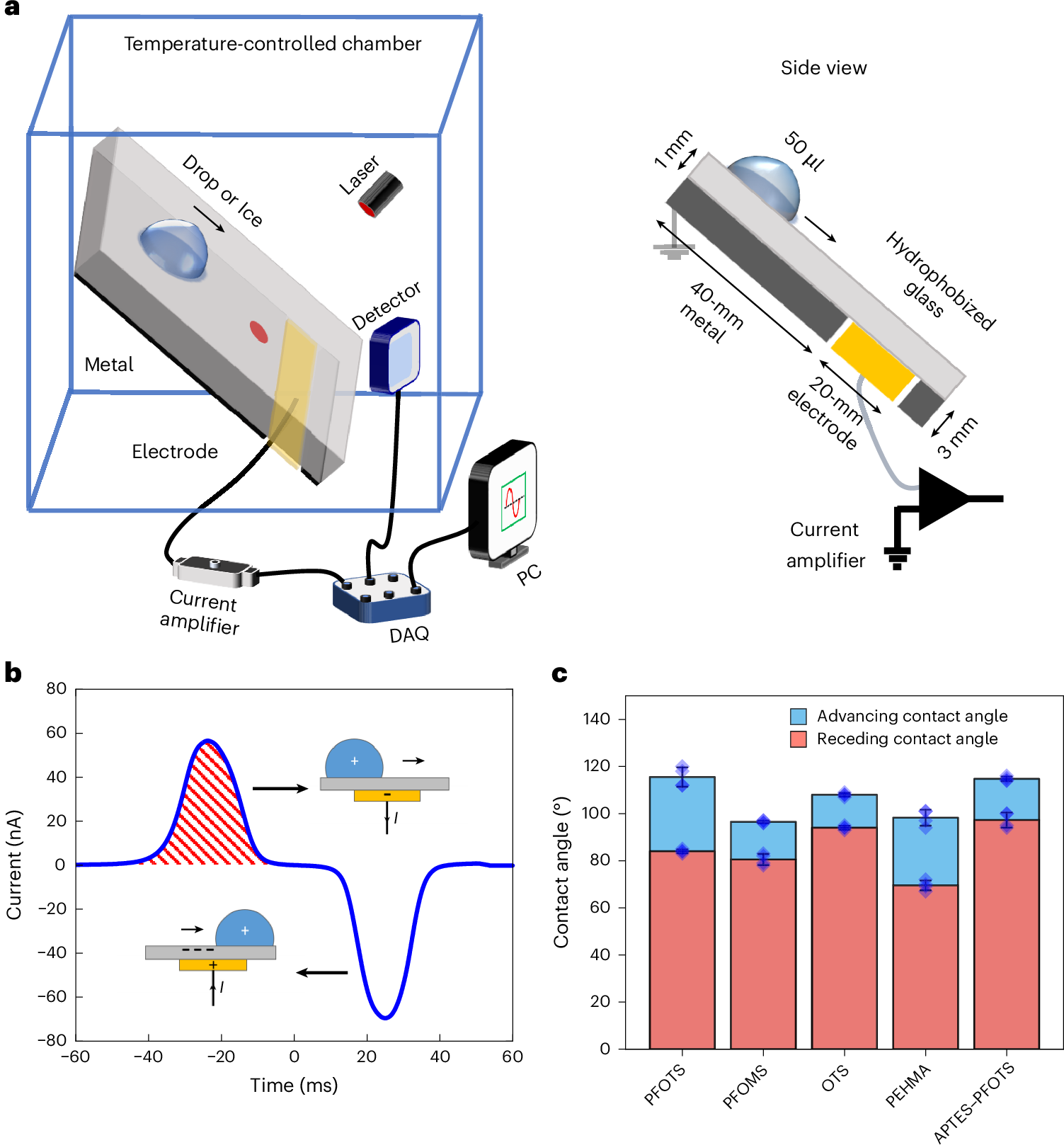
The experiment works by removal. Choose a system that is missing the ingredient the standard model needs, then check whether the effect survives without it. Freely moving ions carry virtually no charge in a nonpolar liquid such as oil [6], and in a frozen polar liquid their mobility is severely restricted [7]. Two polarity classes by two phases gives four sliding conditions [16], and the nonpolar drops charged in both of their phases, much less than the polar drops [8].
The frozen case is the weaker leg of the argument. A block of ice sliding on a solid is a solid-solid contact. Direct electron exchange between two rubbing solids is the older idea: their electron clouds can overlap and hand an electron across, with sliding ice as the standard example [12]. The sharper result is the nonpolar liquid that stayed liquid. High local voltages of the kind that arise between two rubbing solids do not arise when a liquid glides over a solid, and ion exchange was assumed for liquids on that basis [13].
"Slide electrification could occur via at least two mechanisms, with the dominant charge transfer process alternating between ion and electron transfer depending on electronegativity, state of matter and temperature," said Rutvik Lathia, a researcher at the Max Planck Institute for Polymer Research [10][11].
Electron transfer here is an inference by elimination. Nobody watched electrons cross an interface [9]. "Virtually no role" sets a bound on ion transport, and a bound leaves room above zero [6]. The phys.org account does not report the measured charges [18], so a reader cannot yet check whether trace ions in the oil could account for the smaller nonpolar signal. The measurements sit in Nature Physics, in a paper by Lathia and colleagues titled "Electrification mechanisms in sliding liquid and frozen drops" [2].
The industrial framing in the account is a motivation, not a test. Slide electrification is why drops stick on a windowpane and why cleaning steps in chip manufacturing can damage sensitive components [14], and the group hopes the work leads to better materials for triboelectric energy harvesting, ice-repellent surfaces and droplet-based technologies [15]. The work measured no mitigation, and it showed no existing fix failing. By Lathia's own statement the dominant channel switches with temperature and state of matter [10]. That leaves the double-layer account serviceable where it was built, on room-temperature water [5], and open in a cold step or a nonpolar solvent.
The four conditions settle something narrower than the headline idea of a new mechanism, and more useful. Charging survives the removal of mobile ions as a plausible carrier, so any model that treats the electrochemical double layer as the sole route [4] is now short of a case it has to explain [8].
What to watch
- Charge magnitudes and surface materials in the Nature Physics paper, which would show whether the nonpolar signal sits above what trace ions could carry.
- A follow-up that varies surface electron affinity while holding ion chemistry fixed, the cleanest way to separate the two proposed channels.
- Reports from semiconductor cleaning lines of charging in nonpolar-solvent steps that ion-based controls did not suppress.