Product1 distinct publisher3 min readPublished
The Indiana plant broke ground in August with a clean room due by October 2028 and next-generation HBM in mass production the following year, which leaves anyone specifying memory for a 2027 product buying from today's lines.
The Product Desk · Product desk
Compiled by The Product DeskSomething wrong?How this is made
Anyone filling in a 2027 bill of materials this week with a placeholder where the memory price should go will likely see this groundbreaking forwarded from someone senior. The dates in it do not reach their product.
The two milestones sit close together. The clean room is expected to open by October 2028, and mass production begins in the second half of 2029, according to chief executive Kwak Noh-jung [3]. The earliest month of that half leaves a gap of about nine months to move tools in and qualify a line [16]. That is a normal ramp, and it is the only schedule buffer in the announcement. The other word doing quiet work is "next-generation" [3]: the parts coming off this line in 2029 are not the parts in a design being frozen now, so this capacity sits outside the HBM generation currently under allocation.
The second thing worth separating is what actually gets localised. SK Hynix says wafers produced in South Korea will be shipped to Indiana for packaging and testing before going to US customers [6]. Advanced packaging is the weak link the project targets, the step that stacks multiple dies into one package [10], and HBM is a prerequisite for assembling Nvidia's most advanced AI systems [8]. So a buyer in 2029 gets US packaging and test on Korean-fabbed wafers. Geographic risk on the front end stays where it is.
On the money, the CHIPS and Science Act allows as much as US$458 million in direct funding and up to US$500 million in loans [7], which is up to US$958 million of public support [13] against a build the company puts above US$4 billion [2]. At the ceilings, that is roughly 24 percent [14], and less if the cost climbs. Worth noting for anyone quoting the figure: the Straits Times headline says $5 billion while its own text says more than US$4 billion and gives S$5.08 billion, the Singapore-dollar conversion [17]. The item is labelled AI generated and credited to Bloomberg [18]. Kwak's own framing was that SK Hynix will "become the most trusted partner in shaping the future of AI in America" [19], which is a sentence about 2030s positioning rather than about your Q3 memory quote.
Two questions decide whether this plant matters to you: does your product ship before the second half of 2029, and does it use the current HBM generation or the one after it? Ships early on current-generation parts, and your supply comes from existing lines. Ships early on next-generation parts, and the Indiana line is not yet running to supply it. Ships late on current-generation, and the Indiana output is described as next-generation, so it does not apply either. Only the ships-late, next-generation-part box is touched at all, and even there the benefit is packaging location rather than more wafers.
None of this source says what memory prices will do. What it does give planners is a dated increment of US HBM packaging capacity, and the date is in the second half of 2029 [3], with about 1,000 people running it when full [4]. Treat everything before then as a negotiation with lines that already exist, and price the memory line in a 2027 BOM accordingly.
Ranked by verification strength, evidence, and original report placement.
The West Lafayette plant costs more than US$4 billion (S$5.08 billion) and occupies a 54-hectare site.
The Straits Times headline describes a $5 billion memory hub while the article text states the cost as more than US$4 billion, equal to S$5.08 billion.
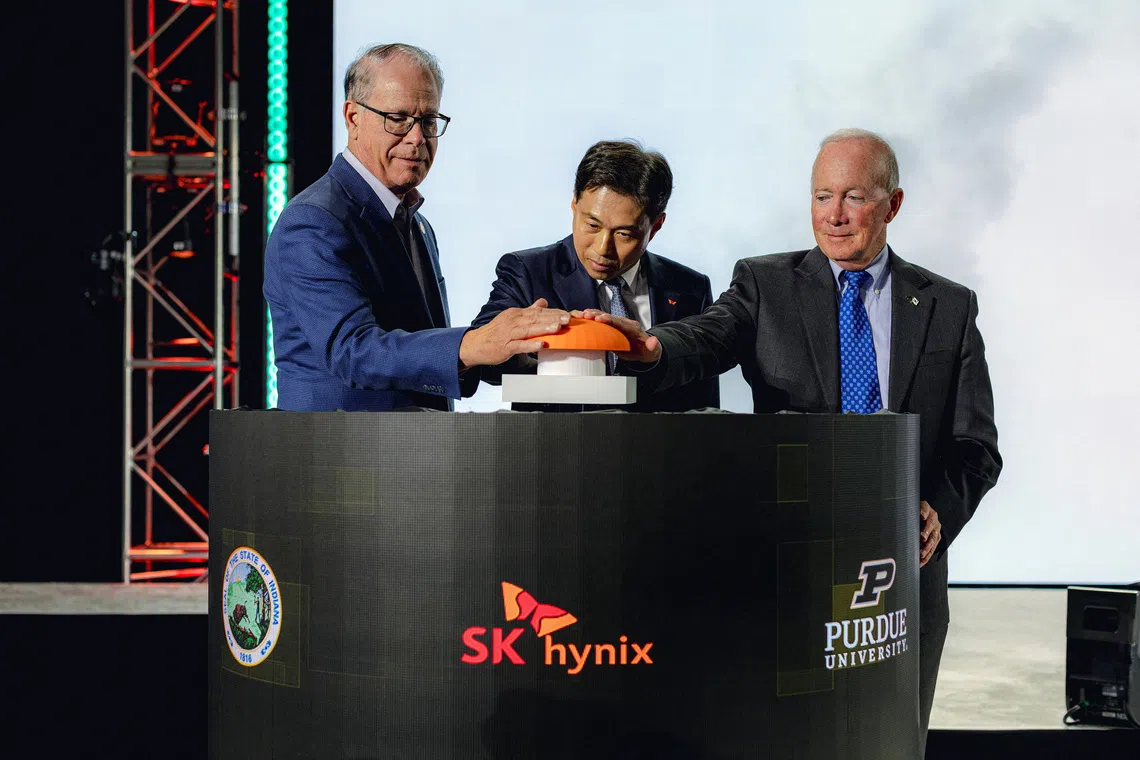
SK Hynix held a ground-breaking ceremony on Aug 27 for an advanced memory packaging facility in West Lafayette, Indiana, its first high-bandwidth memory packaging base in the US.
Chief executive Kwak Noh-jung said the clean room is expected to open by October 2028, with mass production of next-generation HBM scheduled to begin in the second half of 2029.
SK Hynix said wafers produced in South Korea will be shipped to Indiana for packaging and testing before being supplied to US customers.
The Indiana project is backed by the US Chips and Science Act, signed in 2022 by former president Joe Biden, which allowed SK Hynix to receive as much as US$458 million in direct funding and up to US$500 million in loans.
Distinct publishers with included, body-backed reporting in this cluster.
1 article · August 28, 2026
Follow any of these and your For You feed starts watching them — no settings page required.
invest
Warsh turns corporate AI spending into the case for holding rates1 distinct publisher
build
Neither can build it alone: Korean memory and Taiwanese packaging now set the accelerator clock1 distinct publisher
invest
SK's chairman warns of worst-ever memory imbalance while a U.S. fab stays under review1 distinct publisher
invest
Glass, not lithography: Korea's HBM lead rests on a packaging step it does not own1 distinct publisher
Evidence-backed comparisons of source perspectives and observed adoption signals. Read the methodology
Which Builder, Operator, and Investor concerns the observed source mix emphasized—not a truth score.
Evidence, demonstrated adoption, hype gap, incentives, and confidence are assessed independently, each on its own current evidence. How these are measured.
One ceremony, one wire, one publisher
The cost, the hectares, the October 2028 clean room, the 1,000 jobs and the 7,000 jobs all come from SK Hynix or from Kwak Noh-jung speaking at SK Hynix's own event, relayed by Bloomberg and republished once by The Straits Times under an 'AI generated' label. The Chips Act ceilings are the only figures whose existence does not depend on the company's word, and even those are quoted rather than sourced to an award notice. What is solidly established is that a ceremony happened and what was said at it.
Ground broken, nothing packaged
What exists is real and physical: a site, a ceremony, a university research agreement, a supplier field of more than 100 firms being worked through. What does not exist is a single HBM stack packaged in America, and by the company's own calendar none will exist before the second half of 2029 — after which the wafer still starts in South Korea. Commitment is high; capability in use is zero.
Present tense for a 2029 capability
The headline promises a $5 billion hub to 'boost US chip supply'; the text says more than US$4 billion — the $5 billion is a rounded Singapore-dollar figure — and the supply boost is dated to the second half of 2029. Add 7,000 jobs computed by an unstated method and a chief executive pledging to be America's 'most trusted partner' in AI, and the framing runs ahead of what has been built by about the length of the construction schedule. The overstatement is in tense and rounding rather than in fabrication; the underlying dates are stated plainly, just late in the piece.
Everyone on the stage wanted this said
The occasion is a corporate ground-breaking staged for an audience of American policymakers and customers, and it reads that way: Washington's onshoring campaign gets top billing, the Chips Act is named with its signing president, Indiana's Korean War troop contribution and jobs for former US Forces Korea personnel are folded in, and SK Group offers itself as America's most trusted AI partner. SK Hynix wants subsidy goodwill and Nvidia-adjacent customers; the state and the programme want a monument. No participant in this story had a reason to discount the numbers.
Believable, unchecked
These are the kinds of facts a wire service usually gets right — a date, a site, a subsidy ceiling — and nothing in the item contradicts itself except the headline's rounding. But one AI-assembled republication of one wire report, with every figure sourced to the company, is thin ground for anything a reader would act on. Confidence in 'the ceremony happened as described' is high; confidence in the 2029 date, the headcount and the supplier cluster should track the company's own record on schedules, which this reporting does not examine.