Science1 publisher2 min readPublished
Rotating the light's polarization switches one MoOCl2 nanodisk between plasmonic and dielectric modes
MoOCl2 is metallic along one crystal axis and dielectric along the perpendicular one, and an Okayama-led team used that split to measure a dielectric quality factor of 45.3 in nanodisks on gold, about 5.7 times the plasmonic mode's.
The Scientist · Science desk
What happened
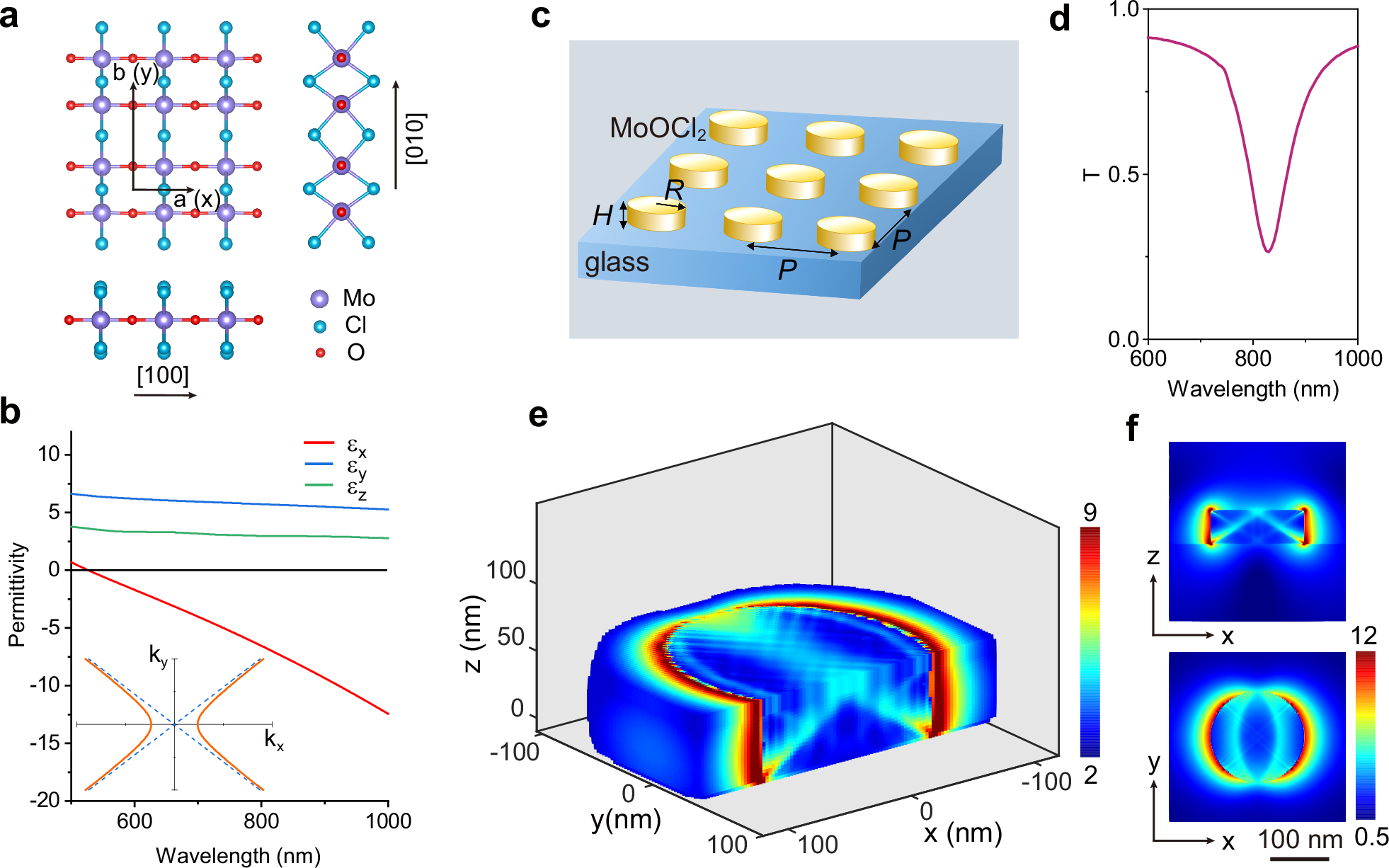
- A team led by Hiroaki Misawa at Okayama University, with colleagues at Hokkaido University and Peking University, built nanostructures from the naturally hyperbolic two-dimensional material MoOCl2, reported in ACS Nano.
- MoOCl2 behaves as a metal along one crystal direction and as a dielectric along the perpendicular one, so a single nanostructure can host both resonance types at once.
- The dielectric resonance reached a measured quality factor of 45.3, roughly 5.7 times the plasmonic resonance's, and the team reports the two modes stay nonhybrid with no crosstalk.
- Photoemission electron microscopy put the dielectric mode's signal nearly 300 times above the plasmonic mode's, which the researchers attribute to the different hotspot locations inside the disk.
Compiled by The ScientistSomething wrong?How this is made
Why it matters
- capability A component built this way is reconfigured by the beam that reads it, so moving between light concentration and low-loss storage needs no second material and no change to the structure.
- constraint The decoupling is a property of crystal axes, so an array only behaves as designed if every element shares one orientation, and flake alignment becomes a fabrication requirement on top of lithography.
- decision Anyone weighing this against a hybrid stack is choosing a sharp dielectric channel next to a plasmonic one whose quality factor works out near eight, and whether eight is sharp enough is application-specific.
Putting both functions in one structure has usually meant a hybrid design, and in those the two optical modes mix and become hard to steer separately [4]. MoOCl2 avoids the mixing inside the crystal, and the hyperbolicity is intrinsic to the layered material [1]. Light polarized along x drives a localized plasmon along the metallic axis; light polarized along y drives a dielectric magnetic dipole along the perpendicular axis [5]. Because the two modes come from different crystal directions, the team reports them as nonhybrid, with no crosstalk [6].
That conclusion rests on spectroscopy, finite-difference time-domain simulation and photoemission electron microscopy of nanodisk arrays on a gold reflective film [7]. The gold works as a mirror, tightening confinement of the dielectric mode while leaving the plasmonic mode intact [8].
The dielectric resonance came in at a quality factor of 45.3, about 5.7 times the plasmonic value [9]. Divide one by the other and the plasmonic mode sits near 7.9 [16]. The photoemission comparison is a number of a different kind: the dielectric mode gave nearly 300 times the signal, and the paper attributes that gap to where the hotspots sit inside the disk [10]. The 300-fold figure therefore describes the field distribution the microscope can sample, and it does not score the same property the quality factor scores [18].
"We wanted to independently control the light-concentrating function of metallic nanostructures and the light-trapping function of dielectric nanostructures within a single structure," Misawa said [12]. He said MoOCl2 "offered this unique opportunity because its optical response changes with crystal direction, allowing two completely different resonance modes to coexist without interfering with each other" [13].
Adjusting the nanodisk geometry brought both resonances onto the same wavelength while preserving the independent polarization control [11]. With the two overlapped and each addressed by an orthogonal polarization, one wavelength can select either mode by a rotation of the incident beam [20].
Misawa said the work "provides a new design strategy for multifunctional nanophotonic devices using a single nanostructure instead of complicated hybrid systems" [14]. The applications named are prospective ones: sensitive optical and chemical sensors, ultracompact optical switches, optical communication, optical information processing, nonlinear devices and multifunctional metasurfaces [15]. The account does not compare 45.3 with conventional dielectric resonators, and it does not report a fabricated device or how the material would be patterned at scale [19].
What to watch
- A fabricated switch or sensor that shows the polarization selectivity outside a nanodisk-on-gold test array.
- Whether MoOCl2 flakes can be oriented across a wafer so every element in an array shares the same crystal axes.
- An independent measurement of the 45.3 quality factor, and whether it survives with both resonances at one wavelength.