Invest1 publisher3 min readPublished
Singapore's 23 AI Co-Lab firms are past halfway on their pledge to train 80,000 staff by 2028
Twenty-three Singapore financial firms say more than half of their 80,000-plus local staff have already had the AI training they pledged to finish by 2028. MAS chairman Gan Kim Yong also asked them to redesign jobs, and that part has pilots but no target.
The Investor · Invest desk
Drafted by a language model from the sources cited here and checked against its claim ledger before publication. How we use AISend a correction
What happened
- IBF is widening a tripartite memorandum with NTUC's finance unions and seven associations whose 800-plus member firms employ more than 70% of the sector's workforce.
- Ten private banking employers committed to train their relationship managers in AI through a Co-Lab track for wealth managers.
- IBF released a Job Redesign Playbook for Financial Services, built with the Skills and Workforce Development Agency and the Institute for Human Resource Professionals.
Compiled by The InvestorSomething wrong?How this is made
Why it matters
- cost What is left of the 80,000 pledge averages at most about 1,740 staff per firm, a modest remaining training load for employers averaging about 3,480 local staff.
- decision Boards approving AI in underwriting, fraud detection or advisory now have the MAS chairman on record asking for a workforce plan at the start of each rollout.
- exposure Operations staff are the Co-Lab group whose routine processes AI is changing, and the programme lists three paths for them without saying how many workers each will take.
- precedent The widened memorandum gives IBF a channel into more than 800 firms, so the 23-firm whole-workforce pledge is the likely template smaller institutions will be asked to match.
If the base is 80,000 and more than half are trained, at least 40,000 people have finished and fewer than 40,000 remain [1]. Spread across the 23 institutions, that leaves at most about 1,740 staff per employer. These firms average roughly 3,480 Singapore employees each [2][3]. The training in question is "critical AI skills" through IBF-recognised programmes [11].
Gan said the government and IBF will keep providing resources and funding for workforce planning, training and career transitions [17]. He did not give an amount, so the report does not show how the bill splits between public money and the institutions' own training budgets.
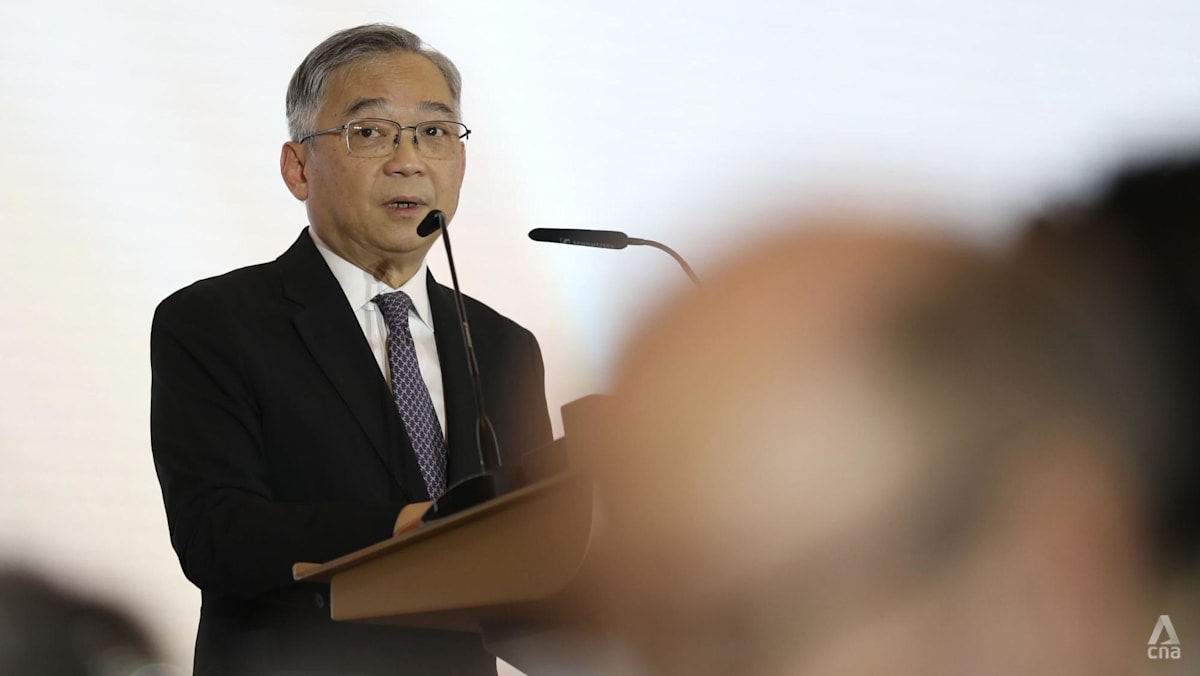
Gan is Deputy Prime Minister as well as MAS chairman [1], and at IBF's Distinction Evening on Sept. 24 he put the duty on the employers [2]. "Developing our workforce must be part of this effort from the outset," Gan said [4]. Institutions must identify how jobs will change, prepare employees early and help them benefit from new opportunities, he said, with the government, IBF and unions in support [5]. He named customer service, financial advisory, credit underwriting, fraud detection, market analysis and software development as work AI is already changing [3]. He also said the scale of change could exceed previous workforce transitions [19]. Everything he announced runs through IBF: an enhanced tripartite memorandum with the NTUC finance union cluster and seven industry associations, the Co-Lab, a job redesign playbook and a pilot that trains undergraduates in AI and finance [7][10][16][18].
In my view the bigger spending is job redesign. The Co-Lab starts that work with leaders, wealth managers and operations staff [13]. In operations, where AI changes routine processes, the listed paths are more responsibility in the same role, a move to a related position, or new work involving AI [15]. This can go three ways. Redesign scales up and absorbs the operations staff the training has prepared. Or the training count is met early while redesign stays at pilot scale in three job families. Or the wealth track carries the programme: ten private banking employers have signed up to add AI skills to their relationship managers as demand for wealth management rises across Asia [14], and a bank can tie that spending to revenue.
I'd expect the second outcome. The counter-case is in the same figures. More than half of the 80,000 had been trained by the time the pledge was announced [12], so these institutions were paying for AI training before this target was public.
The view is wrong if the Co-Lab reports operations staff moving into redesigned jobs at something near the scale of the training count. It is also wrong if a whole-workforce pledge spreads beyond the 23 firms. The associations in the memorandum represent more than 800 institutions and fintechs, with more than 70% of the sector's workforce, according to Gan [8]. The enhanced partnership promises wider outreach, better access to training and programmes for each subsector [9], but the training pledge itself belongs to the 23 [11].
What to watch
- Whether the government or IBF puts a dollar figure on the funding Gan promised for workforce planning, training and career transitions.
- Whether MAS turns the job redesign playbook into supervisory guidance or leaves it as IBF advice for HR teams.
- How many of the first Young Talent Programme cohort get work attachments at financial institutions.