Science1 publisher3 min readPublished Updated
A cloudy-sample absorbance trick aims to put LNPs on the UV/Vis you already own
Marama Labs says an integrating sphere strips scatter so LNP payload reads in 15 seconds without lysis or dyes. The precision figures come from the CEO and a study the company co-authored.
The Scientist · Science desk
Drafted by a language model from the sources cited here and checked against its claim ledger before publication. How we use AISend a correction
What happened
- Lipid nanoparticles that encase RNA and payloads are cloudy by nature, which means analysis cannot be accomplished using the UV/Vis spectrometers that are ubiquitous throughout the life sciences industry.
- Marama Labs has developed a technology that eliminates light scatter in cloudy samples, even samples as cloudy as milk, which co-founder and CEO Brendan Darby, PhD, told GEN unlocks a huge capability for complex particle analysis.
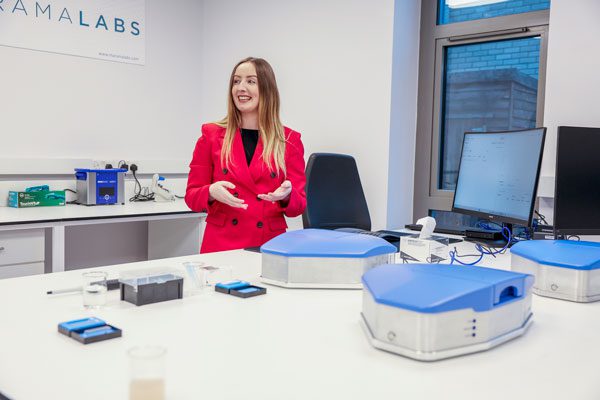
- CloudSpec employs scatter-free absorbance to remove signal interference from cloudiness, using a highly reflective spherical chamber called an integrating sphere, the Beer-Lambert Law on light attenuation, and an algorithm to measure analyte concentrations, enabling measurements similar to a standard spectrometer.
- Using the CloudSpec device, LNP lysing and fluorescent dyes are unnecessary for payload quantification.
- Research from Victoria University of Wellington (New Zealand), University College Cork (Ireland), and Marama Labs indicates this analysis method outperforms fluorescence-based quantification assays in terms of precision and agreement with expected RNA concentrations.
Compiled by The ScientistSomething wrong?How this is made
Why it matters
Marama Labs says its CloudSpec instrument quantifies the RNA payload and ligands in lipid nanoparticles without lysing the particles or adding fluorescent dyes, by using a reflective spherical chamber to pull a scatter-free absorbance reading out of a turbid sample [3][4]. If that survives contact with other people's samples, it deletes a preparation stage that currently keeps LNPs off the UV/Vis spectrometers already sitting in nearly every life sciences lab [1].
The underlying complaint is old and legitimate. A conventional UV/Vis reading measures extinction, which is absorption plus scatter; LNP suspensions are cloudy by nature, so the scatter term contaminates the answer [1][11]. Co-founder and CEO Brendan Darby told GEN that CloudSpec measures extinction and absorption directly and uses the pair to determine scattering, with an integrating sphere, the Beer-Lambert law and an algorithm doing the work [3][11]. Darby says the approach came out of his doctoral research in Eric Le Ru's RAMAN Lab at Victoria University of Wellington, where the measurements he wanted were not possible on the instruments available and scatter was the dominant error term [9][10].
The operational claim is the one that matters to a QC lead. According to Darby, dilution is the only sample preparation and the measurement itself takes 15 seconds, against 8 to 10 steps and 30 minutes to two hours per sample for alternative methods, with variability between samples and between operators [7][8]. On the measurement step alone that is a factor of roughly 120 to 480 [17]. He also says results across the 240 to 850 nm range land within 10 percent of the nominal expected RNA concentration [6].
Read the provenance before the numbers. The comparison that has CloudSpec outperforming fluorescence-based quantification assays on precision and on agreement with expected RNA concentration comes from work by Victoria University of Wellington, University College Cork and Marama Labs, that is, with the vendor as a participant, and the GEN piece names no published paper or dataset [5][16]. The 10 percent figure is a tolerance band around a nominal value, not a repeatability statistic, and it is attributed to the CEO rather than to a method-comparison table [6][16]. The company was incorporated in 2019 by Darby, Le Ru and CTO Matthias Meyer, and its first commercial application was measuring colour and tannin for New Zealand winemakers, not pharmaceutical QC [12][14]. Darby says the thesis work on molecules bound to metallic nanoparticles was extended to RNA therapeutics and validated with CureVac researchers [13].
What to watch: a named, published method comparison against the incumbent dye assay, with per-sample scatter across operators rather than a single tolerance band [16]; and whether the technique can separate encapsulated RNA from free RNA, which the reporting does not address [18]. Until then this is a plausible physics argument with vendor arithmetic attached, and the incumbent dye assays keep their audit trail [5][16].