Product1 publisher3 min readPublished
Serve adds Grubhub, and sidewalk delivery quietly becomes a shared utility
With Uber Eats, DoorDash and now Grubhub all able to summon the same robots, Serve is betting the fleet is the asset. The unit economics are still unproven.
The Product Desk · Product desk
Drafted by a language model from the sources cited here and checked against its claim ledger before publication. How we use AISend a correction
What happened
- Serve Robotics, the sidewalk-delivery company that spun out of Uber, has added Grubhub to its roster of partners.
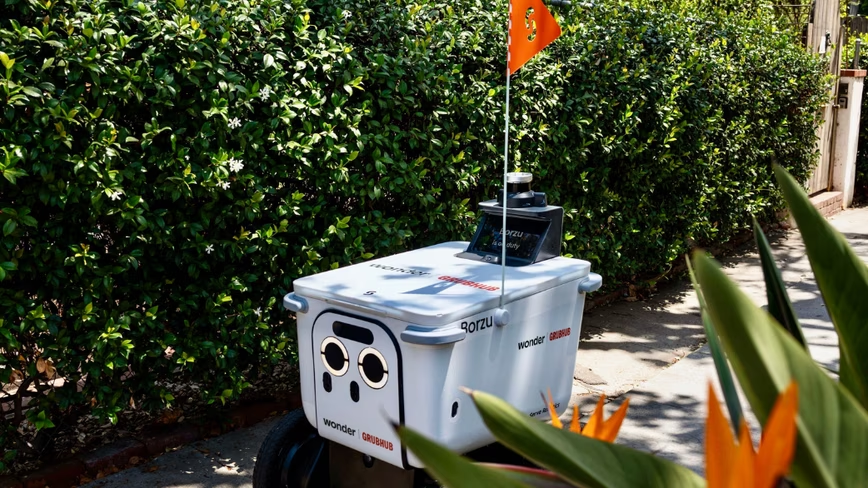
- Through a deal with Wonder, Grubhub's parent, Serve's cooler-sized robots will start carrying takeaway orders placed on the Grubhub marketplace, beginning in Chicago, Los Angeles and Alexandria, Virginia.
- Grubhub is the third of the big US delivery platforms to sign with Serve; Serve already runs deliveries for Uber Eats, the app of its former parent, and for DoorDash.
- Serve says it now has more than 2,000 robots deployed across the US, reaching around three million people and serving over 4,000 restaurants, a fleet built out since promising Uber Eats up to 2,000 bots in 2023.
- Serve said it had switched on two new markets with DoorDash, Washington, DC and San Jose, its seventh and eighth, lifting its combined reach to roughly eight million people across cities that also include Atlanta, Dallas and Miami.
Compiled by The Product DeskSomething wrong?How this is made
Why it matters
Serve Robotics has added Grubhub to a partner list that already included Uber Eats and DoorDash, with its cooler-sized robots starting to carry Grubhub marketplace orders in Chicago, Los Angeles and Alexandria, Virginia, under a deal with Grubhub parent Wonder [1][2][3]. The consequence is structural rather than technical: once all three large US ordering apps can summon the same robots, sidewalk autonomy stops being something one platform owns and becomes a shared utility none of them control.
Serve says it now has more than 2,000 robots deployed across the US, serving over 4,000 restaurants and reaching around three million people, a fleet built out since it promised Uber Eats up to 2,000 bots in 2023 [4]. It also turned on Washington, DC and San Jose with DoorDash, its seventh and eighth markets, which it says lifts combined reach to roughly eight million people across a footprint that also includes Atlanta, Dallas and Miami [5]. The two reach numbers in the same announcement differ by a factor of about 2.7, which suggests "reach" is doing more than one job in the release [6].
The utility posture has a plain operational logic behind it. A fleet with three demand sources is easier to keep busy than one tied to a single app, and idle time is what kills hardware businesses. The Grubhub launch starts with more than 100 participating merchants in Chicago and close to 200 in Los Angeles [7], which is roughly 300 against the 4,000 restaurants Serve already claims, under a tenth of its existing merchant base [8]. That is incremental order flow layered onto streets Serve has already mapped, not a new geographic bet.
The rest of the announcement reads like a company hedging against delivery fees alone. Serve is testing "micro-depots", small low-cost bases intended to let it enter new neighbourhoods without full-scale facilities [9]. It has launched an in-robot advertising line, including a hamburger-suited character called Chomp co-created with Grubhub, which treats a robot parked on a busy pavement as a moving billboard [10]. And it bought Diligent Robotics, maker of the Moxi hospital robot, in 2026, and is rolling out a faster Moxi 2.0 to hospitals in Chicago and Los Angeles on the theory that the same autonomy stack works in a corridor as well as on a street [11].
The Next Web's assessment is that deploying robots is not the same as earning money from them: sidewalk delivery is low-margin, with stubborn hardware, maintenance and mapping costs, and Serve is still spending to prove unit economics rather than banking them [12]. The publication also notes that the release is denominated in robots and reach rather than revenue and margin [13]. That caveat carries weight in a category that has been about to arrive for most of a decade, from Domino's experiments with Nuro to Boston Dynamics teaching Spot to reach a doorstep [14].
What to watch is whether the shared-layer arrangement survives contact with platform incentives. If autonomy becomes a real cost line rather than a pilot, the apps have obvious reasons to demand exclusivity, take a stake, or build their own [15]. Watch also whether micro-depots translate into market count growth [9], whether the Grubhub merchant list expands past its launch numbers [7], and whether Serve starts reporting anything per robot or per market instead of totals [13].