Science1 publisher2 min readPublished
NIST's decade of blinded data deepens the disagreement over gravity's constant
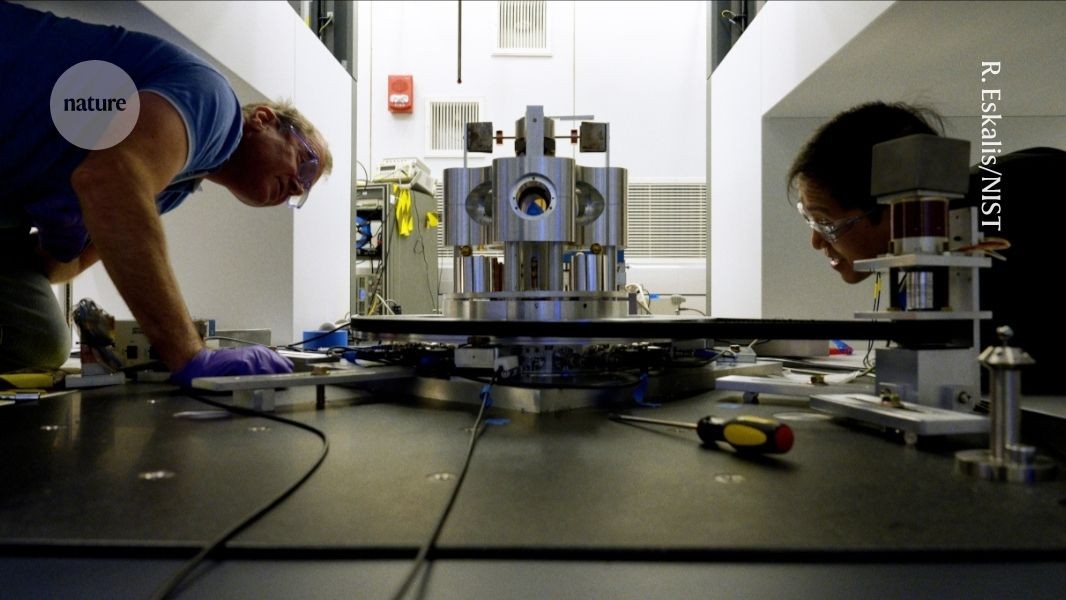
Stephan Schlamminger's team spent ten years measuring big G with part of the data scrambled so that nobody could tune the answer to an expectation. The unblinded value differs unexpectedly from another leading result.
The Scientist · Science desk
What happened
- NIST announced on September 20 that a decade-long experiment produced a new measurement of the universal gravitational constant that differs unexpectedly from another leading result.
- The experiment was built as a replication: an independent team in Gaithersburg, Maryland, using essentially the same approach as the measurement made at the BIPM in Sevres, France, in 2007.
- To keep expectation out of the analysis, Patrick Abbott subtracted a secret number from the measured weights of some of the masses, and the key to unscrambling the data stayed sealed for ten years.
- Measurements of big G disagree by roughly one part in 10,000, more than ordinary experimental uncertainty in those experiments should allow.
Compiled by The ScientistSomething wrong?How this is made
Why it matters
- constraint Ten years of blinding shortens the suspect list without shortening the work, since analyst expectation is excluded for this result and the remaining candidates sit in hardware the field already regards as its most careful.
- decision Groups planning the next big-G attempt have to choose between copying a trusted design once more and building an independent one, and the return on another faithful copy just fell.
- precedent A blind held for a decade and carried through to publication sets an expectation that other precision-constant analyses will be asked how they guarded against knowing the expected answer.
An offset in the masses propagates straight into the answer. Big G is inferred from the masses and the faint pull between them, so masses that are wrong by a secret amount give a value of G that is wrong by a secret amount [4]. Schlamminger's team could still hunt down corrections, check the apparatus and test for internal consistency. The blind kept them from watching the answer move toward a number they expected. NIST's account names that as the effect it wanted to remove: researchers can unintentionally influence how they interpret or analyse measurements when they know what answer they expect [6]. By that same account, Schlamminger was not entirely sure he wanted to open the envelope [3].
A blind of this kind covers one failure mode, the one inside the analyst. Anything the apparatus does wrong survives it. Ruling out the analyst leaves the apparatus explanation with one fewer competitor, and NIST puts a subtle overlooked experimental effect at the top of its own list of explanations, ahead of the possibility that scientists are missing something about gravity itself [8].
The spread among measurements is about one part in 10,000 [7]. Written as a percentage that is 0.01 percent [1], so the values agree to four digits and part ways in the fifth. Most laboratory work would be delighted with that. Here the spread is wider than the uncertainty the experiments claim for themselves [7].
The reason those uncertainties are so hard to pin down is the size of the force. A magnet about as big as a pinhead lifts a paper clip against the gravitational pull of the entire Earth [10]. Laboratory masses are roughly 500 billion trillion times smaller than the planet, which is 5 x 10^23 [11][2], and the attraction between them is correspondingly slight. After more than 225 years of attempts, big G is known less precisely than the constants attached to electromagnetism and to the strong and weak nuclear forces [9].
Nineteen years separate the BIPM measurement at Sevres from the opening of the envelope at Gaithersburg [3]. NIST's run was a control on a method, and a faithful copy of a design that returns a different number leaves the design itself as the thing to examine. The announcement as published does not include the new value or its uncertainty, so nobody outside the team can yet say whether the gap is wider than before or simply sits elsewhere. On what NIST has described, the next measurement of big G worth doing is one built on an apparatus independent of the existing ones.
What to watch
- The peer-reviewed paper, and whether the new NIST value sits farther from the 2007 BIPM result than earlier work did.
- Whether NIST's team identifies a specific apparatus effect large enough to account for a one-part-in-10,000 difference.
- Whether other big-G groups publish blinded reanalyses of data they have already released.