Science1 publisher2 min readPublished
Impact modeling narrows the RNA World's onset to a 100-million-year window
A Planetary Science Institute team scored early Earth for both impact sterilization and impact-built hydrothermal systems. The habitability optimum falls at 4.33 billion years ago, roughly 130 million years before LUCA.
The Scientist · Science desk
What happened
- A study published on Sept. 22 in Nature Communications dates the optimal conditions for the onset of the RNA World, the proposed pre-DNA stage of life, to 4.33 billion years ago.
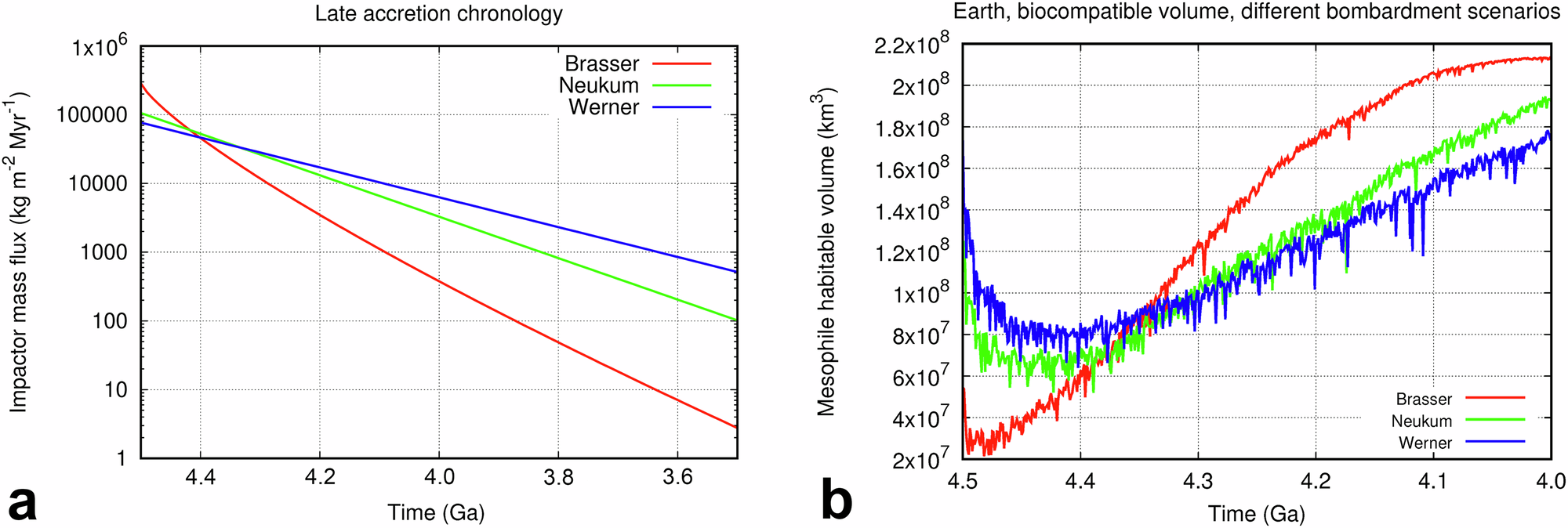
- The team ran giant impacts from 4.5 billion to 3.5 billion years ago through a computer model of Earth's interior to score how each one changed the crust's compatibility with life.
- In the model, objects hundreds of miles across, an order of magnitude larger than the asteroid that killed the dinosaurs, kept hitting Earth and sterilizing its surface until 4.4 billion years ago.
Compiled by The ScientistSomething wrong?How this is made
Why it matters
- contradiction How much of an improvement this is depends on which prior estimate you measure against: the new band halves one published range and cuts another by a factor of 5.5.
- constraint Because the bombardment model is tuned to the lunar cratering record, the date for Earth's earliest habitability is only as firm as the Moon's impact chronology.
- capability Prebiotic chemists get a dated setting to design experiments around: impact-generated hydrothermal systems in the near-surface crust, concentrating RNA ingredients, at a specified time in Earth's history.
The 4.33-billion-year figure is the peak of a modeled curve. Abramov and colleagues tracked two opposite consequences of the same impacts [3]. "We examined both detrimental effects of impacts, such as temperature-induced degradation of key biomolecules, and effects conducive to life, such as generation of hydrothermal systems," Abramov said [7]. After 4.4 billion years ago, he said, conditions stabilized and clusters of hydrothermal vents formed in the near-surface crust, concentrating nucleotides, peptides and lipids [11]. Abramov did not say how the harmful and helpful terms were weighted against each other.
The calibration comes from the Moon. Revise the lunar cratering chronology and the Earth date moves with it. "We constructed an impact bombardment model constrained by observables such as the lunar cratering record," Abramov said [6].
"The timing is consistent with previous estimates of approximately 4.35 billion years ago, but our range of uncertainty is significantly narrower," Abramov said, adding that "previous ranges included 4.46 to 4.26 billion years ago, and 4.45 to 3.9 billion years ago" [4][5]. The first of those spans 200 million years, the second 550 million [18][19]. The new suitability window, 4.4 to 4.3 billion years, spans 100 million [12][20]. The improvement is a factor of two against one published range and 5.5 against the other [21].
The model dates the planet's condition. The RNA World is a hypothetical stage before LUCA, when RNA would have carried genetic information forward by copying itself [13]. Abramov said it is a leading hypothesis, and researchers have also proposed alternative and hybrid scenarios for how life began [14]. Earlier onset estimates came out of geochemical modeling, biomolecular analyses and simulations of early atmospheric chemistry [17]. This one comes out of impact physics, so what it constrains is when the crust could have hosted RNA chemistry. Whether that chemistry took hold is a separate question.
Subtract the LUCA age researchers favor, about 4.2 billion years, from 4.33 and 130 million years is left [22]. Into that interval the field fits an RNA world, then an RNA-and-protein world, then two DNA stages nicknamed the U-DNA and T-DNA worlds [15]. Live Science reports that uncertainties on both dates could stretch the interval to 240 million years [16].
What to watch
- Whether the published habitability metric moves the 4.33-billion-year peak when its destructive and constructive terms are reweighted.
- Any recalibration of the lunar cratering record for the interval 4.4 to 4.3 billion years ago. That is the interval the model is tuned to.
- New estimates of LUCA's age. Those would resize the interval available for the RNA-to-DNA transitions.