Science1 publisher3 min readPublished
Cooling minerals pull CO2 into Mojave soils every night, Berkeley researchers find
UC Berkeley researchers say Mojave soil minerals adsorb CO2 at night and release it by day, moving 1 to 3 gigatons of carbon a year if scaled globally. Part of the soil exchange long credited to microbes may be physical, though the global figure rests on Mojave soils alone.
The Scientist · Science desk
What happened
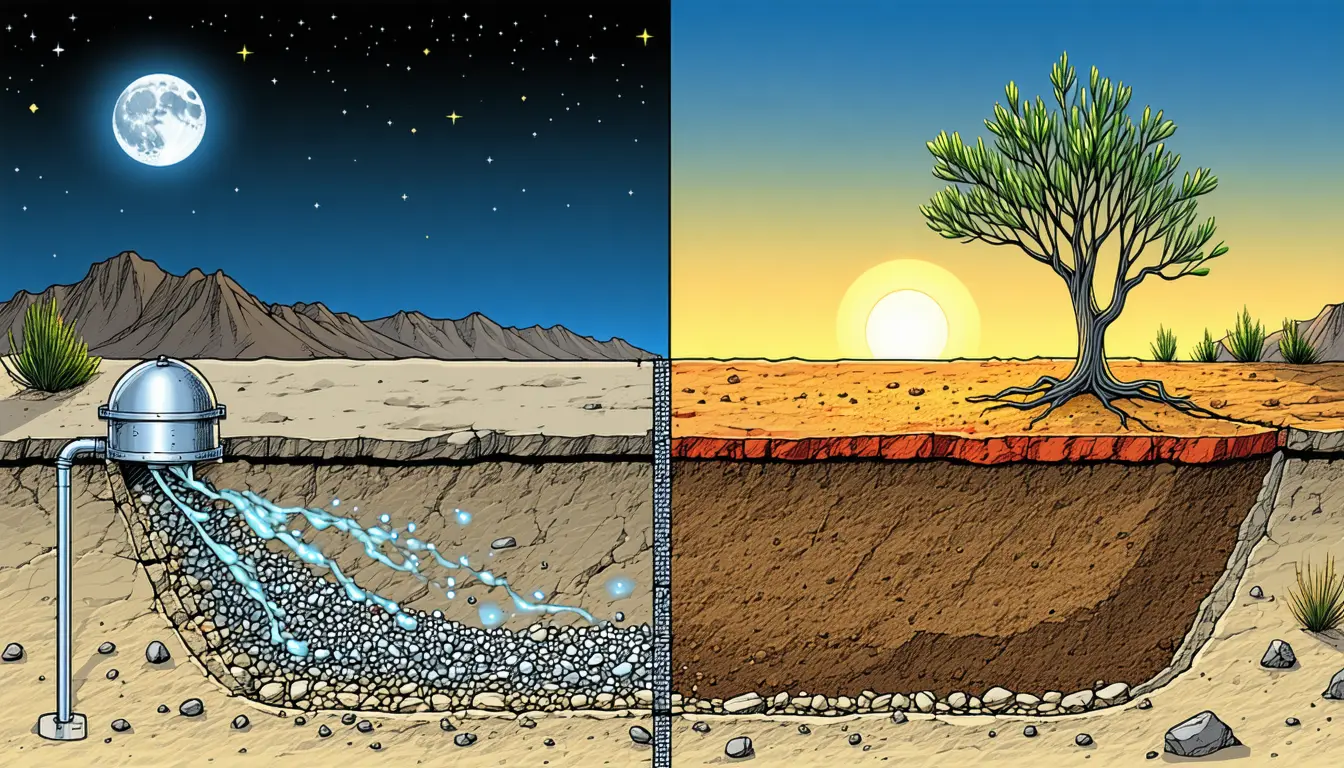
- UC Berkeley soil scientists reported in Science Advances on Sept. 23 a daily cycle in which Mojave soils adsorb CO2 at night and release it by day.
- Field sensors showed CO2 at 5 centimeters depth falling below surface levels at night, so gas flowed into the ground instead of out of it.
- Scaled globally, the authors estimate 1 to 3 gigatons of carbon move into and out of desert soils each year, roughly a tenth to a third of annual human emissions.
Compiled by The ScientistSomething wrong?How this is made
Why it matters
- exposure Dryland respiration estimates built on the assumption that soil CO2 exchange is wholly biological now include a mineral term of unknown size at each site.
- constraint Anyone inferring microbial activity from desert soil flux has to separate a temperature-driven adsorption signal before reading the numbers as biology.
- constraint The 1 to 3 gigaton figure counts carbon going both in and out each day, so it cannot be booked as a desert sink offsetting human emissions.
- precedent Sightings in cold deserts including Antarctica make adsorption a term other dryland flux studies will be expected to measure, and new soils could push the Mojave-based total higher.
A physical carbon flux is easiest to mistake for a biological one in a desert. Amundson said respiration tends to run slowly there because plants are sparser than in humid regions such as the tropics [19]. Scientists read soil-air exchange mainly as respiration: microbes feed on organic carbon, and the CO2 they make diffuses out of the ground [3]. "It's always been assumed that this is entirely driven by a biological process," Amundson said [4].
The study pairs two records gathered independently. The field record comes from soil sensors the team has run in the Mojave since 2017 [5]. Jennifer Mills, a co-author, found that at night the CO2 concentration 5 centimeters down fell below the concentration at the surface, so gas moved into the soil [8]. Respiration pushes CO2 upward, and a gradient pointing down at night has the opposite sign. "There's no biological explanation for this," Amundson said [7].
The lab record took three years. Anna Abramova, the lead author, took Mojave samples to Lawrence Berkeley National Laboratory and measured how much CO2 they adsorbed across a range of temperatures and CO2 concentrations [11]. The desert surface can reach 60 degrees Celsius by day and fall below 20 at night [9], a swing of more than 40 degrees [10]. Across temperatures spanning that night and afternoon, the soils took up more CO2 as they cooled and released it as they warmed [12]. "We designed these lab experiments to quantify adsorption rates and compare that to how it occurs in the Mojave," Abramova said [14]. Her data showed that adsorption could explain what the field sensors had recorded [23]. "It was exciting to see how two completely different, independently obtained data sets are very much aligned," she said [15].
The global figure needs its denominator checked. The authors estimate that 1 to 3 gigatons of carbon move into and out of desert soils each year, roughly a tenth to a third of annual human emissions [16]. Human emissions are a one-way addition to the air. The desert figure counts carbon that enters the soil at night and leaves it by day [2], so it measures turnover. The high end is three times the low end [22], and the estimate rests on Mojave soils alone; the authors say it could be higher for that reason [17]. The same uptake has been observed in cold deserts, including Antarctica [18].
Abramova said the cycle offers an alternative explanation for how soils exchange carbon with the air [21]. I think the concern for dryland carbon budgets holds in direction. Desorption tracks temperature [12], so a flux record that reads daytime desert efflux as respiration would credit microbes with CO2 that minerals took up the night before [2][3]. The thing this doesn't tell you is how a given site's afternoon efflux splits between the two. Phys.org's account of the study does not estimate that share for any desert.
What to watch
- Site-level partitions of desert chamber or flux-tower records into respiration and mineral desorption, which would size the budget error.
- Adsorption measurements on soils from deserts other than the Mojave, testing the 1 to 3 gigaton global extrapolation.
- Any estimate of net annual uptake or release from the daily cycle, which would decide whether it belongs in carbon-sink accounting.