Science1 publisher2 min readPublished
Fourteen tail bones from Teruel put Diplodocus on a second continent
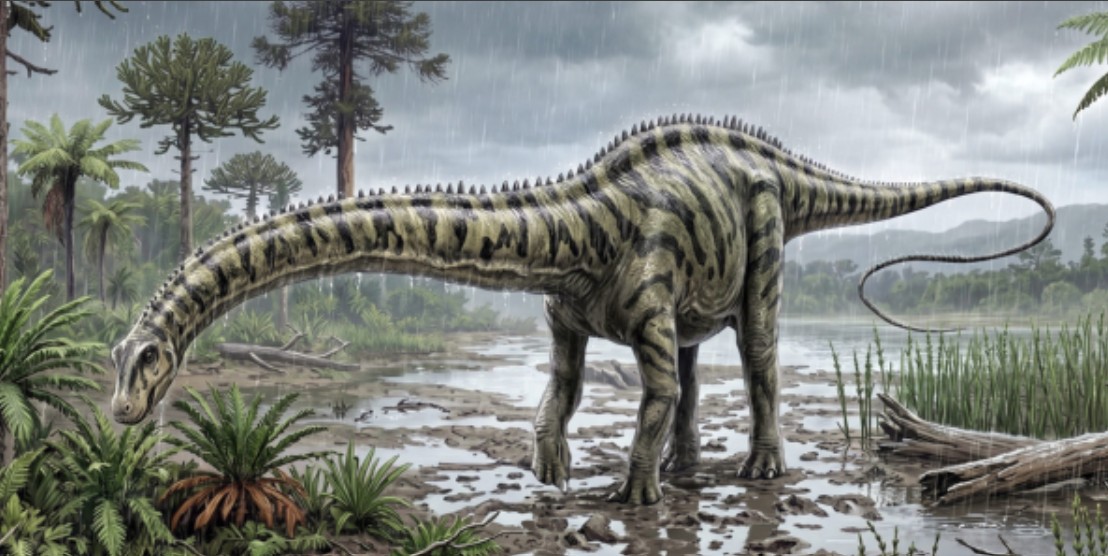
A sauropod from El Castellar in Spain has been identified as Diplodocus from its tail bones alone. The Teruel team takes the find as a sign that animals moved between Europe and North America late in the Jurassic.
The Scientist · Science desk
What happened
- Researchers at the Fundacion Conjunto Paleontologico de Teruel-Dinopolis identified a Spanish sauropod as Diplodocus, the first confirmed occurrence of the genus outside North America, in the Journal of Vertebrate Paleontology.
- The material came from the La Tejeria site at El Castellar in Teruel: 14 well-preserved caudal vertebrae and several chevron bones.
- Until now, every confirmed Diplodocus specimen had come from the Morrison Formation of the western United States.
- Co-author Alberto Cobos put the animal at approximately 25 meters long, comparable in size to its North American relatives and another of the giant sauropods of the Spanish Jurassic.
Compiled by The ScientistSomething wrong?How this is made
Why it matters
- constraint The diagnosis sits in caudal anatomy, so anyone who wants to contest it has to argue over the same tail series the team described.
- contradiction The specimen is called among Europe's most complete diplodocids while the material described is a partial tail. That says as much about the state of Europe's diplodocid sample as about this animal.
- capability Dated occurrences on both sides of the proto-North Atlantic give biogeographers something testable against sea-level curves, since shared genera should cluster in regressive intervals if land bridges explain the pattern.
- precedent With one Morrison genus accepted in Iberia, other European diplodocid material becomes easier to argue as North American genera instead of local relatives.
Tail bones are a narrow base on which to name a genus, and they are also where diplodocine anatomy is most distinctive. Preservation at La Tejeria was good enough for the team to pick out large pneumatic cavities inside the vertebrae and deep longitudinal grooves, traits the release lists among those associated with Diplodocus [12]. Sergio Sanchez Fenollosa, the lead author and a PhD student in biodiversity and evolutionary biology at Fundacion Dinopolis [13], said the identification arrived in stages. "As we looked more closely at the anatomy, we began to identify a combination of features characteristic of Diplodocus species. Then, as we carried out different evolutionary analyses, they kept pointing in the same direction," he said [10].
Those are two lines of evidence pointing the same way, an anatomical comparison and a set of evolutionary analyses, both drawn from the same 14 vertebrae and chevrons [3].
The dispersal claim needs more care. Sanchez Fenollosa said "the outcome of the dig is some of the strongest paleontological evidence for episodes of dispersal and faunal exchange between the two continents across the proto-Atlantic Ocean during the Late Jurassic" [11]. The route the authors offer is a temporary land bridge exposed when sea levels dropped during regressive phases of the proto-North Atlantic, which the release presents as what the researchers believe may have happened [9]. A tail in Teruel places an animal and dates it. The bones do not record how its lineage got to Iberia; that is an inference from Late Jurassic geography.
The release dates the Spanish animal to roughly 150 million years ago and does not tie the El Castellar beds to a particular interval of the Morrison [8][18], so the two occurrences are known to overlap at the scale of the Late Jurassic.
The 18 September release from Taylor and Francis Group also calls the specimen among the most complete diplodocid skeletons ever uncovered in Europe [7][15]. The ranking is against other European finds, and the Morrison Formation material on which the genus was built is not part of the comparison [4].
Alberto Cobos, managing director of Fundacion Dinopolis and a co-author, set the animal beside Turiasaurus and Losillasaurus, Teruel sauropods with "characteristics very different from those of diplodocids" [6]. Counting the new specimen, at least three named giant sauropod genera now come from Teruel's Jurassic [14]. "The fossils of all these dinosaurs, including those of the new Diplodocus specimen, make Teruel a reference place for understanding this great diversity," Cobos said [17].
What to watch
- Whether the published paper's measurements show the 25-meter estimate came from scaling against Morrison specimens or from proportions preserved in the Teruel tail itself.
- Whether the authors or later workers assign the El Castellar animal to a named Diplodocus species or leave it at genus level.
- Any biostratigraphic or radiometric work that ties the El Castellar beds to a specific Morrison interval. That work would date the proposed crossing.