Product1 distinct publisher3 min readPublished
San Francisco's Mara raised $7 million for a tube-launched interceptor weighing 250 grams, on the argument that fiber-spooled and self-navigating FPV drones have made jamming unreliable enough that buyers now shop on cost per kill.
The Product Desk · Product desk

invest
Khosla and a16z put $7M into counter-drone startup Mara, at 1/50th their Hermeus cheque1 distinct publisher
product
Terra keeps its factories in Ghana and Nigeria, moves its sales desk to London3 distinct publishers
build
Vivodyne is spending venture money on wet-lab throughput, not bigger models2 distinct publishers
invest
Public miners are unplugging hash faster than the network, and rebilling it as colocation1 distinct publisher
Compiled by The Product DeskSomething wrong?How this is made
The failure case Mara is selling against is narrow and specific: the jammer is on and the quadcopter keeps flying, because its control link is a fiber spool or because it never needed a link at all. Mara says electronic warfare is becoming less reliable exactly as those two features spread [4]. The company's answer is geometry rather than transmit power. Co-founder and CEO Daniel Kofman says most defenses concentrate both replacement cost and line of fire in one place, while Spike spreads small, cheap nodes that can each aim and shoot in multiple directions at once [6].
The division of labour is plain enough. A "spotter" node watches with cameras and microphones, with radar as an option, and the software fuses those feeds to identify likely drones, track them and work out where they are heading [7]. A "seeker" then leaves a tube and flies itself into the target [8]. Mara claims the distributed launchers let it assign separate interceptors to several drones in the same moment, where guns and directed-energy mounts generally hold one line of fire per weapon and must work through a queue [10]. The nodes are meant to be attritable, which is the vendor's way of saying you are allowed to lose one [11].
Run the physics on the interceptor and the design logic falls out. At 250 grams and 200 kph, the seeker carries roughly 386 joules at impact [14]. That is a plausible budget for the kill mechanism the company describes, which is breaking a propeller, motor or arm rather than detonating a warhead [12].
What crews are actually rationing on a bad day is how many objects can be engaged inside the same ten seconds, and how many rounds are left in the tube [10]. That is the number that decides this procurement, and it is also the number nobody has published. Mara's material puts no price on a seeker; the only cost statement on the record is comparative, from Khosla Ventures partner Nicole Fraenkel, who says the system cost is orders of magnitude below anything else she has seen [13][15]. Set that against the attacker's economics, where an FPV airframe runs a few hundred dollars and the defense against it can cost many multiples once EW and missile interceptors are counted [3].
The forcing function for anyone shopping this year comes down to cost per intercept including the consumable, not the capital price of the mount, and the number of simultaneous engagements before a queue forms. Neither is hit probability. Multiply the first by the largest raid you think you will see, compare it with a few hundred dollars per airframe on the other side [3], and if your figure is larger by a factor your budget cannot absorb monthly, the problem is arithmetic, and no amount of capability language closes an arithmetic gap. Fraenkel's own description places Spike at user testing, which is a stage, not a fielded answer [13].
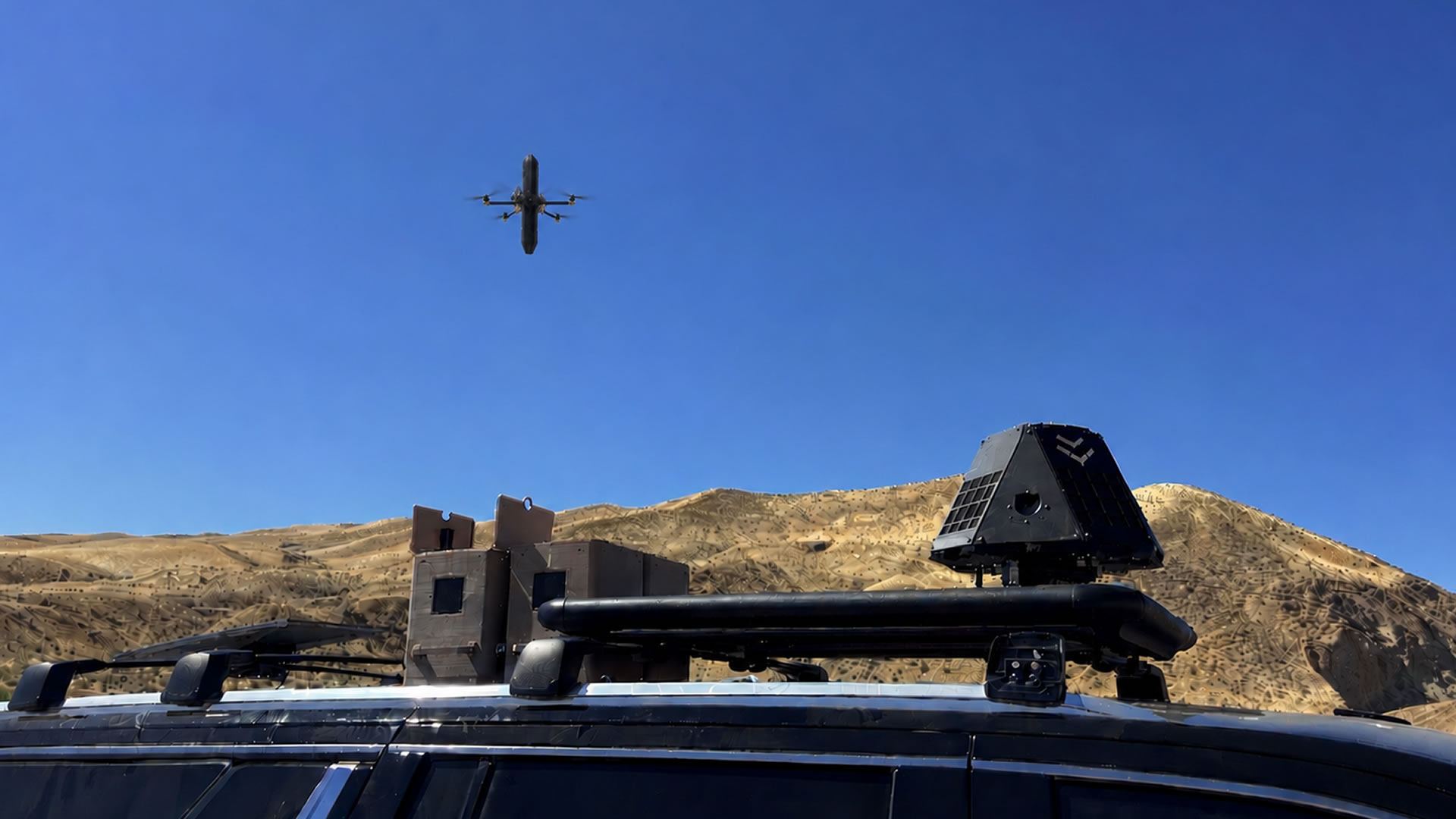
Ranked by verification strength, evidence, and original report placement.
San Francisco-based Mara secured $7 million in funding for its counter-drone system Spike, with the round intended to help bring the technology to market.
Spike is specifically designed to counter drone swarms and is described as a kind of miniature automated air-defense network for FPV drones.
Daniel Kofman, co-founder and CEO of Mara, said most defenses still concentrate both replacement cost and line of fire, while Spike creates a distributed mesh of small, cheap nodes that can each aim and shoot in multiple directions at once.
The Spike "spotter" includes cameras, microphones and optionally radar watching in all directions, with AI combining the sensor feeds to identify likely drones, track them and calculate where they are going.
The Spike "seeker" is an 8.8-ounce (250-gram) interceptor launched from a tube that flies at around 124 mph (200 kph) and steers itself toward the detected FPV drone to physically intercept it.
Spike is not fully automated: human operators are on the loop, giving the system rules of engagement and supervising operation rather than directly controlling it.
Distinct publishers with included, body-backed reporting in this cluster.
Follow any of these and your For You feed starts watching them — no settings page required.
Evidence-backed comparisons of source perspectives and observed adoption signals. Read the methodology
Which Builder, Operator, and Investor concerns the observed source mix emphasized—not a truth score.
Evidence, demonstrated adoption, hype gap, incentives, and confidence are assessed independently, each on its own current evidence. How these are measured.
One release, two interested quotes
Everything load-bear— everything this story stands on comes from Mara's own announcement as relayed by Interesting Engineering: the specs, the swarm-engagement advantage, the cost comparison. The two people quoted are the CEO and the venture partner who wrote the check. What survives independent scrutiny is narrow: the disclosed hardware figures, and the arithmetic you can do on them.
Funded, not fielded
The only adoption facts on the table are a closed round and a passing reference to 'user testing' with no user named. No contract, no delivered unit, no exercise, no battlefield use. The money exists; the deployment does not, at least not on this record.
The cost claim outruns the receipts
A swarm-killer framing and 'orders of magnitude lower' sit on top of a system with no published price, no hit rate and no identified user. The gap is not the hardware — 250 grams at 200 kph is a specific, defensible engineering choice — it is that the entire argument is economic and the economics are unquantified. Sell cost per kill, show the cost.
Announcement told by the announcers
This is a funding release amplified at the moment Mara needs market attention, with its lead investor's partner supplying the memorable line about cost. Both quoted parties gain from the same framing, and the outlet adds engineering exposition rather than friction. None of that makes the claims false; it does mean nothing in the story was written by someone who could lose from it.
Clear about what it is
We are confident about the shape of this story even while its substance stays unverified: the provenance is unambiguous, the specifications are stated precisely enough to check by arithmetic, and the publisher was careful enough to mark the swarm-engagement advantage as claimed. What would move this most is not a second write-up of the same release but a price per seeker or a hit rate from a range.