Product1 publisher3 min readPublished
Risotto bets its IT agent can turn each Tier-2 fix into a reusable runbook
Risotto launched an agent for ambiguous Tier-2 IT tickets that saves each new fix as a runbook, and says its customers auto-solve 40% to 90% of tickets. Its bet is that the knowledge from a hard fix, usually lost in a closed ticket, can be kept and run again.
The Product Desk · Product desk
Drafted by a language model from the sources cited here and checked against its claim ledger before publication. How we use AISend a correction
What happened
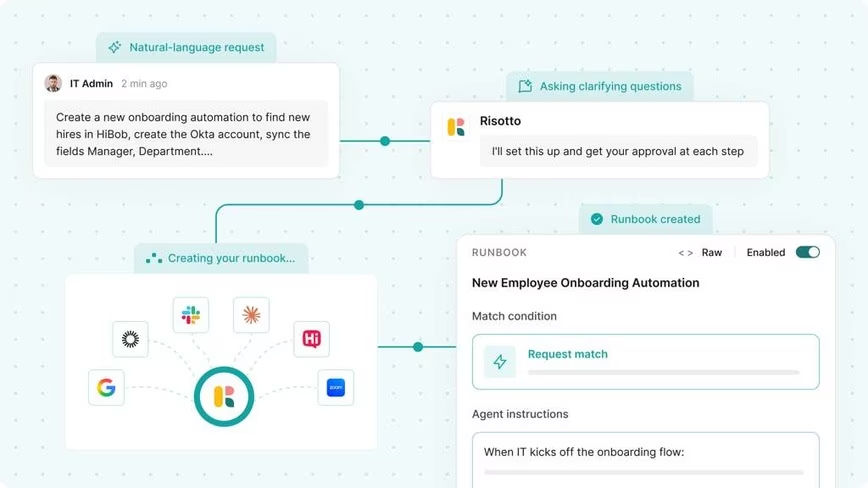
- The agent reads system logs and live user context, proposes a step-by-step fix, and executes it only after a human approves.
- A Past Ticket Mining feature scans 90 days of a company's ticket history to generate automation workflows from problems already solved.
- Teams can describe an automation in plain language, and Risotto builds and tests it against existing tools through API or MCP endpoints.
- Risotto names Gusto, Instacart, Docker, Retool, ThoughtSpot, Patreon and Ironclad among its current customers.
- The company raised a $10M seed round earlier this year, led by Bonfire Ventures with 645 Ventures and Y Combinator also investing.
Compiled by The Product DeskSomething wrong?How this is made
Why it matters
- contradiction Risotto is selling the agent on Tier-2 work while the only customer result tied to a tier measures Tier-1 requests, so the published figures cannot tell a buyer how the agent handles hard tickets.
- cost Because every fix waits for human approval, an IT engineer still signs off each Tier-2 change and answers for it, so the saving on offer is investigation time.
- exposure Runbooks that Risotto calls self-improving become standing procedures that someone in IT has to own and audit long after the engineer who approved the original fix has moved on.
An engineer spends an afternoon in the logs on a problem nobody has filed before. The fix works and the ticket closes. In The Next Web's account, that resolution usually disappears into the closed ticket history, and the next person to hit the same problem repeats the manual work [6].
Risotto's Autonomous IT Engineer is built to save that fix as a runbook that can be run again [1]. Aron Solberg, Risotto's chief executive and co-founder, said: "Every AI helpdesk can deflect password resets, but the real bottleneck in IT lies mapping out and automating complex operational workflows that haven't been previously documented." [4] He also said, "The agents don't just use tools, they build the tools they need." [5]
The pitch is an agent that builds its own tools. On a given Tier-2 ticket, what it does is produce a diagnosis and a step-by-step fix, and the fix waits for a person to approve it [2]. The runbook comes after, and it is only worth anything if the same problem shows up again.
The published results mostly measure something else. Risotto says customers average first responses under four seconds and auto-solve between 40% and 90% of tickets [10]. That range is 50 percentage points wide [16]. First-response time measures when a reply arrives, and it says nothing about when an employee's broken laptop works again.
The one customer figure labelled by tier is Vidyard's 80% automation rate on Tier-1 requests within 30 days [12]. Gusto's 53% resolution rate on day one comes without a tier [13]. Its estimated 114,000 hours saved are hours of support wait time [13]. Those are hours employees spent in the queue; engineer hours saved on hard tickets would be a separate figure. Ironclad's 91% autosolve rate, from a Risotto case study [11], is one point above the top of the range Risotto gives for customers generally [17].
The customer quote in the announcement is about setup. "Risotto's AI-powered support system had a massive impact straight out of the box and with very little setup," said Mike Smith, IT Operations Manager at Jobber [14]. The announcement does not include any count of how often a generated runbook gets used a second time.
Teams often assume an edge case that cost an afternoon will come back. Whether it does is in the ticket history: users file whatever broke today, and the history shows how much of it breaks the same way twice. Risotto's own ticket mining already looks back 90 days [7].
I'd sort Tier-2 ticket types on two axes before any trial. One is whether the same problem appeared more than once in those 90 days. The other is what a wrong fix breaks. A recurring problem with a cheap failure is the case Risotto is selling, and what it calls a self-improving runbook [3] is worth keeping with light review. If the problem recurs and a wrong fix is expensive, keep the runbook but give it a named owner and approval on every run. A one-off with a cheap failure gets the diagnosis, and the runbook is a note in the wiki. The rare, expensive ticket is where the human approval step is most of what a team is paying for, and the engineer stays on the ticket.
What to watch
- Risotto publishing resolution or auto-solve rates for the new agent split between Tier-1 and Tier-2 tickets.
- Whether a generated runbook can run on later tickets without a fresh human approval each time.
- A price for the Autonomous IT Engineer, and whether it is charged per resolved ticket or per seat.