Science1 distinct publisher3 min readPublished
A Nature Methods team reads millions of individual tau molecules with a repeating antibody panel and finds a non-random pattern of phosphorylation, though the single-timepoint census leaves the order in which those marks arrived unresolved.
The Scientist · Science desk

science
A microfluidic chip reads genome folding and chromatin access from the same square of tissue1 distinct publisher
product
Vivodyne says the AI drug bottleneck is human tissue data, not model capability1 distinct publisher
science
REDCAT reads metabolic state and cell identity off one section, in ratios not molecules1 distinct publisher
Compiled by The ScientistSomething wrong?How this is made
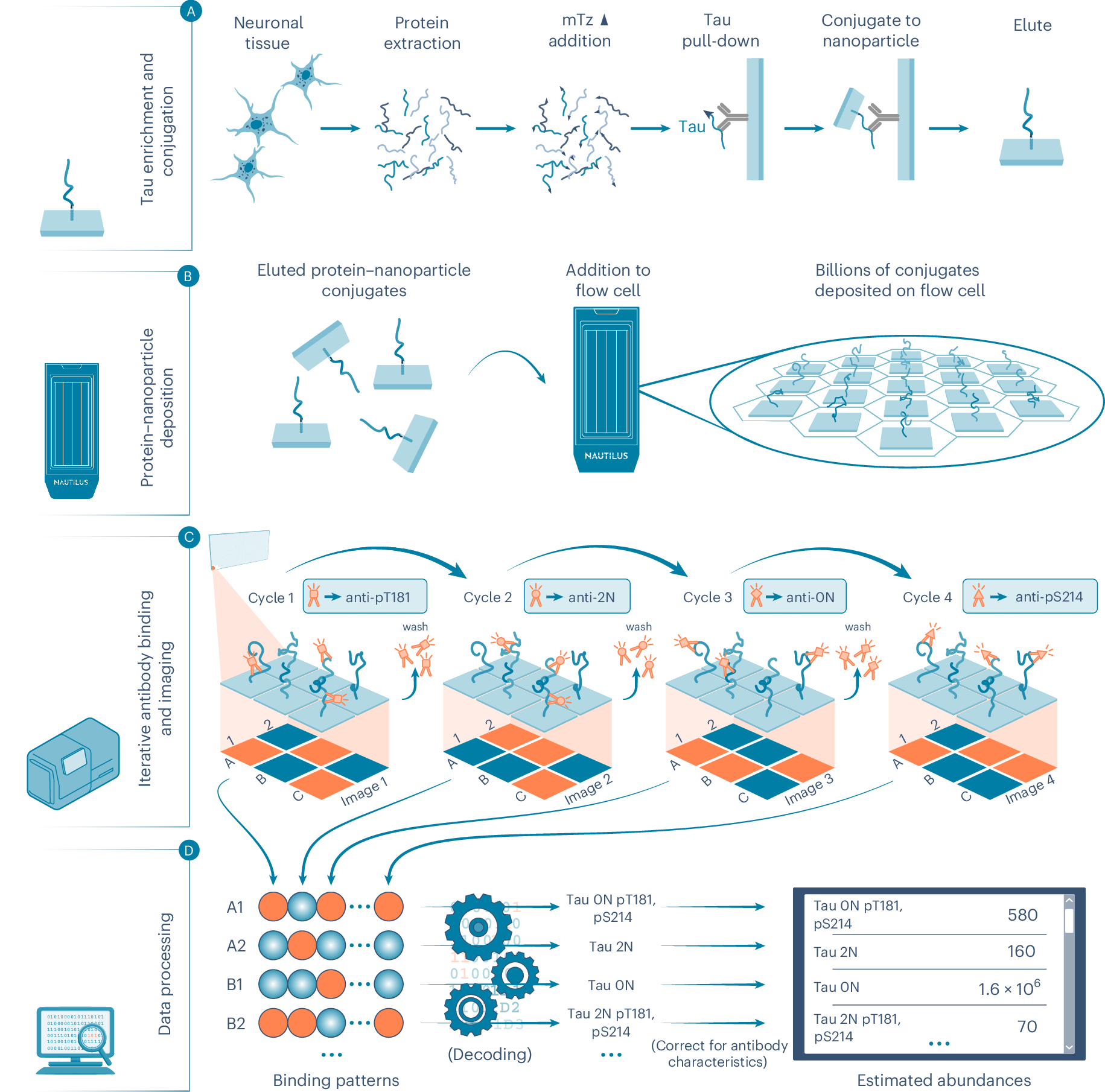
The design earns its result by holding the molecule still. The same single molecules are probed round after round with fluorescently labeled antibodies [1], so what comes out is a per-molecule pattern rather than a population average. That is precisely what bottom-up mass spectrometry surrenders when it digests proteins into peptides: the evidence that two modifications sat on the same chain [10].
Twelve site-specific antibodies [2] read as present or absent define 4,096 possible patterns, which makes the 130 groups reported [8] about three percent of the accessible space [20]. The ratio matters in both directions. Tau's observed combinatorial diversity sits well below its theoretical ceiling, and that ceiling is set by the panel rather than by tau: modifications outside those twelve epitopes fall outside the census entirely. Top-down mass spectrometry, which keeps proteins intact, retains the one thing an antibody panel cannot offer, the ability to find modifications nobody thought to probe for [14]. There is also still no comprehensive reference database of human proteoforms to check assignments against [13].
The sensitivity figure is what makes frequency arguments possible. A proteoform at 0.1 percent abundance [3] turns up roughly a thousand times in a million-molecule readout [21], enough to compare how often combinations occur rather than merely note that they exist. A median coefficient of variation below 5.5 percent [4] is precision across replicates, and it says nothing about whether each antibody bound the site it is named for. That dependency has history: the commentary accompanying the paper, by Albert Heck, lists the 2011 assessment of histone-modification antibody quality among its references [16][17].
The ordering result is the interesting science, and it carries a condition. A non-random distribution of phosphorylation events across proteoform groups [9] is what ordered, site-specific modification would produce, and the paper places the order and timing of modification among the field's open questions [15]. The census captures a single moment, leaving the sequence in time unresolved. Combination frequencies also depend on how long each proteoform persists before degradation and on which cells contributed molecules to the sample. A snapshot in which AB and ABC are common while AC is rare fits ordered writing, and it fits faster clearance of molecules carrying C. A time course would separate those.
Read as a neurodegeneration assay rather than a methods advance, the picture is narrower. Human Alzheimer's material was analysed alongside organoids and mouse brain [7], and the authors report the assay resolving closely related proteoform groups better than conventional techniques [6], which is the specific weakness of bulk phospho-tau measurement. The reported figures show analytical performance and a group count, not donor-level discrimination between cases and controls [22]. The same commentary cites recent mass spectrometry work on the tau proteoform landscape of human brain and on molecular features that distinguish tauopathy-associated dementias [19], which is the literature any disease-level claim from this assay will have to be measured against.
Ranked by verification strength, evidence, and original report placement.
Iterative Mapping of proteoforms enables massively parallel interrogation of millions to billions of single-protein molecules through iterative probing with fluorescently labeled antibodies.
The authors applied Iterative Mapping to tau using 12 site-specific antibodies.
The nonrandom distribution of the phosphorylation events suggests ordered and site-specific modification processes rather than random, stochastic accumulation, according to the authors.
The tau proteoform assay detects proteoforms at 0.1% abundance.
The assay showed high reproducibility, with a median coefficient of variation below 5.5%.
The assay has a broad dynamic range spanning more than three orders of magnitude.
Distinct publishers with included, body-backed reporting in this cluster.
2 articles · September 3, 2026
Follow any of these and your For You feed starts watching them — no settings page required.
Evidence-backed comparisons of source perspectives and observed adoption signals. Read the methodology
Which Builder, Operator, and Investor concerns the observed source mix emphasized—not a truth score.
Evidence, demonstrated adoption, hype gap, incentives, and confidence are assessed independently, each on its own current evidence. How these are measured.
Peer-reviewed primary, one address
Every figure that matters — the 0.1% floor, median variation under 5.5%, 130 proteoform groups, six phosphorylations on one molecule — comes from a single Nature Methods abstract written by the people who built the assay. Heck's commentary is a real second voice, but he reads the paper rather than re-running it, and the part of his argument that would weigh the antibody panel is paywalled. The paper's own text available to us stops partway through the introduction, before any validation detail.
One paper, one issue, no second lab
Iterative Mapping exists in exactly two documents, both published the same day in the same journal, one of them commentary on the other. No other group has run it, nothing is described as shipping, and the tau panel's twelve antibodies are the developers' own choice. Methods usually wait years for the second laboratory; this one is days old.
'Ordered' carries more than the data
The authors' verb is careful — non-random distribution 'suggests' ordered modification — but a census taken at one moment can establish that patterns are non-random without establishing which mark landed first, and the same paper lists the order and timing of modification among its unanswered questions. The arithmetic tightens the point: twelve binary readouts allow 4,096 patterns, and 130 groups is about 3% of them, a solid result described in language that invites a bigger one. Nature's own 'the good, the bad and the ugly' framing pulls the same way.
The builders keep the scorecard
Sensitivity, reproducibility, dynamic range and the claim of outperforming 'conventional techniques' are all scored by the team whose method benefits, and the comparison set is their own choosing. The only disclosure a reader can actually see belongs to the commentator: Heck names Dutch NWO Spinoza and Roadmap support and declares no competing interests. Whatever the paper's authors declare lies past the point where the text we have cuts off. Nature's paywall notice sits in the middle of the commentary, which is its own small reminder of who controls access to the argument.
Specific enough to check later, not now
The claims are unusually precise and pinned to a named journal, volume and page range, which makes them easy to verify in a year and impossible to verify today. Both documents come from nature.com, so a reader gets the developers' account and a colleague's reaction — and nothing from anyone with an interest in a different answer.