Science1 publisher3 min readPublished
The fight over data center water is argued in milliliters per query, while the most cited US projection says the deciding variables are which plant fills the power contract and which basin the campus sits in.
The Scientist · Science desk

Compiled by The ScientistSomething wrong?How this is made
A gas or coal plant condenses its steam back into liquid with water, after that steam has spun the turbine [6]. That withdrawal happens wherever the electrons were made, which can be a different county and a different basin from the one the campus sits in, and no meter at the data center fence records it. Solar and wind need little to no water to run [7], so changing supply subtracts from the total rather than trimming it.
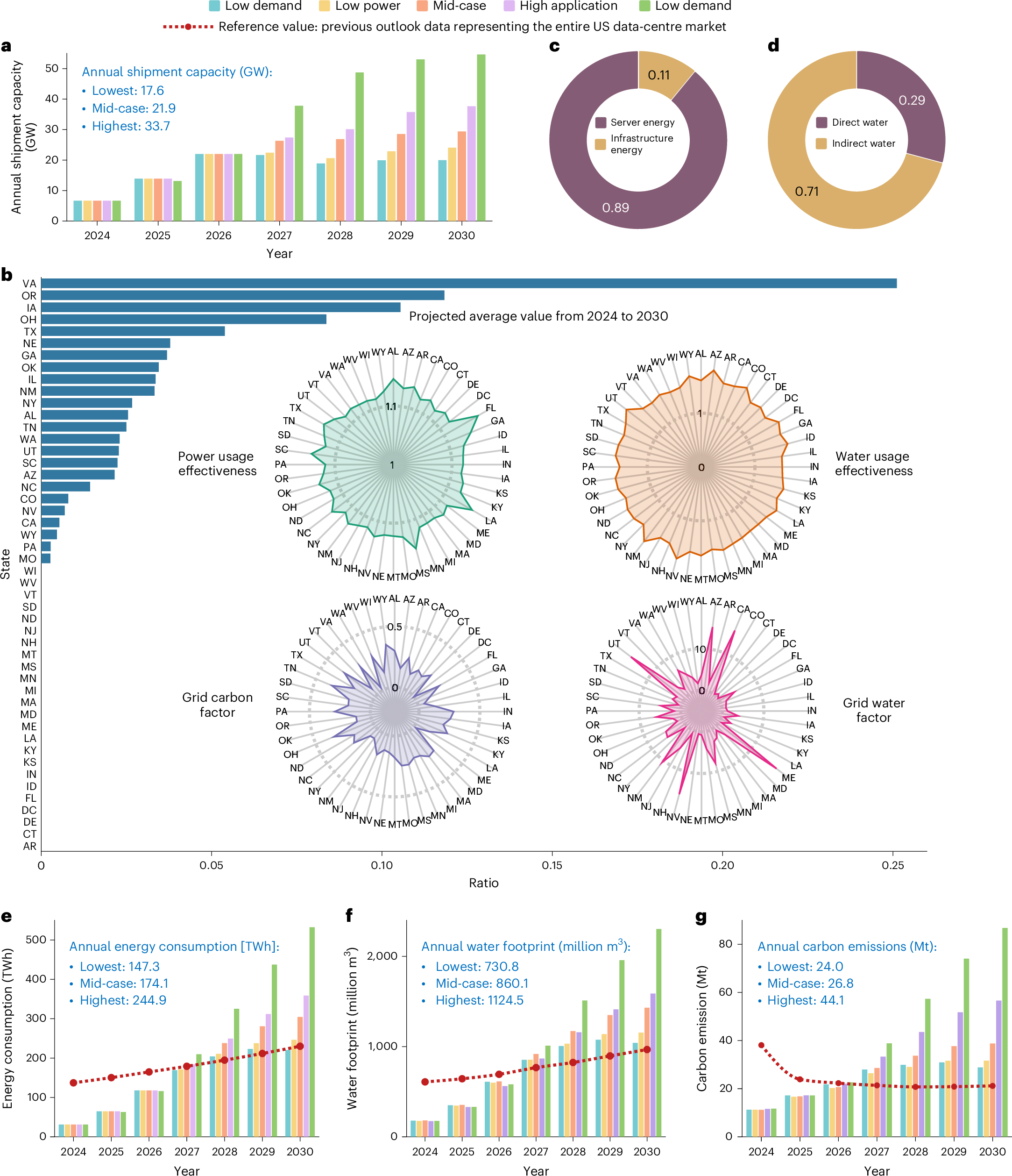
In the Cornell group's accounting the generation term is the larger one. Their 2030 range of 731 billion to 1,125 billion liters a year covers cooling plus a greater volume spent generating the power [4][5], which puts more than half of the projected footprint outside the fence [4]. Cooling design is improving on its own terms in the meantime: the newest AI-specific facilities use less water than the older generation that pushed warm water to a tower and lost some of it to the air [15].
The width of that range deserves attention. It spans 394 billion liters [1], roughly six times the 66 billion liters attributed to cooling systems in 2023 [3][2]. The pair also does not yield a growth multiple, because the 2023 number counts cooling alone [3] and the 2030 number counts cooling and generation together [5]. Applying You's 86 percent reduction to the top of his own range [9] leaves about 158 billion liters a year [3].
The per-query figures are not measuring the same thing as one another. Shaolei Ren's half-liter came from GPT-4 and described drafting a short email, and he says it is now outdated because models became more efficient [10]; Google's 2025 estimate of five drops describes a median-length Gemini query [11]. Neither says which watershed paid. That is also how a national share under 1 percent [3] coexists with real local scarcity: the same buildout is unremarkable where water is plentiful and material in drought-strapped New Mexico or Arizona [14]. For scale, the researchers quoted by Live Science note that data center water use is small next to agriculture and some kinds of manufacturing [18].
The optimistic numbers carry conditions. The 86 percent is a modeling result covering siting together with other measures [9], not a measured outcome at a site, and Fengqi You's net-zero remark applies to on-site cooling [16], the smaller share by his group's own arithmetic [4]. Operators cannot settle the question either, since their water disclosures are often incomplete and inconsistent [12]. Which leaves whether a campus that would otherwise go to Arizona instead goes to Nebraska or South Dakota [8], and whether it buys wind or gas: those two decisions move more liters than any cooling retrofit.
Ranked by verification strength, evidence, and original report placement.
Locals across the United States are increasingly protesting the rapid expansion of data centers, angered by water use, energy consumption and pollution, with protest signs appearing from Texas to New Mexico to Arizona.
Researchers have estimated that data center cooling systems consumed 66 billion liters of water in 2023, less than 1 percent of total US water consumption.
The group of energy systems expert Fengqi You at Cornell University predicted that by 2030 US data centers could consume 731 billion to 1,125 billion liters annually, the upper figure roughly equivalent to New York City's annual drinking water supply.
Those 2030 figures factor in not just cooling but also a greater amount of water used to generate the electricity that powers data centers.
Much of the electricity powering data centers comes from burning coal or gas, where water is used to cool steam back into liquid after it has spun the electricity-generating turbines.
Fengqi You says AI's water consumption can be significantly reduced by shifting to solar and wind, which require little to no water to operate.
Follow any of these and your For You feed starts watching them — no settings page required.
Evidence-backed comparisons of source perspectives and observed adoption signals. Read the methodology
Which Builder, Operator, and Investor concerns the observed source mix emphasized—not a truth score.
Evidence, demonstrated adoption, hype gap, incentives, and confidence are assessed independently, each on its own current evidence. How these are measured.
Named experts, unlinked numbers
Every quantitative anchor comes with a name on it: You for the 2030 range, Ren for the retired half-liter estimate, Bahadur for the Texas share. None arrives with a paper a reader can open, and Live Science itself notes that company water reporting is patchy, which is the same data the academic estimates have to lean on. The mechanism claims about evaporative and closed-loop cooling are the sturdiest part.
Efficiency deployed, siting still advisory
The efficiency half of the story is already happening: liquid cooling is in use at Amazon, Microsoft and Google, and Texas operators treat misting as a summer measure. The siting half is a recommendation. No company in this reporting has moved a campus out of a stressed basin, and Google's Gemini figure is the sole number an operator has put on the record.
One number retired, another inherited
Live Science does the unglamorous work of killing the 500-milliliter-per-query claim at its source, then hands the headline to a projection whose own range is 394 billion liters wide and to an 86 percent savings figure with no method behind it. The New York City drinking water comparison will travel much further than the assumptions that produced it, and even an 86 percent cut off the high case leaves roughly 158 billion liters a year.
Researchers advocate, Google self-reports
The mitigation agenda is voiced by researchers whose work is that agenda, and the friendliest per-query number in the piece is Google's own accounting of its own chatbot. Live Science has no stake in the buildout, which shows in how quickly the framing moves from the protest signs it opens with to the engineers who say the problem is tractable.
Internally consistent, externally unchecked
This account holds together internally: its central structural point, that generation water outweighs cooling water, is stated plainly by the source of the projection. That coherence rests on a single publisher, no primary documents, and a 2030 forecast whose spread is larger than the sector's entire current cooling footprint.
product
Cherokee Nation bans hyperscale data centers, adding a jurisdiction incentives cannot buy2 publishers
product
Thailand halts construction on 49 data centres pending new oversight rules1 publisher
invest
Nvidia's August 26 print: 92% of the quarter rides on one segment1 publisher
security
Passkey enrollment becomes a persistence trick: $10,000 kit outlives the password reset3 publishers
Publishers with included, body-backed reporting in this cluster.
1 article · September 6, 2026