Science1 publisher3 min readPublished
Young white men reported the strongest support for white nationalism in three national surveys
Political scientists at NYU and Vanderbilt described the movement's tenets to more than 7,800 white US adults and then asked directly whether they supported it. The age pattern runs against the usual finding on racial attitudes.
The Scientist · Science desk
What happened
- Political scientists at NYU and Vanderbilt report in Nature the first study to document the demographic, economic and behavioural correlates of explicit support for white nationalism among white Americans.
- Support also ran higher among white respondents with less education and lower incomes, those who were more religious, and among white Republicans, conservatives and the politically disaffected.
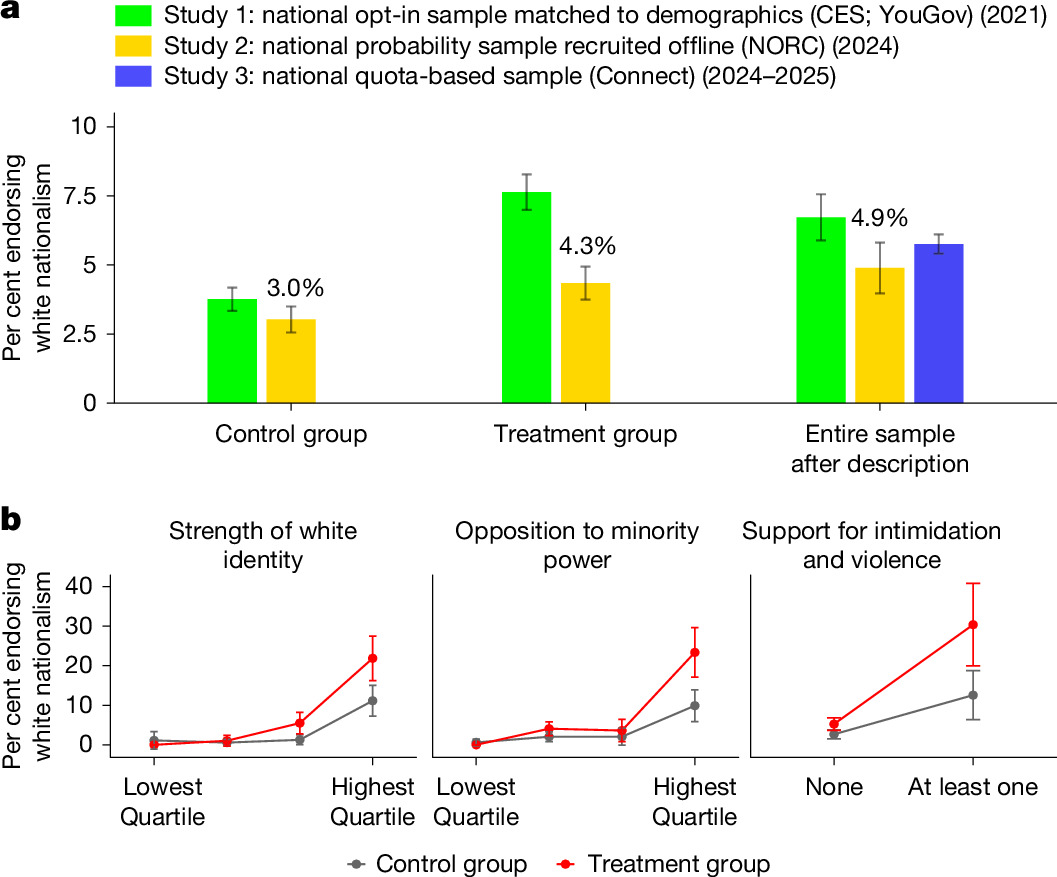
- The measure came from three surveys of non-Hispanic white US adults in 2021, 2024 and 2024-25, in which respondents read a short description of the movement's tenets before being asked directly if they supported it.
Compiled by The ScientistSomething wrong?How this is made
Why it matters
- capability A movement too new for reliable name recognition can now be polled at national scale: describe its tenets, ask the direct question, then validate the answers against existing racial-attitude scales.
- constraint Because affiliation was never measured, none of these associations can be read as a headcount of people inside organisations, and nothing in the design shows an endorsing respondent ever acts on the belief.
- contradiction Anyone modelling racial attitudes as a one-way generational trend now has a result pointing the other way for this belief set, and has to carry a separate term for it.
- decision For researchers choosing what to collect next, the variable that looks worth measuring here is the composition of a person's closest friendships.
Respondents were asked to think about their three closest friends and to say whether they knew each one primarily online or offline. Endorsement of white nationalist ideas was much more prevalent among those who put two or three of the three in the online column [9]. How often someone used social media had no relationship to support at all [8]. "More frequent social media use was not correlated with higher support for white nationalist ideas," said Joshua A. Tucker, an NYU professor and co-director of the Center for Social Media, AI, and Politics, where all the authors are affiliated [11][18].
Tucker offered a reading of the pattern. "One implication of this finding is that online activity may be especially consequential for people who are socially isolated offline, perhaps making it more important to adopt views aligned with their online communities," he said [10]. Each survey was a single snapshot, so the opposite path fits the same data. A person who already holds these views has reason to spend time in communities where they are welcome, and to let offline friendships thin out.
The age result is the one that inverts a familiar finding. Support was higher among young white men than among any other group in the white population the researchers measured [2]. "Young people typically have more liberal views on racial matters, but the opposite is true for white nationalist beliefs among young white men," said Patrick Egan, the NYU professor who led the paper [3]. He added: "Young men have long been prime targets for hard-line messages across the political spectrum. Time will tell if white nationalism's appeal holds for this generation of young white men as they grow older" [4]. The three waves sit about four years apart [22]. That gap is too short to tell a cohort pattern from a life-cycle one.
Hardship predicted support too, personal and local [6]. "We found backing for white nationalism was stronger in areas with higher rates of poverty and unemployment, and for those experiencing personal difficulties like health problems and the loss of loved ones," said James Bisbee, an assistant professor of political science at Vanderbilt and one of the authors [7].
Participants read a short description of the movement's core tenets, as those tenets are commonly invoked by self-described white nationalists, and were then asked directly whether they supported the movement [13]. What that yields is agreement with described content, measured without relying on respondents recognising a label. Expressed support is a different thing from organizational affiliation, and affiliation went unmeasured [14]. The authors checked the measure against established constructs of racial attitudes from political science, psychology and sociology [15], and ran survey experiments to rule out question wording, inattentive respondents, acquiescence and priming from where the questions fell in the instrument [16]. Nearly all responses came in through confidential online surveys, which the authors say reduces the concern that people hid their real attitudes [17].
More than 7,800 non-Hispanic white adults answered across the three surveys, an average above 2,600 a wave [12][19]. The estimates for young white men come out of a slice of that. The university announcement did not disclose the share of respondents who said they supported the movement, or how wide the gap between age groups was [20].
What to watch
- Whether an independent team reproduces the online-friendship association using a different way of eliciting who a respondent's closest friends are.
- Any follow-up that re-interviews the same respondents as they age, which is the design that would separate a cohort pattern from a life-cycle one.
- Whether the full Nature paper reports how the endorsement rate moved between the 2021 wave and the 2024-25 wave.