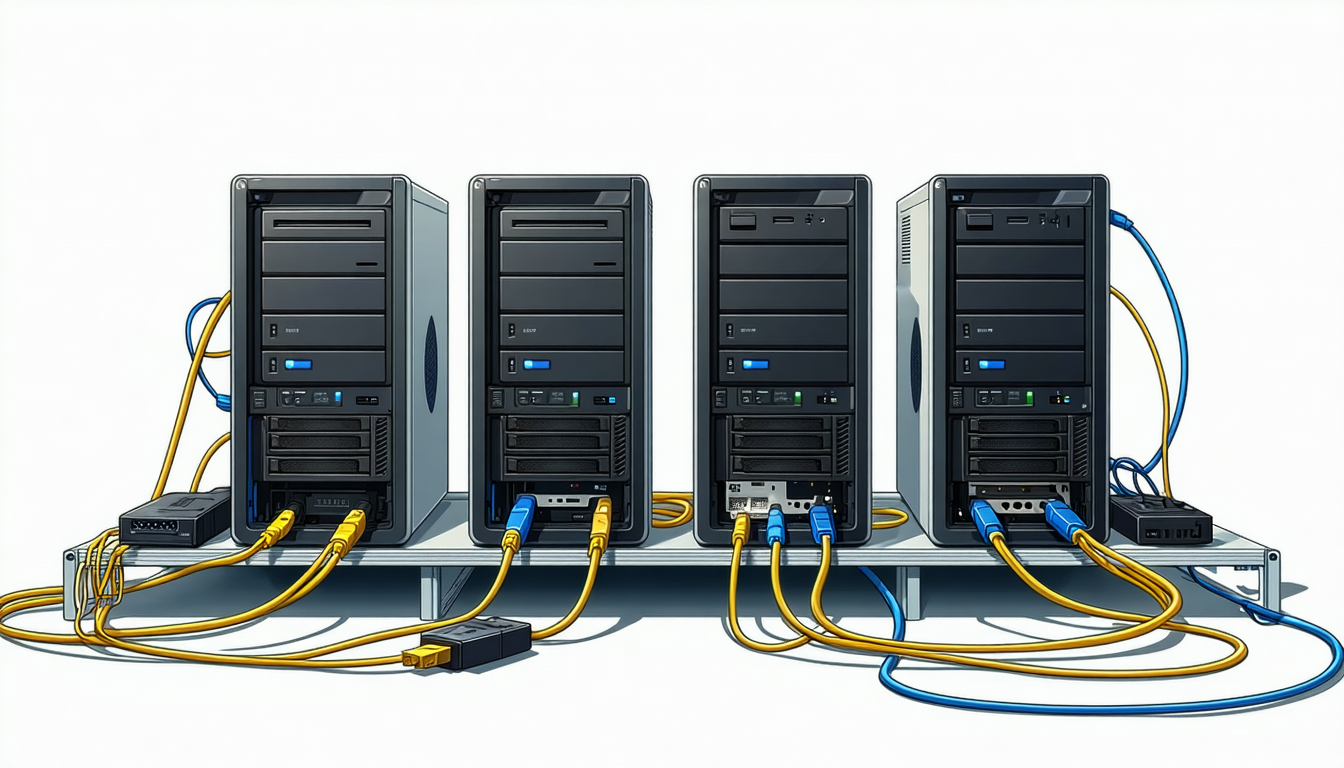
NVIDIA PAIR schedules each subagent call onto whichever LAN box already holds the model
PAIR proxies Ollama and LM Studio, so the agent keeps seeing one connection and no harness code changes. The adoption cost moves to disk, because a node is only eligible if it already has the exact model downloaded.
The Engineer · Build desk
What happened
- NVIDIA launched the Personal AI Router on Thursday, an open source software router for the home network that puts idle Macs and PCs to work running small models for agent workloads.
- PAIR sends each independent inference request to an available machine on the network and speaks the existing Ollama and LM Studio interfaces, so the agent harness needs no changes.
- Each request is assigned to exactly one eligible node and stays there for its lifetime, and Nvidia says PAIR neither merges GPUs nor splits a single request across machines.
Why it matters
- What it costs cost Widening the pool costs another full copy of the weights on each machine you want eligible, so the limit is set by the least-provisioned disk rather than by the number of GPUs in the house.
- What it limits constraint Throughput for fan-out workloads improves, but a model that does not fit on one machine stays out of reach, so this does not substitute for buying a bigger card.
- Who has to decide decision The choice this forces is operational rather than architectural: which machines you agree to keep powered, loaded and reachable, because a laptop that sleeps is a node that has left the pool.
- Who's exposed exposure Keeping prompts and inference traffic local puts the trust boundary on the LAN, where every paired machine now accepts routed requests carrying that data.
Next story · Build · yesterday
Muse Spark Open's license asks hosted-model sellers above $20M in revenue for a written deal with MetaConfirmed13 publishers
The 1.6x is the only performance number in the announcement, and it describes NVIDIA's workload. Five subagent requests, two nodes, the Qwen3.6 35B A3B model on a pair of RTX 5090 machines with 32 GB [23]. Because a request is assigned to one node and stays there for its lifetime [1], the placement problem is list scheduling. If the five calls cost roughly the same and the single-node baseline runs them one after another, the best possible split is three on one machine and two on the other: makespan falls from five units to three, which is 1.67x [18]. Measured result, about 1.6x [23]. That is roughly 96 percent of the bound the topology allows [19], which is a well-behaved scheduler.
The same arithmetic caps the upside. A third machine with that model on disk would take the makespan to two units, or 2.5x [20], and a fourth buys nothing at five requests. For the number to transfer, four things have to hold: the subagent calls are independent and similar in cost, there are more of them than nodes, every candidate node already has the exact model, and nobody has reclaimed the GPU for something interactive.
The third condition is the one with a price tag. PAIR routes only to a machine with the required engine enabled and the exact requested model available, and installing the same model on several machines is what gives the router options [8]. Eligibility is therefore a function of disk, not of idle silicon. It also does not pool VRAM or merge GPUs [2], so a model too large for any single node is still too large.
The design decision worth praising is the proxy. Rather than publishing a cluster API and asking every harness to integrate, PAIR sits behind the Ollama and LM Studio interfaces the agent already speaks, identifies the engine and model requirements, and picks a node while the caller keeps seeing one connection [5][7]. The New Stack frames the target as agents like NemoClaw, OpenClaw and Hermes running more subagents in parallel [16]. The supported pool is broad: GeForce RTX 20 Series and newer, RTX PRO workstation GPUs from Turing on, DGX Spark, and Apple M4 or newer silicon [9].
Home hardware is the awkward part, and NVIDIA says so. Nodes join when ready and drop away when they power down or hibernate [14], and when a user reclaims a GPU the local inference engine is stopped [11]. What neither writeup states is what happens to a request already executing on a node that leaves. Given that placement is for the request's lifetime, that is the first thing I would test.
One more figure, from The New Stack rather than NVIDIA: an RTX 5090 currently goes for about $5,000 against a $2,000 initial MSRP [21]. The reference configuration for a feature about using hardware you already own therefore holds roughly $10,000 of GPU [22].
What to watch
- Whether NVIDIA documents what happens to a request already executing on a node that hibernates or has its GPU reclaimed.
- Numbers from a mixed pool of Macs and a gaming PC rather than two RTX 5090 machines, which is the configuration The New Stack says most readers will actually assemble.
- RTX Spark PCs and laptops arriving later this year, which changes what a typical eligible pool looks like.
Clarity's read
What the record supports and how the coverage leans. The claims behind it follow.
Reality
- Evidence62
- Adoption
- Not scored
- Hype gap+30
- Incentives72
- Confidence60
Perspective Coverage
7 publishers- Builder
- Builder 45%
- Operator
- Operator 38%
- Investor
- Investor 17%
Claim ledger
Ranked by verification strength, evidence, and original report placement.
- [1]
This is workload-level concurrency: PAIR does not make one inference request run across several GPUs, and every request is assigned to one eligible node and remains there for its lifetime.
- [2]
Nvidia stresses that PAIR does not merge GPUs or pool VRAM into a single accelerator and cannot split a single inference request across machines.
- [3]
On Thursday, Nvidia launched the Nvidia Personal AI Router (PAIR), an open source software router for the home network that lets idle Macs and PCs run small models on demand and speed up agentic workflows with subagents.
- [4]
The NVIDIA PAIR beta is available for supported Windows, macOS, and Linux systems through graphical and terminal interfaces.
- [5]
PAIR routes each independent inference request to an available system on the home network and works with familiar local inference services including Ollama and LM Studio, so no agent harness changes are necessary.
- [6]
PAIR discovers local systems with mDNS, pairs supported devices, tracks whether each system is ready for a request, schedules independent jobs, and returns each response to the originating application.
- [7]
PAIR receives the request through its proxy, identifies its engine and model requirements, and selects one eligible node; that node executes the request from start to finish and sends the response back through PAIR, while the agent continues to see one connection.
- [8]
Each system can host different models, but PAIR will only route a request to a machine with the required engine enabled and the exact requested model available; installing the same model on several machines gives the router more options for distributing concurrent requests.
- [9]
PAIR supports compatible systems with NVIDIA GeForce RTX 20 Series GPUs and newer, NVIDIA RTX PRO workstation GPUs (Turing architecture and newer), NVIDIA DGX Spark, and Apple M4+ silicon.
- [10]
The New Stack reports that RTX Spark PCs and laptops will also qualify once they are available later this year.
- [11]
PAIR keeps track of which computers are available, and once a user returns to work or gaming on a machine and reclaims the GPU, the local inference engine is stopped.
- [12]
Getting started requires installing PAIR on every machine, having it discover and pair those systems, and having Ollama or LM Studio installed with models downloaded; PAIR can also install those engines and initiate model downloads on paired machines.
- [13]
PAIR is designed to keep prompts, data, and inference traffic on the user's existing local network, and pairs supported devices on the private network.
- [14]
Elastic clients: compatible systems can contribute capacity when available and drop away when needed, such as powering down or hibernating.
- [15]
PAIR is not a new inference engine; Ollama or LM Studio still runs the model on the selected machine.
- [16]
The New Stack reports PAIR is meant to speed up agents like NemoClaw, OpenClaw or Hermes by allowing them to use more subagents in parallel.
- [17]
NVIDIA says the breadth-first multi-agent approach can improve task completion speed and response quality but can also bottleneck the system as many requests are sent to the GPU simultaneously.
- [18]
With five equal-cost requests, two nodes, and each request pinned to one node, the best achievable makespan is three request-units against five run serially, a 1.67x speedup ceiling.
- [19]
The reported 1.6x is about 96 percent of the 1.67x ceiling for five equal jobs on two nodes.
- [20]
A third node holding the same model would cut the makespan for five equal requests to two units, a 2.5x ceiling.
- [21]
The New Stack notes the RTX 5090 carries a roughly $5,000 price tag at present, despite its initial $2,000 MSRP.
- [22]
Two RTX 5090 cards at The New Stack's cited current price come to about $10,000 of GPU in NVIDIA's example configuration.
- [23]
In Nvidia's example, using PAIR with two PCs running RTX 5090 GPUs with 32 GB and the Qwen3.6 35B A3B model sped up work with five subagents by about 1.6x.
Sources
5 independent publishers whose own reporting we read for this story.
- dev.toNvidia PAIR enables local AI cluster construction
1 article · September 5, 2026
- developer.nvidia.comNVIDIA PAIR Virtual Inference Router Expands Available Compute on Your Local Network
2 articles · September 3, 2026
- Personal AI Router for Local Inference | NVIDIA PAIR
nvidia.com
1 article · September 3, 2026
- runtimewire.comNVIDIA PAIR turns spare PCs into a local AI inference cluster
1 article · September 3, 2026
- the-decoder.comNvidia wants your home network to work like a mini data center for local AI
2 articles · September 4, 2026
- thenewstack.ioNvidia PAIR lets you put your idle Macs and PCs to work for AI agents
2 articles · September 3, 2026
- tomshardware.comNvidia PAIR utility joins every GPU in your home into a cluster for agentic AI tasks — tool uses spare cycles to keep agent swarms from hammering one GPU
1 article · September 3, 2026
Topics and entities
Topics
- AI Agents
- Local AI Inference
- Distributed inference
Entities
- Qwen3.6 35B-A3B
- Nvidia
- Ollama
- LM Studio
- GeForce RTX 5090
- Hugging Face
- NVIDIA DGX Spark
- NVIDIA Personal AI Router (PAIR)