Product1 publisher3 min readPublished
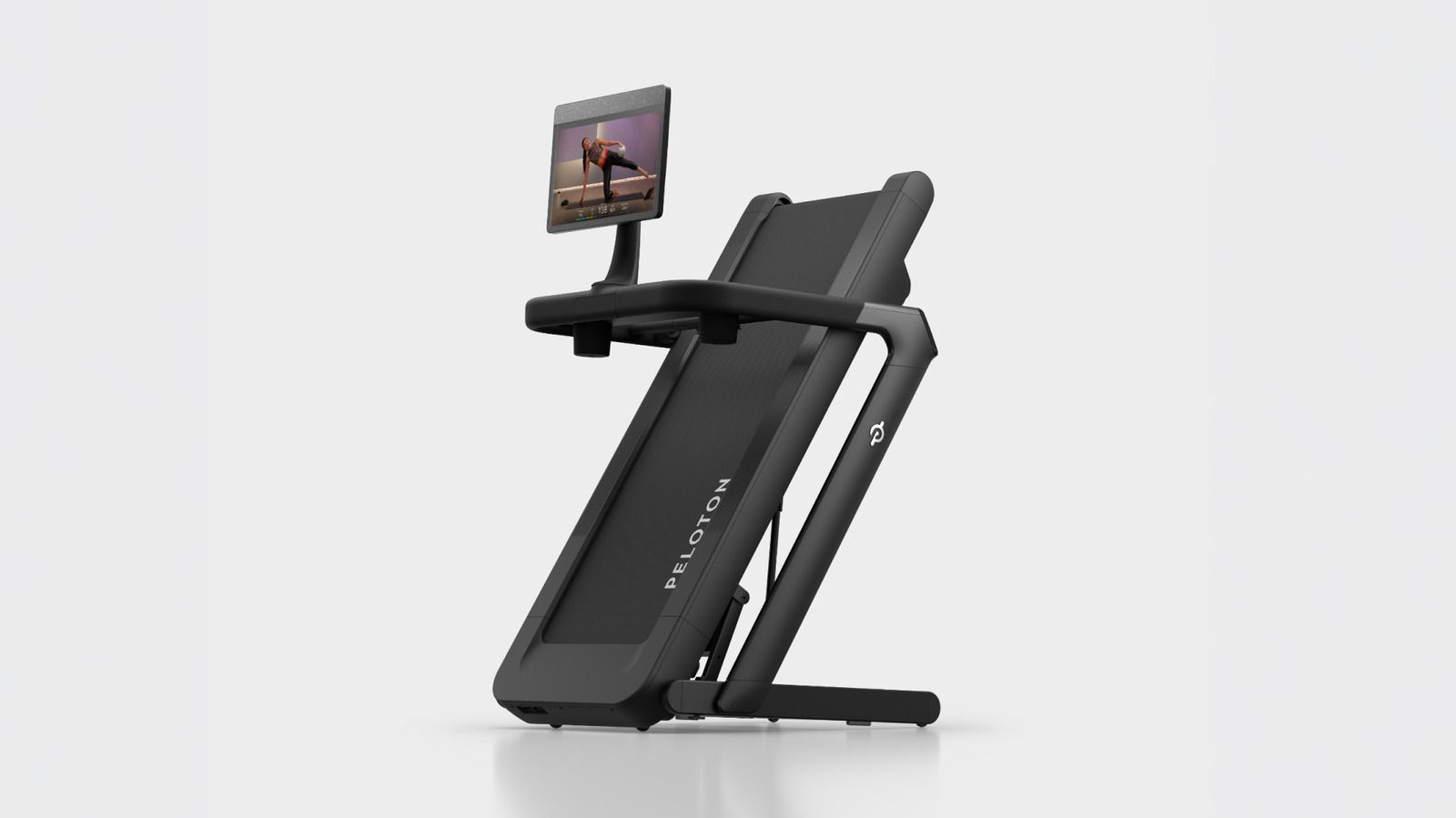
Peloton folds its cheapest treadmill into half the floor space at $2,195
The $2,195 Tread Flex stands upright on wheels in about half the footprint of Peloton's other treadmills. It undercuts the roughly $4,000 debut Tread by about 45 percent. The camera that grades running form stays on the dearer models.
The Product Desk · Product desk
What happened
- Peloton's fall 2026 treadmill line has three models at three prices: the $2,195 Tread Flex, the $3,495 Tread Vision and the $6,695 Tread+ Vision.
- The Tread Flex is the first Peloton treadmill that folds, standing vertically in roughly half the footprint of the company's other machines and rolling on wheels so it can be repositioned.
- It is also the cheapest treadmill Peloton has sold, coming in about 45 percent below the roughly $4,000 debut Tread of more than eight years ago in nominal dollars.
- The Flex has no camera, so Peloton's new computer-vision run analysis stays on the pricier models, though the Flex keeps Peloton IQ pace targets and Zone 2 heart-rate training.
- Peloton has not said how big the Flex screen is, only that it pivots and is smaller than the 23.8-inch display on the two Vision treadmills.
Compiled by The Product DeskSomething wrong?How this is made
Why it matters
- constraint A buyer who needs the treadmill to fold away cannot get form scoring at any price in this line, because Peloton has not put its camera on a folding deck.
- cost The ladder charges $1,300 to move up to the camera, the bigger screen, the fan, the phone tray and the jump buttons, and another $3,200 on top of that for the slat belt and Sled Mode.
- decision Anyone judging the Flex inside a return window is judging hardware, since the software needs ten logged runs before its pace targets adapt to the person using it.
- exposure The folding machine is aimed at rooms with neighbours on the other side of the wall, and the sound figure Peloton offers them is 70 dB at 12.5 mph with nobody on the belt.
Peloton says the Tread Flex has a two-step release that lowers the running deck gradually, and a locking pin that stops it falling open while it is stored upright [4]. Those are details for somebody who parks a treadmill against a wall in a room used for other things. It rolls on wheels so it can be moved and repositioned [3].
Against the debut Tread, which Engadget puts at around $4,000 more than eight years ago [7], the Flex is $1,805 cheaper, about 45 percent lower in nominal dollars [1]. The report compares the two prices without adjusting for inflation, so the real gap is wider. Top to bottom, the 2026 treadmill line spans a factor of about three [4].
The camera is the dividing line. The Flex ships without one [12]. On the Tread Vision, Peloton's first computer-vision treadmill, the camera gauges running form, gives post-run feedback and places cues at the start of the next run [17]. It tracks vertical oscillation, cadence and stride length to produce an efficiency score [18]. Peloton told Engadget the team worked with a biomechanics group that specializes in running and injury prevention to develop the run analysis [19]. The same feature is also coming to the existing Cross-Training Tread+, which already has a camera [20].
The Flex keeps Peloton IQ, with training scheduling, feedback and coaching, pace targets on a one to ten scale, and heart-rate zone work including Zone 2 [13], which Engadget reports was one of the top requests from Peloton's user base [14]. The pace targets are not there on day one. IQ has to monitor 10 running workouts before it recommends a custom pace range [15], so someone running three times a week waits more than three weeks for the software to adjust to them [5]. There is also ReRuns, which maps a run recorded in Peloton's app or on an Apple Watch onto the Tread and mimics the elevation [16].
Engadget's writer points out that the person running is where most of a home treadmill's noise comes from [9]. Peloton did not have the Flex on display at IFA in Berlin, where Engadget saw the Tread Vision in person [23], so nobody outside the company has stood next to one at speed.
The decision has two axes: whether the machine has to fold away between sessions, and whether the coaching has to see you move. The Flex covers the first [3] and the Vision models cover the second [17]. No model in this line does both, so the buyer in a one-bedroom who wants form scoring gives up either the floor space or the score.
Peloton kept selling to serious runners while it cut the entry price. The $6,695 Tread+ Vision has a slat-belt deck and a ball-bearing system, and it is the only model that offers Sled Mode [22]. Engadget's report does not include sales, subscriber or product-mix figures, so the $2,195 tag shows where Peloton set its floor for a treadmill this year and not what happened to demand at the top.
What to watch
- Whether Peloton confirms the Tread Flex screen size that Engadget says it has asked about.
- A measured decibel reading taken with a runner on the Flex belt, and how the fold mechanism holds up to daily use.
- Whether Peloton ever puts a camera on a folding deck, or keeps run analysis as the reason to pay $3,495.