Science1 distinct publisher2 min readPublished
Injecting CO2-rich water into Western Australia's iron-rich basement could make hydrogen and mineralise carbon in the same rock, but CSIRO's geochemical modelling finds the hottest conditions favour the gas over the storage.
The Scientist · Science desk

Compiled by The ScientistSomething wrong?How this is made
Temperature controls two separate outcomes here, and they move in opposite directions. Higher temperature speeds the oxidation of iron that frees hydrogen, so gas yield keeps rising with the thermometer [7]. Temperature also decides which minerals form, and the mineral assemblage is what determines whether dissolved CO2 ends up as a stable carbonate [8]. That is why the modelled storage optimum lands in a band of roughly 150 C to 200 C, only fifty degrees wide [9][19], while hydrogen keeps improving above it [10].
In the model, temperature, salinity and pH are three independent inputs [6]. A formation supplies them as one package, and the package is not adjustable. The fluid the model likes for hydrogen is low in salinity [11] and alkaline [12]. Whether any drillable interval of the Yilgarn Craton, one of Australia's oldest and best-preserved geological blocks [15], offers that alongside 150 C to 200 C is a question for a borehole rather than a solver.
The reported results are qualitative rather than quantitative: they show direction, not amount, for either product. The only quantities in the reported results are temperatures; salinity and pH arrive as directions, more or less, with no hydrogen yield per volume of rock, no injection rate and no cost [20]. CSIRO's Regina Sander, an experimental reservoir engineer and techno-economic modeller, calls the dual benefit a potential one, and says plainly that the conditions maximising hydrogen are not always the conditions maximising carbon storage [13][14].
The valuation argument survives that, in a weaker form. Large areas of the Australian continent contain the rock types these reactions need [17], and the Yilgarn's mafic-ultramafic units come out of the modelling with strong potential for orange hydrogen [18]. The reason to look at ancient basement at all shifts: iron-rich and magnesium-rich crust becomes a candidate reservoir rather than a foundation under the prospective stuff [16], though the arithmetic of a single well stays the same. A first project picks one temperature, and on this modelling the temperature that maximises hydrogen is not the one that maximises stored carbon [10][14], so one of the two products arrives as a by-product of the other.
Ranked by verification strength, evidence, and original report placement.
New CSIRO research published in the International Journal of Hydrogen Energy investigated the potential of orange hydrogen in the Yilgarn Craton, Western Australia.
The research was led by CSIRO Energy Research Scientist Dr Lingping Zeng.
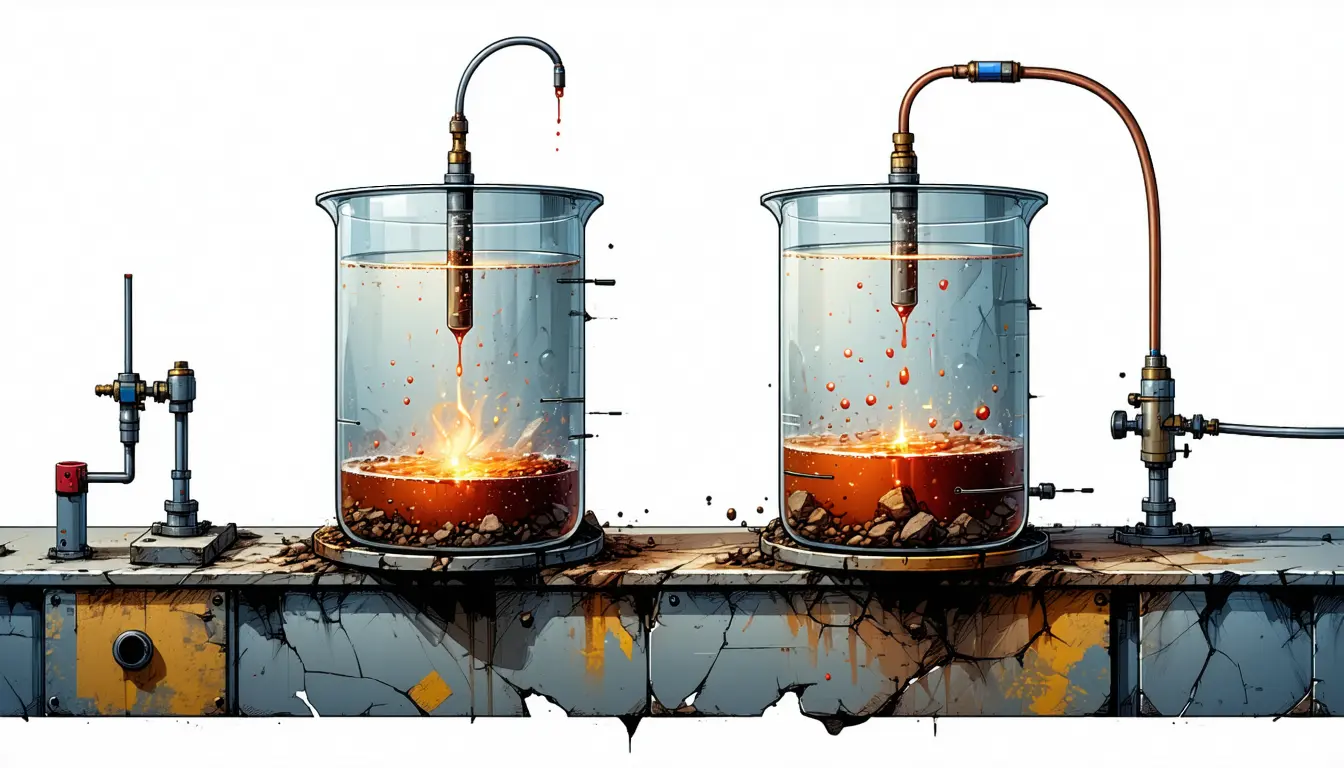
Zeng: orange hydrogen uses the naturally occurring geological process of serpentinization but stimulates it by injecting CO2-saturated water into iron-rich rocks underground; the 'orange' name refers to the oxidised iron involved in the process.
In serpentinization, water interacts with iron-bearing minerals, the iron is oxidised, and hydrogen gas is produced.
CSIRO researchers used advanced geochemical modelling to simulate reactions between underground fluids and mafic-ultramafic rocks within the Yilgarn Craton.
The study examined how temperature, salinity and pH influence both hydrogen production and carbon mineralization.
Distinct publishers with included, body-backed reporting in this cluster.
phys.org
1 article · September 4, 2026
Follow any of these and your For You feed starts watching them — no settings page required.
science
A pole-on magnetar hands vacuum birefringence its first astrophysical candidate1 distinct publisher
science
A 24-day reef voyage co-designed with Traditional Owners maps land that drowned 7,000 years ago1 distinct publisher
science
Hot water pulled hydrogen from Pilbara magnetite across a 60-day pressure test1 distinct publisher
science
A magnetar may have done what no lab can: bend light in apparently empty space1 distinct publisher
Evidence-backed comparisons of source perspectives and observed adoption signals. Read the methodology
Which Builder, Operator, and Investor concerns the observed source mix emphasized—not a truth score.
Evidence, demonstrated adoption, hype gap, incentives, and confidence are assessed independently, each on its own current evidence. How these are measured.
One institutional account, one number
Every fact in this story reaches the reader through CSIRO's own write-up as carried by phys.org. The International Journal of Hydrogen Energy paper is named but never quoted, the two people interpreting the results are the two people who produced them, and the salinity and pH findings arrive as directions rather than values. The chemistry described is textbook serpentinization, a mechanism that stands on solid ground, but the site-specific conclusion about the Yilgarn rests on a model no one outside the agency has looked at.
Still at the modelling stage
CSIRO says plainly that commercial-scale orange hydrogen does not exist in Australia and that laboratory work and field trials are the next step, so there is no pilot, no well and no operator to point at. The only concrete activity in the story belongs to a different technology: Western Australia's planned renewable and hydrogen projects on the craton's northwestern edge, and the depleted gas fields elsewhere in the state that would have to hold what those projects store.
Headline reaches past the model
phys.org asks whether these rocks could help power a low-carbon future; what the work delivers is a geochemical simulation whose one number is a 50-degree temperature window. The gap stays moderate rather than wide because the piece keeps CSIRO's own caution intact, including the admission that hydrogen and carbon storage peak under different conditions and that nothing has been built. A promotional account that reports the finding working against its own pitch is doing part of the checking itself.
The modellers are also the advocates
Both quoted researchers work for the agency whose modelling is the story, and the forward-looking section describes the laboratory and field programme they would themselves conduct next. phys.org contributes no external assessment, so the sense of promise a reader takes away is the institution's own. That is ordinary for research communication, and it is still the reason a second opinion would change how much of this to believe.
Internally consistent, externally untested
The chemistry, the temperature results and the caveats fit together without contradiction, and nothing in the reporting looks stretched, so this is probably a faithful rendering of the paper. Faithful rendering is not verification: it comes from a single publisher relaying a single institution, with no competing model to check it against, and most of the results cannot really be argued with since no underlying values were published in the first place.