Security3 publishers2 min readPublished
OpenAI ties ChatGPT ads to purchase tracking through LiveRamp, Tealium and Hightouch
OpenAI, whose ChatGPT reaches 1.2 billion people a week, is connecting its ads to conversion data from Hightouch, Tealium and LiveRamp. For privacy teams, staff use of the consumer app now sits inside an advertising system built to tie ad views to purchases.
The Watch · Security desk
Drafted by a language model from the sources cited here and checked against its claim ledger before publication. How we use AISend a correction
What happened
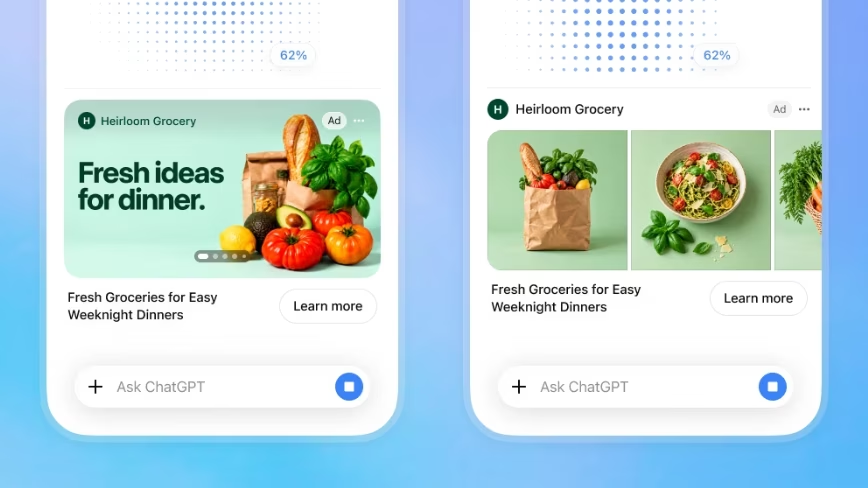
- OpenAI will start testing visual ads during ChatGPT image generation later this month, in the U.S. only, with an initial group of advertisers.
- OpenAI's attribution partners now include AppsFlyer, Adjust, Branch, Triple Whale and Kochava, plus several others the report does not list.
- DoubleVerify and Integral Ad Science are working with OpenAI on brand suitability for ads that appear around conversations.
- OpenAI says the independent partners checking its ad safeguards will not get access to private user conversations.
Compiled by The WatchSomething wrong?How this is made
Why it matters
- exposure Staff using consumer ChatGPT become an ad audience that advertisers can measure against their own purchase data. The app belongs in the same privacy review as other ad-supported services.
- constraint As reported, OpenAI's no-access promise covers only the partners auditing its safeguards. Privacy teams cannot rely on it to clear data flows to the conversion and attribution vendors.
- decision Policy owners have to decide whether consumer ChatGPT falls under ad-tracking rules as well as AI-use rules before ads grow beyond the current U.S. test.
Conversion data tells an advertiser whether a ChatGPT ad led to a purchase or another conversion [10]. Counting only the firms named in the report, ten outside companies now work on ChatGPT advertising: three for conversion data, five for attribution and two for brand suitability [1].
For a privacy team, the open question is how a chat session gets linked to a record in an advertiser's systems. Measuring conversions requires that link [10]. The report does not say how a conversion is matched to a ChatGPT user. It also does not say whether OpenAI's no-access promise covers the conversion and attribution partners, or how advertisers and their creatives are screened [6].
Ad placement already depends on what a conversation is about. OpenAI says its safeguards are designed to keep ads out of emotionally vulnerable, sensitive or otherwise unsuitable conversations [7]. BleepingComputer notes that suitability matters more in ChatGPT because ads appear around conversations, where elsewhere they would sit on a traditional webpage [12].
The record does not show a malicious-ad risk. Brand suitability keeps an advertiser's ad away from content it does not want to appear next to [5]. Screening out ads that could harm the person who clicks them is a separate control. OpenAI's own description of the format covers labeling. "Initially, we'll test this new ad format during image generation in ChatGPT. Ads will be clearly labeled, and remain separate from the image being created," OpenAI said [8]. The company also repeated that ads do not influence ChatGPT's answers [9].
BleepingComputer describes advertising as a way for OpenAI to earn money from users who may not pay for a subscription [11]. It also reports that OpenAI expects ads to become a much larger part of ChatGPT [13]. I'd put consumer ChatGPT on a privacy team's inventory of ad-supported services with conversion tracking now. I would not give it a malvertising rating until there is an incident or a published screening policy to judge.
What to watch
- Whether OpenAI discloses how conversions are matched to ChatGPT users, and which identifiers pass through the Hightouch, Tealium and LiveRamp integrations.
- Whether OpenAI publishes an advertiser and creative screening policy for user safety, separate from the DoubleVerify and Integral Ad Science brand-suitability work.
- Whether the visual format expands beyond the U.S. test and its initial advertiser group, and which ChatGPT plans see it.