Product1 publisher3 min readPublished
OpenAI's ad business leaves pilot phase: 31 European markets, then a self-service Ads Manager
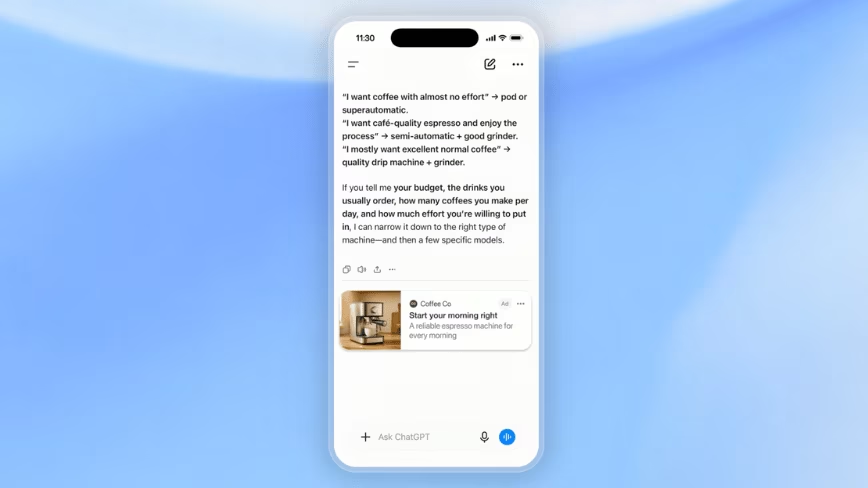
Ads run only on ChatGPT's Free and Go plans, which makes the cheap tiers the inventory. Anyone building on ChatGPT is now building inside an ad-funded surface.
The Product Desk · Product desk
Drafted by a language model from the sources cited here and checked against its claim ledger before publication. How we use AISend a correction
What happened
- OpenAI is bringing ads inside ChatGPT to 31 European countries, in its largest expansion of the ad business so far.
- The European rollout starts next week, OpenAI said in a blog post.
- The list of new markets runs from Germany, France, Spain and Italy to Sweden, Norway, Denmark, the Netherlands, Ireland, Belgium, Austria, Poland, the Czech Republic and Portugal, according to Adweek.
- The move extends a pilot OpenAI began in the United States in February.
- Over six months the pilot added eight more markets: Canada, Australia, New Zealand, the UK, Japan, South Korea, Brazil and Mexico, Adweek reported.
Compiled by The Product DeskSomething wrong?How this is made
Why it matters
OpenAI said it will begin running ads inside ChatGPT in 31 European countries next week, the largest expansion of its advertising business so far [1] [2]. The ads appear only for users on the Free and Go plans, while Plus, Pro and Enterprise stay ad-free [9] [10], which means the cheap tiers are the inventory and everyone shipping on top of ChatGPT is now shipping into an ad-funded surface.
The arithmetic is the story. The pilot started in the United States in February, and over six months added eight markets: Canada, Australia, New Zealand, the UK, Japan, South Korea, Brazil and Mexico [4] [5]. Adding 31 at once takes the footprint to roughly 40 countries [6], and the new list includes Germany, France, Spain and Italy alongside Sweden, Norway, Denmark, the Netherlands, Ireland, Belgium, Austria, Poland, the Czech Republic and Portugal, according to Adweek [3]. This is not a test any more; it is distribution.
The second signal is who gets to buy. For now, advertisers come in through OpenAI's own sales team and its agency and technology partners [7]. A self-service tool called Ads Manager follows later this summer, which would let smaller advertisers buy without talking to a salesperson [8]. Self-service is the point at which supply meets an auction rather than a negotiation, and it is usually the point at which volume and pricing pressure both arrive. The plumbing is being fitted to match: OpenAI says it has moved past cost-per-impression and cost-per-click bidding to let advertisers optimise for conversions, and has added geo-targeting and custom audiences [19] [20]. Those are table stakes on established ad platforms [21].
The demand pitch rests on scale and intent. Enterprise marketing chief Colin Fleming said on a briefing call reported by Adweek that ChatGPT has one billion weekly active users and that 20% of them show commercial intent [16] [17], which works out to about 200 million people a week weighing a purchase [18]. Fleming also said ad revenue has risen more than 25% since the start of August and called the European launch a "material expansion" [14] [15]. OpenAI did not publish a revenue number in its own post [15], and at Cannes in June the company said it was "clearly in the advertising business now" while acknowledging ad revenue was still small at the time [13]. A percentage without a base is a growth story, not a size one.
On trust, the company's claims are its own: conversations stay private from advertisers, customer data is never sold, ads are labelled and kept separate from answers, advertising does not influence responses, and users can control personalisation [11]. OpenAI published no figures to support those points, which it presents as principles rather than audited facts [12].
What to watch. First, whether Ads Manager actually ships this summer and what minimum spend it carries, because that sets whether small advertisers are customers or just a headline [8]. Second, whether conversion optimisation comes with attribution anyone outside OpenAI can verify [19]. Third, the position of the Go tier: it is a paid plan that carries ads [10], so its price and its ad load are the clearest read on whether subscriptions or inventory are the priority. Fourth, whether the ad-free promise on Plus, Pro and Enterprise survives the next expansion [9].