Build1 publisher2 min readPublished
OpenAI policy chief Morgan Dwyer backs a voluntary federal tally of AI use at work
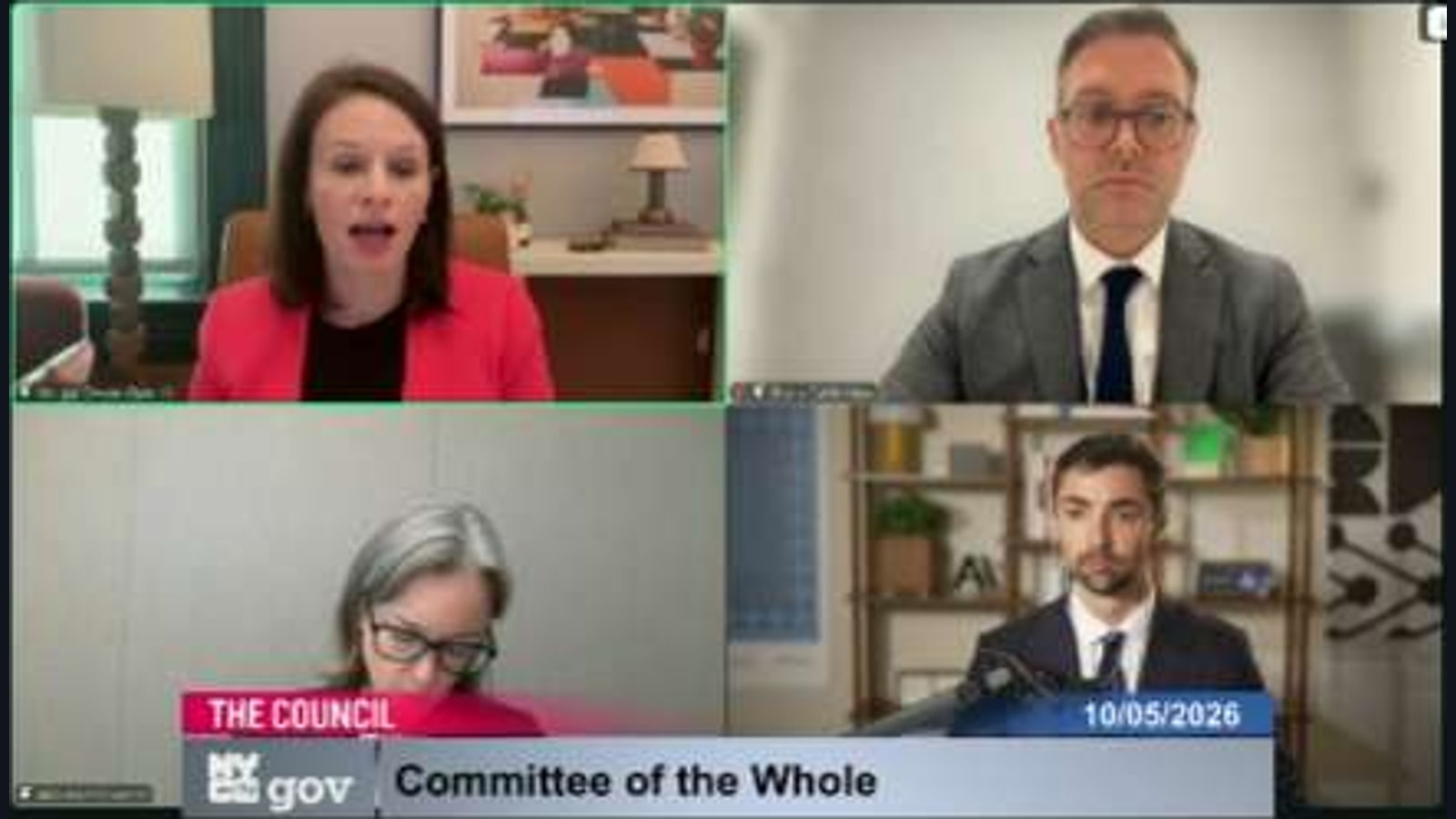
OpenAI's Morgan Dwyer told a New York City Council hearing the company backs the Warner-Budd workforce bill and will publish its own job-impact analysis. The bill would gather voluntary usage data by task, enough to map AI adoption but not to settle what it does to jobs.
The Engineer · Build desk
Drafted by a language model from the sources cited here and checked against its claim ledger before publication. How we use AISend a correction
What happened
- OpenAI's support was already public, since the senators' announcement named it as a backer and quoted Chan Park, its head of U.S. and Canada policy and partnerships.
- The Labor Department would collect and publish the aggregated submissions together with the Bureau of Labor Statistics and the Census Bureau.
- The bill's latest listed action is referral to the Senate Committee on Health, Education, Labor, and Pensions.
- OpenAI separately runs an Economic Research Exchange that lets outside researchers use privacy-protected data from its tools under defined governance and review processes.
Compiled by The EngineerSomething wrong?How this is made
Why it matters
- constraint Employers that reshape roles around AI would take on no duty to report or justify those changes under the bill as written, so its federal series could not be used to test their explanations.
- exposure OpenAI's pledged job-impact analysis would come from the developer whose products the bill sets out to measure, and it would arrive while the federal channel is still at committee stage.
- constraint Until the bill moves, outside researchers who want structured AI-use data can get it through company-run programs such as OpenAI's exchange, under that company's own review processes.
Each participant would send three kinds of data: task-level AI use, the geographic spread of uses and users, and how usage changes over time [6]. All three describe adoption. The bill does not require companies to report layoffs attributed to AI, and it does not set out to show that a change in AI use caused a change in employment [10].
Participation is opt-in. AI developers and users would decide whether to submit, and the data would be de-identified and aggregated to protect privacy [5][8]. I would treat the resulting tables like a vendor benchmark. They describe the organizations that chose to run the test [8]. For a national figure to transfer, the participants would have to use AI the way non-participants do. Under an opt-in design that match is assumed, and the picture depends on who takes part [8].
OpenAI's own published numbers have the same limit. In July its Economic Research team analyzed more than 800,000 messages from U.S. ChatGPT users [11]. By the team's count, 16.8% of the work-related messages were about tasks that belong to a different occupation, and among messages specific to an occupation that share was 43.5% [12]. Runtimewire, which reported the hearing, describes those as measures of message content and task crossover, not a count of jobs created or eliminated [13]. For the 43.5% to say something about employment, a message about another occupation's task would have to correspond to work that actually left that occupation. Usage patterns alone do not establish that [15].
Sens. Mark Warner, a Virginia Democrat, and Ted Budd, a North Carolina Republican, introduced the bill on April 30 [3]. Dwyer spoke 158 days later, at the October 5 hearing [1][16]. Asked there for a number, she said OpenAI's economic research team was studying the question and offered none [2]. The team's July analysis had reported task crossover to one decimal place [12].
I think the bill is a reasonable first instrument for counting adoption. Routing submissions through the federal statistical agencies is the part of the design I would keep [7]. Judging what AI did to a particular role would take outcome data on hiring, wages and job counts, joined to the usage fields [15].
What to watch
- Any action on the Workforce Transparency Act in the Senate HELP committee beyond referral, such as a hearing or markup.
- Publication of OpenAI's promised job-impact analysis, and whether it reports employment outcomes or only usage patterns.
- Amendments that add outcome fields, such as hires, wages or AI-attributed layoffs, to the bill's disclosure list.