Science1 publisher2 min readPublished
Reclamation sent Flaming Gorge water downstream to hold up Lake Powell's hydropower
Lake Powell's surface read 3,517.24 feet on September 10, the lowest on record, after the Upper Colorado Basin's 2025-2026 snowpack came in thin and record warmth took more of it before the melt reached the river.
The Scientist · Science desk
What happened
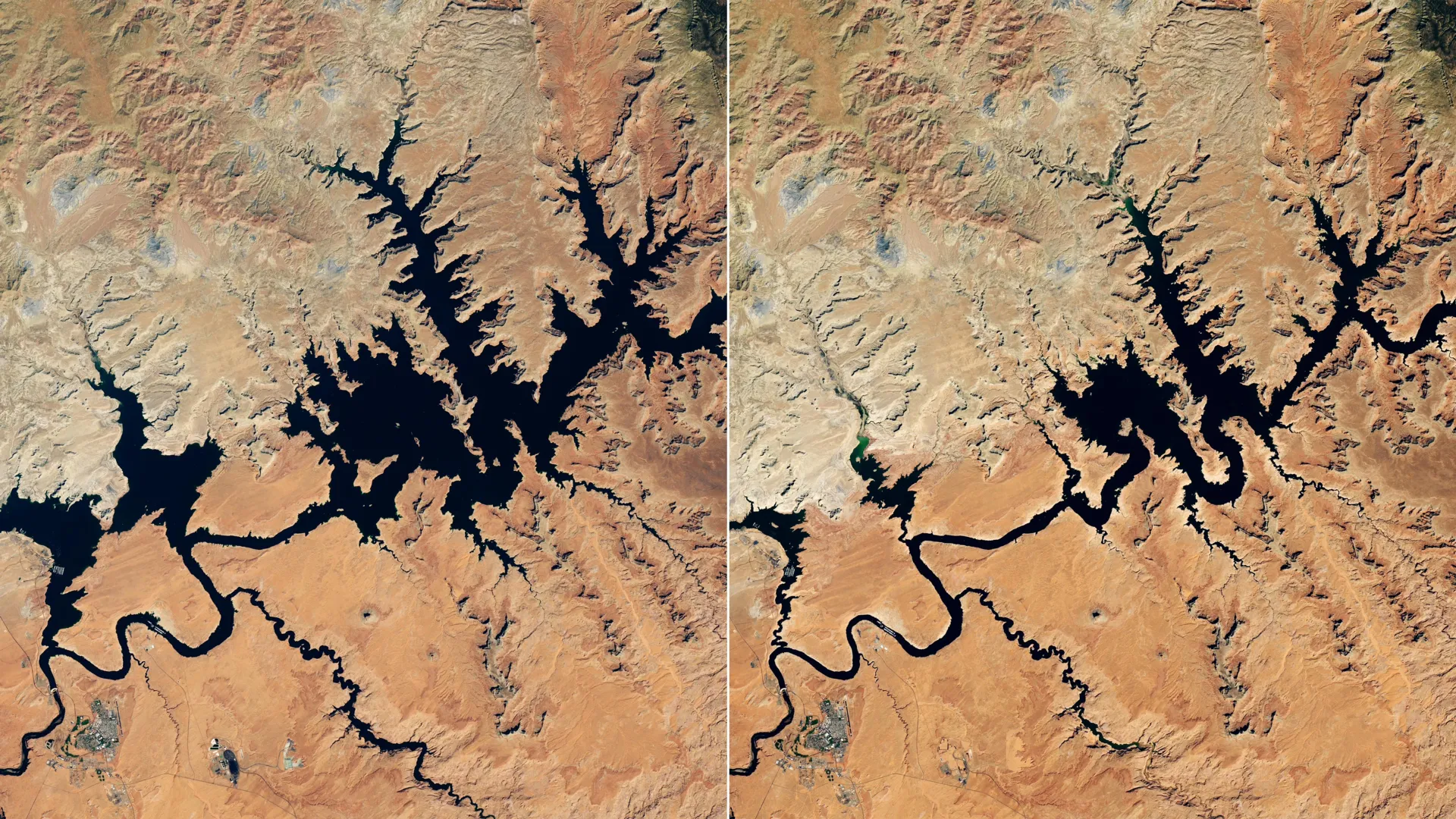
- The Operational Land Imager aboard Landsat 8 put Lake Powell's surface at 3,517.24 feet on September 10, 2026, the lowest level on record at the second-largest reservoir in the United States.
- The Upper Colorado Basin got unusually little snow over winter 2025-2026, a shortage the NASA summary calls a snow drought, and periods of record warmth cut the remaining snowpack further.
- Lake Mead, the next major reservoir downstream on the Colorado, reached record-low levels of its own in August 2026.
- The Bureau of Reclamation began stabilizing Powell in April 2026, having judged that without intervention the reservoir could fall below the elevation needed to generate hydropower by August.
- Reclamation canceled the controlled flood planned for April to rebuild sandbars used as fish habitat, and in August skipped a cool mix release meant to protect native species.
Compiled by The ScientistSomething wrong?How this is made
Why it matters
- exposure More than 40 million people in cities including Las Vegas, Phoenix, Los Angeles and San Diego, plus about 5 million acres of irrigated farmland, draw on a river whose upstream storage is now being managed against a hydropower floor.
- constraint Holding Powell up spends water banked elsewhere in the basin, so a second thin snowpack would find less cushion in Flaming Gorge and less water withheld behind Glen Canyon to give.
- precedent An emergency reoperation decided in April on the strength of one winter's snowpack sets the expectation that Colorado River operations get adjusted inside the same water year they are measured in.
The September figure is a surface elevation, which is the quantity Reclamation's April decision turned on. The old record, 3,519.92 feet, was set on April 13, 2023 [3]. Take 3,517.24 feet from that and Powell's September 10 surface sat 2.68 feet below it [2][4]. The agency's stated aim in April was to keep the reservoir above the elevation required to generate hydropower at all, and without intervention it considered falling below that level realistic by August [15].
Most of the Colorado's annual flow starts as snow at high elevation and arrives as melt in spring and early summer, in a basin that is otherwise arid or semi-arid [13]. The system gets one filling season a year. The Upper Basin's 2025-2026 snowpack was unusually thin, periods of record warmth took more off it, and the melt that reached the reservoirs was far below normal [12].
One dry winter did not empty two reservoirs of this size. NASA Earth Observatory's account has the weak melt providing "little relief for already depleted lake levels" [14], and it dates the regional dry period to around the beginning of this century, a megadrought in the language the summary uses [18]. The same satellite instrument photographed Powell on September 1, 2017, during one of its highest levels of the past decade [20].
Both emergency measures move water that is already in the basin. Extra releases from Flaming Gorge draw down storage in northern Utah and southern Wyoming, and cutting Powell's releases keeps water out of the reservoir below it [16]. What Reclamation chose in April, then, was which reservoir absorbs the shortfall. NASA's summary does not break out how much of Lake Mead's August minimum came from those reduced releases [8].
The monitoring has improved through this drought. At the river's headwaters, a dashboard built around the Western Land Data Assimilation System gives managers real-time soil moisture, snow water equivalent and evapotranspiration [19]. The dashboard improves the forecast. It does not improve the supply. Reclamation started reoperating the system in April, before the runoff season was over [15], and Powell's level kept falling into early September [7].
What to watch
- The Upper Basin's 2025-2026 snowpack was the trigger this year; the 2026-2027 accumulation decides whether Flaming Gorge keeps being drawn on.
- Whether Reclamation publishes the elevation at which Glen Canyon generation stops, and the volume it moved out of Flaming Gorge.
- Whether the canceled habitat flood and the skipped cool mix release are rescheduled in a later water year.