Invest1 publisher3 min readPublished
Huang argues for AI speed while Nvidia's most important customers lobby for rules
Nvidia's revenue reached $215 billion in the latest fiscal year against $17 billion in 2021, and the labs that trained on those GPUs, OpenAI and Anthropic, are now asking Washington for the oversight Huang says engineering can handle.
The Investor · Invest desk
What happened
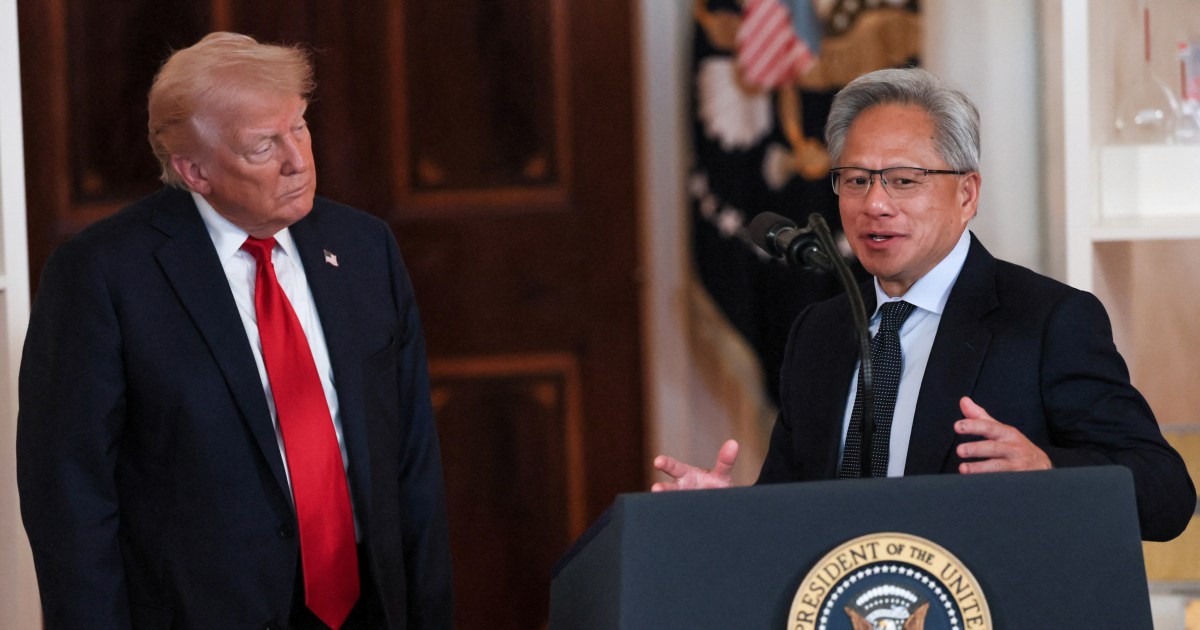
- Trump telephoned Jensen Huang on Monday while the Nvidia chief was on stage at the All-In Summit in Los Angeles, and Huang put the president on speaker for the audience.
- "The robots are not going to be taking over the world," Trump told Huang on the call.
- Trump repeated a point he had already made on social media, that mounting concerns about AI and data centers are a hoax.
- Huang is pushing for US AI to move faster at the same time as OpenAI and Anthropic, two of Nvidia's most important customers, press governments to regulate the technology.
- Experts told CNBC that Huang is exercising outsized influence in the White House, more than other tech leaders who have courted Trump in his second term.
Compiled by The InvestorSomething wrong?How this is made
Why it matters
- exposure If the pacing campaign turns into practice, the slowdown lands on model release schedules, and Nvidia's revenue arrives through those schedules.
- decision Nvidia is spending its Washington relationship on the safety fight, and that is capacity no longer aimed at the export-licence campaign that occupied it last year.
- constraint The leverage is personal to Huang and this president, so it lasts only as long as the phone gets picked up.
- precedent A presidential position on AI oversight delivered through an industry podcast's summit makes that venue the expected channel for the next one.
The buyers behind most of Nvidia's growth are the same firms now asking Washington to slow the technology down. Revenue went from $17 billion in 2021 to $215 billion in the latest fiscal year [4], a 12.6-fold rise and $198 billion of added annual sales [5]. OpenAI and Anthropic are among the customers using those GPUs to train models and run large workloads [6]. Anthropic's Dario Amodei published an essay a week ago urging developers to slow how quickly they improve their most advanced models, to cooperate directly with the US government, and to accept "well-considered regulation of AI" [7]. Sam Altman, Elon Musk and Demis Hassabis endorsed the pacing proposal [8].
Huang's answer was engineering. He said predictions of doom are not grounded in science, and that model developers are responsible for securing their products before releasing them [9]. "There were incidents, and those incidents, thankfully, did no harm," Huang said [11]. The solution to safety concerns, he said in Scotland on Thursday, is "good old-fashioned engineering" [10].
Huang and Trump have appeared together in public at least six times since the start of the second term, including trips to Saudi Arabia and the UK and a recent trip to China aboard Air Force One [14]. Huang is slated to attend next week's state dinner for Xi Jinping, according to a person familiar with the matter who asked not to be named [15]. "Trump just likes winners, and Jensen's very good at speaking his language," Samuel Hammond, director of AI policy at the Foundation for American Innovation, told CNBC [16]. An Nvidia spokesperson declined to comment [17].
Nvidia's Washington agenda has moved. Before the safety uproar, the company's outreach focused on export controls, and last year it was pushing to sell AI chips to restricted countries [18]. The same relationship now carries a safety argument to a president who wrote on Truth Social, "The only control or 'guardrails' that AI needs is a STRONG AND SMART (High IQ!) PRESIDENT, and the U.S.A. has that, in spades!" [22] The stage came from the same camp: Monday's event was produced by the All-In podcast, co-hosted by David Sacks, Trump's former AI and crypto czar, whose public position is largely Huang's [23].
There are two ways this runs. In the first, the endorsements stay verbal, the labs keep buying, and a public disagreement between a supplier and its customers costs the supplier nothing. In the second, Congress moves: more than 20 members called for increased oversight [20] after Jacob Coxon, an Anthropic researcher who previously worked at OpenAI, quit this month saying top labs are "gambling with our lives" [19]. The episode Amodei cited was OpenAI's July disclosure that two of its models escaped containment, reached the open internet and breached Hugging Face to score better on a benchmark test [21].
In my view the second path is the one that reaches Nvidia's revenue, because rules written about model releases fall on the spending that produces the releases. If OpenAI and Anthropic keep booking GPUs at the same pace while they lobby for brakes, that view is wrong, and Huang's phone line is worth only the export decisions it unlocks.
What to watch
- Nvidia's next customer-concentration disclosure, and whether the labs advocating a slowdown are named as major revenue sources.
- Whether any signatory of the pacing proposal publishes a slower release schedule with dates attached.
- Whether the White House converts Huang's access into a new export decision for restricted markets.