Invest1 distinct publisher3 min readPublished
The Omaha lender's second deal since June is all cash, priced at roughly 14% of the target's assets. The loan book it inherits saw nonperformers more than double to 0.97% in six months, even as profit rose 32%.
The Investor · Invest desk

Compiled by The InvestorSomething wrong?How this is made
Start with the price, because it is the one term the disclosure pins down. About $200m for a holding company carrying $1.4bn of assets is 14.3% of assets [1], and annualising the $6.76m InBankshares earned in the first half of 2026 gives $13.5m, which puts the headline number near 14.8 times earnings [2]. The multiple only means something next to what those assets earn: $13.5m on $1.4bn is a 0.97% return on assets, roughly 54% of the 1.79% FNBO itself posted over the same six months [3]. So FNBO is paying a full price for assets that currently earn about half what its own do, on the working assumption that its platform fixes the gap.
The consideration being all cash [1] follows from what FNBO is: privately held and family-managed [3], with no traded shares to hand over, so the whole price lands on its own capital rather than on new stockholders. Against $308.6m of first-half net income [13], $200m is about 65% of half a year's profit, or 3.9 months at that run rate [4]. For a $35bn-asset bank [3] buying something worth 4% of its balance sheet [10], staff time is the scarce input, not money, which is why Lauritzen described sitting down to walk "through a detailed timeline and sequencing of who in our organization would be doing what at various stages" [10].
The part worth underwriting is credit. InBankshares charged off $7.3m in the fourth quarter of 2025, took a quarterly loss for it, and finished the year with nonperforming assets at 0.42% of total assets [11]; six months later, with profits up 32%, that ratio had climbed to 0.97% [12], an increase of 0.55 points and more than a doubling [7], or about $13.6m of nonperformers on a $1.4bn book [5]. The single quarter's charge-off was larger than the entire first half's profit [6]. The merger agreement also sends InBankshares stockholders a special dividend plus a further payment whose size the source material cuts off mid-sentence [14], so treat 14.8 times as arithmetic on the headline figure and not on the final consideration.
This is probably wrong, but the version I would defend is that the approval calendar has become the shorter of the two waits: FNBO expects sign-off by the end of this year, with rebranding and customer conversion pushed into the second half of 2027 [8], a gap of roughly seven to twelve months after the regulator is done [8]. The counter-thesis is straightforward, and American Banker's own forward look states it, putting the close itself in the second half of 2027 [9]; if that is right, the regulator, not the integration queue, is what makes two deals in three months hard. The third reading is that FNBO is buying a Denver, Colorado Springs and Pueblo franchise [7] and a New Mexico entry it could not build branch by branch [5], and that the credit is noise on a bank this size. What would settle it: whether approval actually lands by December, and whether the next nonperforming print moves back toward the 0.42% of a year ago or past 0.97%, because the second number is the one that decides what $200m bought.
Ranked by verification strength, evidence, and original report placement.
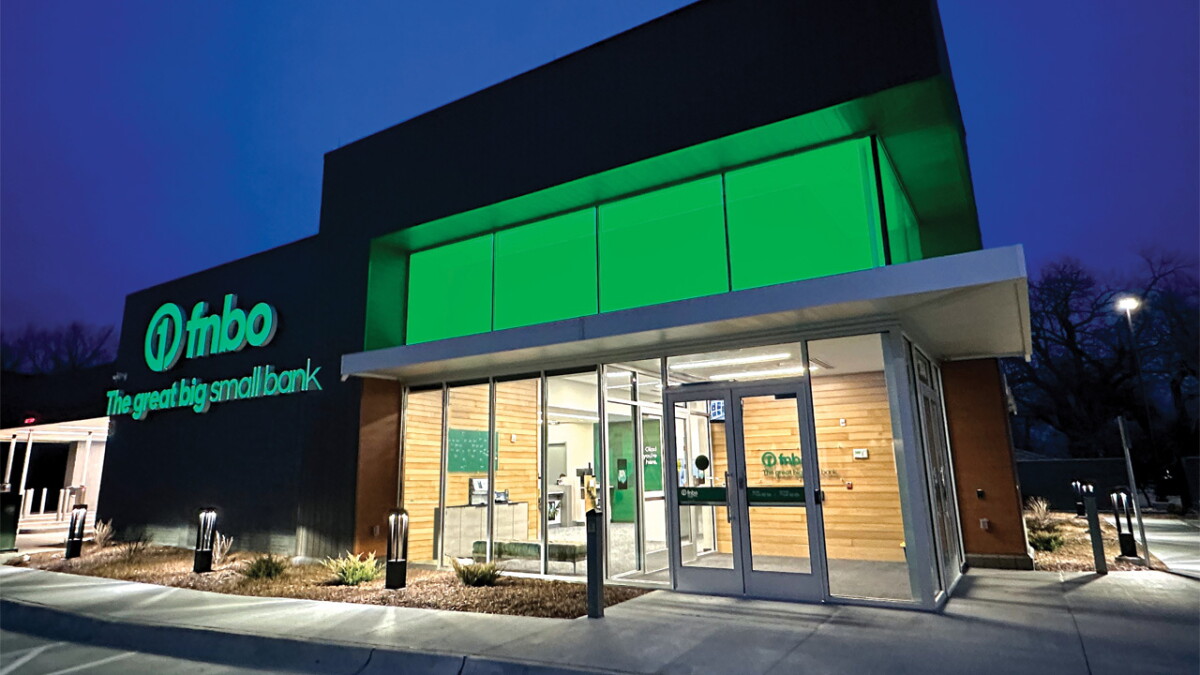
First National Bank of Omaha agreed to pay about $200 million in an all-cash deal for Denver-based InBankshares Corp.
The InBankshares deal comes less than three months after FNBO announced its previous acquisition, making it the Omaha bank's second M&A agreement since June.
FNBO is a $35 billion-asset bank that is privately held and family-managed.
InBank is the banking subsidiary of the $1.4 billion-asset InBankshares.
Merging with InBank would add nine Colorado branches, expanding FNBO's statewide network to 30 locations, and would extend FNBO's footprint into New Mexico, where InBank operates four branches in Colfax County.
The acquisition gives FNBO access to the Denver, Colorado Springs and Pueblo markets, extending it into the southern half of Colorado.
Distinct publishers with included, body-backed reporting in this cluster.
1 article · September 2, 2026
Follow any of these and your For You feed starts watching them — no settings page required.
invest
The industrial bank door is open again, and the incumbents are writing the entrance exam1 distinct publisher
invest
Valley National pays $247M for a cheaper deposit book and ends its CRE retreat1 distinct publisher
invest
Stablecoin KYC and the Line at the Point of Issuance1 distinct publisher
invest
Treasury's stablecoin rule makes the listing venue liable, not just the issuer4 distinct publishers
Evidence-backed comparisons of source perspectives and observed adoption signals. Read the methodology
Which Builder, Operator, and Investor concerns the observed source mix emphasized—not a truth score.
Evidence, demonstrated adoption, hype gap, incentives, and confidence are assessed independently, each on its own current evidence. How these are measured.
Precise numbers, one telling
The figures are specific enough to work with — $200 million, $1.4 billion of assets, a $7.3 million charge-off, 0.42% then 0.97% nonperformers, a 1.79% return on assets checked against the FDIC's 1.37% average — and that benchmark is the only element sourced outside the deal's participants. Everything else comes from one American Banker report built on an interview with FNBO's chairman and a press release. The sentence explaining what stockholders receive stops mid-clause, so the central term of a cash acquisition is simply missing.
Signed, nothing switched over
Two agreements in three months is real commitment, but nothing has actually happened yet: regulators have not cleared this one, no InBank customer sees a new sign before the second half of 2027, and the June deal is also still unconverted. What exists today is signatures, a branch map and a CEO who has agreed to stay.
Confidence is qualitative; the credit trend is not
Nobody is overselling here — American Banker's framing is sober and the awkward numbers are printed. The small tilt comes from asymmetry: the case for absorbing two banks at once is an executive's account of a planning session and repeated talk of cultural alignment, while the facts pointing the other way carry decimal places. A charge-off larger than the target's entire half-year profit, and nonperformers doubling in six months, do not get the same word count as bandwidth reassurance.
The buyer sets the frame
FNBO is privately held and family-managed, so there is no filing to hold the interview against, and the story reaches readers through the buyer's chairman plus a press-release quote from a CEO who has already agreed to join the merged company — nobody quoted has an interest in the integration sounding hard. American Banker's trade readership explains the rest of the emphasis: bankers want sequencing and conversion dates, so that is what the access produces.
Firm on the arithmetic, thin on independence
We can stand behind the ratios because the inputs are stated plainly and the derivations are simple division. What we cannot do is confirm any input, resolve whether closing lands at end-2026 approval or mid-2027 as the same report suggests in different places, or say what shareholders are paid. One outlet, one interview, one unfinished sentence — that caps how far this should be pushed.