Science1 publisher2 min readPublished
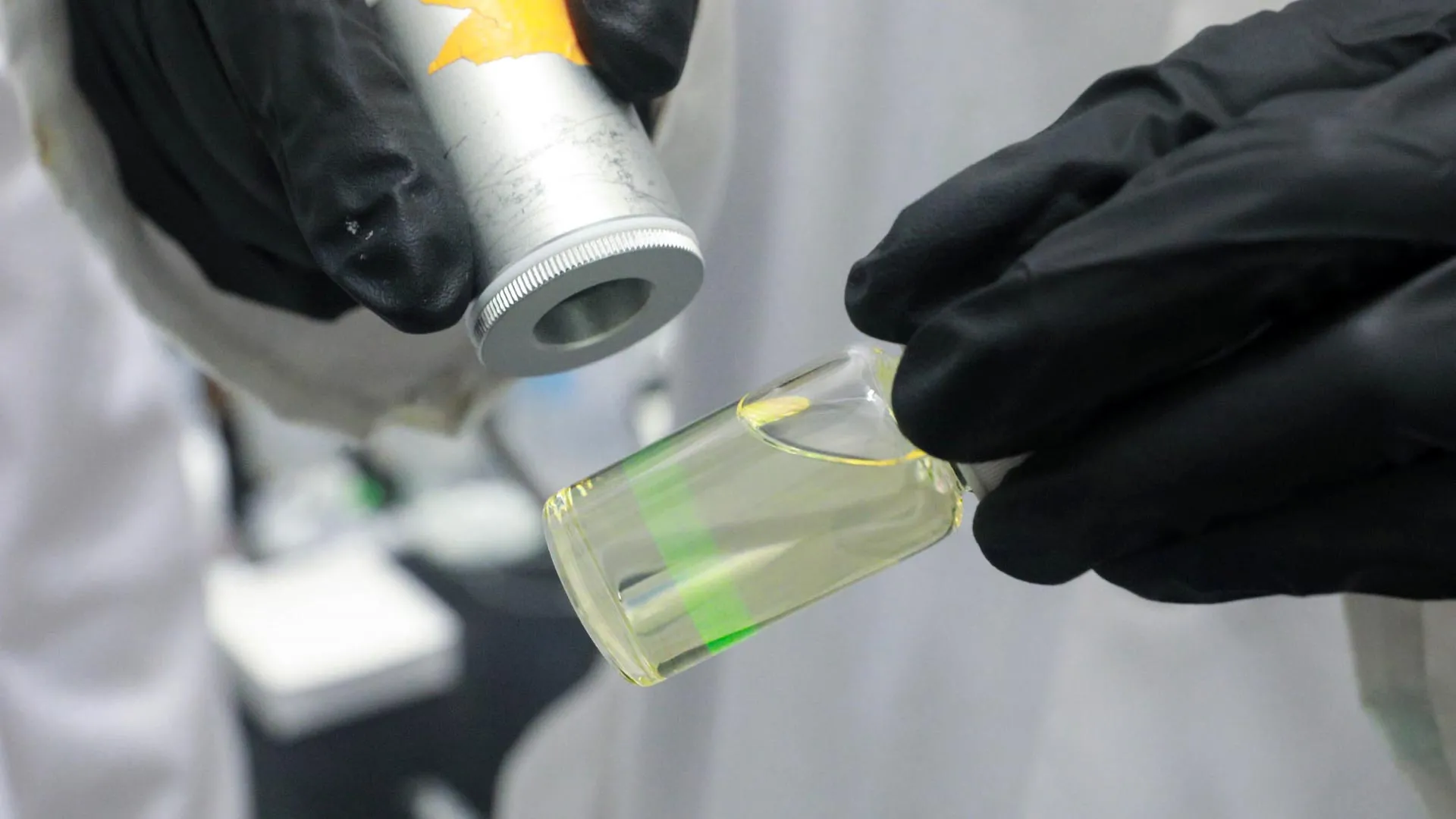
Dye-coated nanoparticles turn low-cost infrared laser light into a green sensing signal
A University of Toronto team layered ytterbium and erbium so energy moves one way through the particle. The payoff they claim is trace-chemical sensing driven by the kind of near-infrared laser that costs very little.
The Scientist · Science desk
What happened
- Engineers at the University of Toronto reported dye-sensitized nanoparticles that detect chemicals at extremely low concentrations and can tell apart molecules of nearly identical shape.
- The particles absorb low-energy photons and emit higher-energy ones, so near-infrared light from a low-cost laser makes them glow bright green, according to senior author Kai Huang.
- Earlier versions of these probes were flat hexagonal structures with ytterbium and erbium spread through a sodium, yttrium and fluorine host under an outer coat of organic dye molecules.
- Brightness in that design has a ceiling, because densely packed ytterbium absorbs both the energy coming in and the green energy heading out, as lead author Jiaze Wu described it.
Compiled by The ScientistSomething wrong?How this is made
Why it matters
- capability With emission sitting above the excitation frequency, a detector can ignore whatever the sample itself fluoresces, so sensitivity depends less on how optically clean the sample is than it does with conventional dyes.
- constraint A brighter probe gives a stronger signal without making it more specific, so whatever separates two near-identical molecules here has to come from the chemistry that attaches the particle to its target.
- decision Any lab weighing this against an existing assay wants the power-dependence curve first: two absorbed photons feed one emission, so the signal a cheap diode can actually drive decides whether the cost saving exists.
Upconversion is addition. Each green photon leaving these particles carries more energy than any near-infrared photon that went in, so at least two absorptions have to feed one emission [18]. Absorptions that go to waste reappear later as required laser power. The brightness engineering and the low-cost laser are one piece of work [5].
Ytterbium is where the waste accumulates. Infrared light hits the dye coat, the dye hands energy to ytterbium, ytterbium relays it to erbium, and erbium emits green [11].
"But there's a problem," said Jiaze Wu, a PhD student in Huang's lab and lead author on the paper. "If you pack the ytterbium atoms in too densely, they start to absorb not only the energy coming in, but also the energy coming out" [13][4]. "This is called back-energy transfer," Wu said. "It means that the energy that would have been emitted by the erbium ions as green light instead gets bounced back to the ytterbium relay and never reaches the surface" [12]. The team's answer was to split those jobs across layers, which the university describes as a one-way energy path [14].
Telling near-identical molecules apart is a separate function from emitting brightly. The particles produce their signal after attaching to the chemical they were designed to detect [2], so the shape discrimination sits in that attachment chemistry. The layered design governs how much light the attachment produces. The university's summary describes detection at extremely low concentrations with no numeric limit and no names for the molecules that were separated [17].
The background advantage rests on an asymmetry Huang used to define conventional dyes. "With fluorophores, the excitation frequency has to be higher than the emission frequency, which means that they convert high-energy photons into low-energy photons," he said [6]. Anything in the sample that fluoresces follows the same rule, so a detector watching a band above the excitation frequency collects none of it [20]. Huang put it in terms of the sky. "Shifting the excitation frequency lower produces zero-autofluorescence background in the samples you are analyzing, while the luminescent nanoprobes keep shining," he said. "It is like turning off the sun, so you can see the stars better" [8].
Toronto's Faculty of Applied Science & Engineering keeps the applications in the conditional, saying the technology could one day provide a cheaper way to catch dangerous drug impurities or trace pollutants using simple low-cost lasers [16]. Pharmaceutical impurity identification and groundwater pollutant screening are the two uses it names [15]. The work itself is a probe design, published in the Journal of the American Chemical Society with Kai Huang as senior author [3].
What to watch
- The JACS paper's power-dependence data: how green output tracks excitation power at the low end a cheap diode laser actually delivers.
- A test in a real matrix, with a stated limit of detection and the identity of the near-identical pair the particles separated.
- Which recognition chemistry gets paired with the particles, since the selectivity claim rests on the attaching step.