Product1 distinct publisher3 min readPublished
Tianmushan Lab and Tsinghua reported 602.5 Wh/kg from a lithium-rich manganese cathode, while the 180-cycle durability figure came from a lower-energy build. The second number is the one a fleet has to spec against.
The Product Desk · Product desk

Compiled by The Product DeskSomething wrong?How this is made
The two numbers in this result came off different cells, and only one of them was cycled. The 602.5 Wh/kg is the reversible specific energy of a lithium metal anode paired with a lithium-rich manganese-based cathode [2]. The 80 percent capacity retention after 180 cycles belongs to 10Ah pouch cells built with high-nickel ternary cathodes, which measured 550.7 Wh/kg [3][4]. On energy, the two builds sit about 9 percent apart (602.5 divided by 550.7) [2]. On durability they are not comparable, because the reported cycle figure covers the lower-energy build only [4].
Both are large against the incumbent. Graphite-anode commercial cells are approaching a theoretical ceiling near 350 Wh/kg [5], which puts 602.5 at 1.72 times that number, or 72 percent more [1], somewhat short of the doubling a round 600 invites you to assume. The researchers' own comparison is more conservative again: more than 50 percent above mainstream power batteries currently on sale [6].
A cycle count reads differently in a paper than in a maintenance schedule. Treat 180 cycles as the interval to 80 percent and apply a duty cycle. A pack charged five times in a working day reaches it in 36 days [3]. A pack charged once a day reaches it in about six months [4]. Energy density buys the thing the airframe team wants, which is more stored energy for the same pack mass and therefore longer time aloft [16]. Cycle life decides how often finance buys the pack again, and that question currently has a published answer for the 550.7 Wh/kg build [4] and no published answer for the 602.5 one.
Lithium metal has stayed out of products for two specific reasons. Needle-like dendrites grow on the anode, reducing stability and creating safety risk [9], and the electrolyte can decompose under high-voltage operation [10]; between them, those failure modes have restricted commercial use of high-energy lithium metal cells [11]. Attacking both from the electrolyte side is the interesting part of the work [7][8]. It is also why the team is careful about status: laboratory research stage, further technical development needed before manufacturing at scale [12], and no flight-time estimate offered [13]. The low-altitude economy this points toward consists of drones and eVTOL aircraft still under development, held back by how much energy a pack stores without adding weight [14].
The test worth applying to the next cell announcement is whether the energy number and the cycle number came from the same cell. When they did not, the cell that was cycled is the one a specification can be written against, and the other is a direction of travel. The second step is dividing the claimed cycle count by your own daily cycles and comparing the result to your maintenance interval. If calendar life lands inside that interval, the cell is a consumable rather than a component, and whoever answers for the fleet should be in the room when it is chosen.
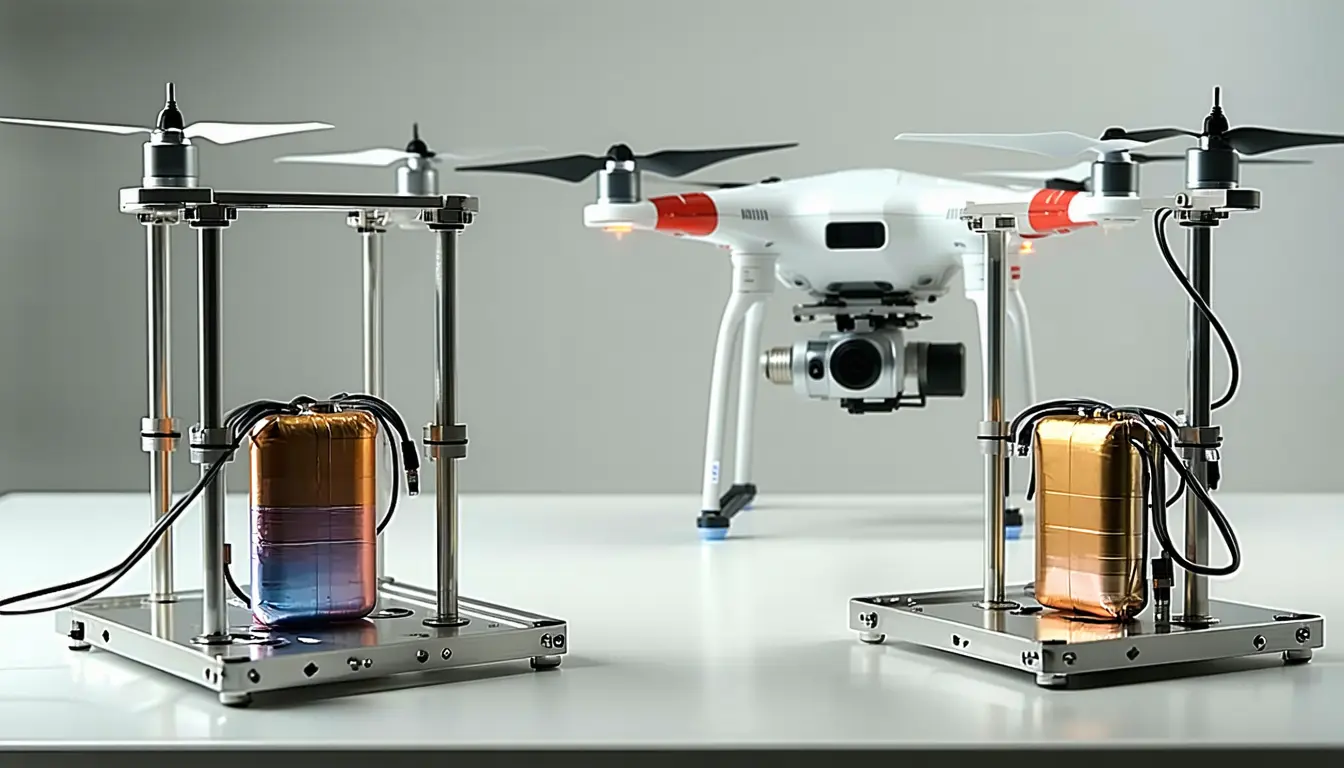
Ranked by verification strength, evidence, and original report placement.
A joint team from Tianmushan Lab and Tsinghua University developed a high-stability lithium metal pouch cell with energy density exceeding 600 Wh/kg, using a new electrolyte additive designed to protect both electrodes.
When the researchers paired the lithium metal anode with a lithium-rich manganese-based cathode, the reversible specific energy climbed to 602.5 Wh/kg.
The team tested its electrolyte design in 10Ah pouch cells equipped with high-nickel ternary cathodes, and those cells achieved an energy density of 550.7 Wh/kg.
The 10Ah pouch cells that measured 550.7 Wh/kg retained 80 percent of their original capacity after 180 cycles.
Commercial lithium-ion batteries typically use graphite anodes and are approaching a theoretical energy density limit of about 350 Wh/kg, a ceiling that makes it difficult to meet the endurance requirements of emerging electric aircraft.
On the cathode, the additive forms a thin and dense protective film that helps reduce damage to the cathode material during repeated high-voltage charging and discharging.
Distinct publishers with included, body-backed reporting in this cluster.
1 article · August 28, 2026
Follow any of these and your For You feed starts watching them — no settings page required.
product
US grid storage nears 52GW, and arbitrage is now writing the evening price curve1 distinct publisher
product
MIT's magnet trick makes correlated microwave signals without the cryostat1 distinct publisher
product
LLNL closes a 20 percent gap in diamond melting, and stakes a fusion gain claim on it1 distinct publisher
product
Illinois team builds the charge into the extraction molecule, and the reagent bill drops1 distinct publisher
Evidence-backed comparisons of source perspectives and observed adoption signals. Read the methodology
Which Builder, Operator, and Investor concerns the observed source mix emphasized—not a truth score.
Evidence, demonstrated adoption, hype gap, incentives, and confidence are assessed independently, each on its own current evidence. How these are measured.
Precise numbers, unnamed study
The figures are specific enough to be checkable — 602.5 Wh/kg, 550.7 Wh/kg, 10Ah, 80 percent after 180 cycles — and yet the study behind them is never named, dated or linked, and no second outlet or lab has touched it. What we can verify is internal consistency and nothing else. The one measurement that matters most operationally, cycle life at 602.5 Wh/kg, simply does not exist in this reporting.
Bench cells only, nothing fielded
Zero would be unfair — real 10Ah pouch cells were built and cycled, which is further along than a coin-cell claim. But the researchers themselves close the door on anything more: laboratory stage, further development required before scale manufacturing. No manufacturer, no pilot line, no aircraft, no customer appears anywhere in this reporting.
One headline, two different cells
The gap is not invention, it is attachment. The record energy density comes from a lithium-rich manganese build; the 180-cycle durability result comes from a high-nickel ternary build about 9 percent lower in specific energy. Read as one cell, the story becomes a 602.5 Wh/kg battery with proven cycling, which nobody claimed. Add a headline promising longer drone flights over an article that concedes no flight-time estimate exists, and the overshoot is in the framing rather than the data.
Record announced by its own authors
Every number here reaches readers from the institutions that produced it, relayed once, unverified, and framed against a national industrial priority in low-altitude aviation — a setting where energy density records carry funding and prestige weight. What pulls the score back toward the middle is that the sharpest caveat in the story is also the researchers': they are the ones saying this cannot yet be manufactured at scale.
Coherent account, single channel
We can be fairly confident about what was reported and how the two cells differ; the reporting is internally consistent and flags its own limits. We cannot be confident the measurements hold, because there is one channel, no named publication, and no outside check. That split — high confidence in the account, low confidence in the claim — is the honest reading of this story.