Product1 publisher3 min readPublished
MIT's bacterial transistors move the logic onto the leaf, at eight hours per answer
Engineered Pantoea agglomerans colonies compute with chemical signals instead of wires. The demonstrations are on agar in Petri dishes, and one calculation takes about eight hours.
The Product Desk · Product desk
Drafted by a language model from the sources cited here and checked against its claim ledger before publication. How we use AISend a correction
What happened
- MIT researchers have engineered bacteria that can perform the basic switching functions of transistors, letting them build biological circuits from living cells instead of electronic components.
- The researchers used Pantoea agglomerans, a bacterium commonly found on plants and other surfaces, and engineered two versions of it to work as biological transistors.
- Electronic circuits move electrical signals through wires, while these biological circuits move molecules between bacterial colonies.
- Researchers envision bacteria on plant leaves or roots that detect stress and trigger responses without conventional electronics.
- One transistor switches on when it receives a chemical signal; the other performs the opposite function.
Compiled by The Product DeskSomething wrong?How this is made
Why it matters
MIT researchers have engineered *Pantoea agglomerans*, a bacterium commonly found on plants and other surfaces, into two kinds of transistor, and connected colonies of them into circuits that pass molecules between cells rather than electricity through wires [1][2][3]. The consequence is not the transistor itself but the placement: the team's stated aim is bacteria on leaves or roots that detect stress and trigger a response without conventional electronics, which puts the sensing and the logic where the measurement problem actually sits [4].
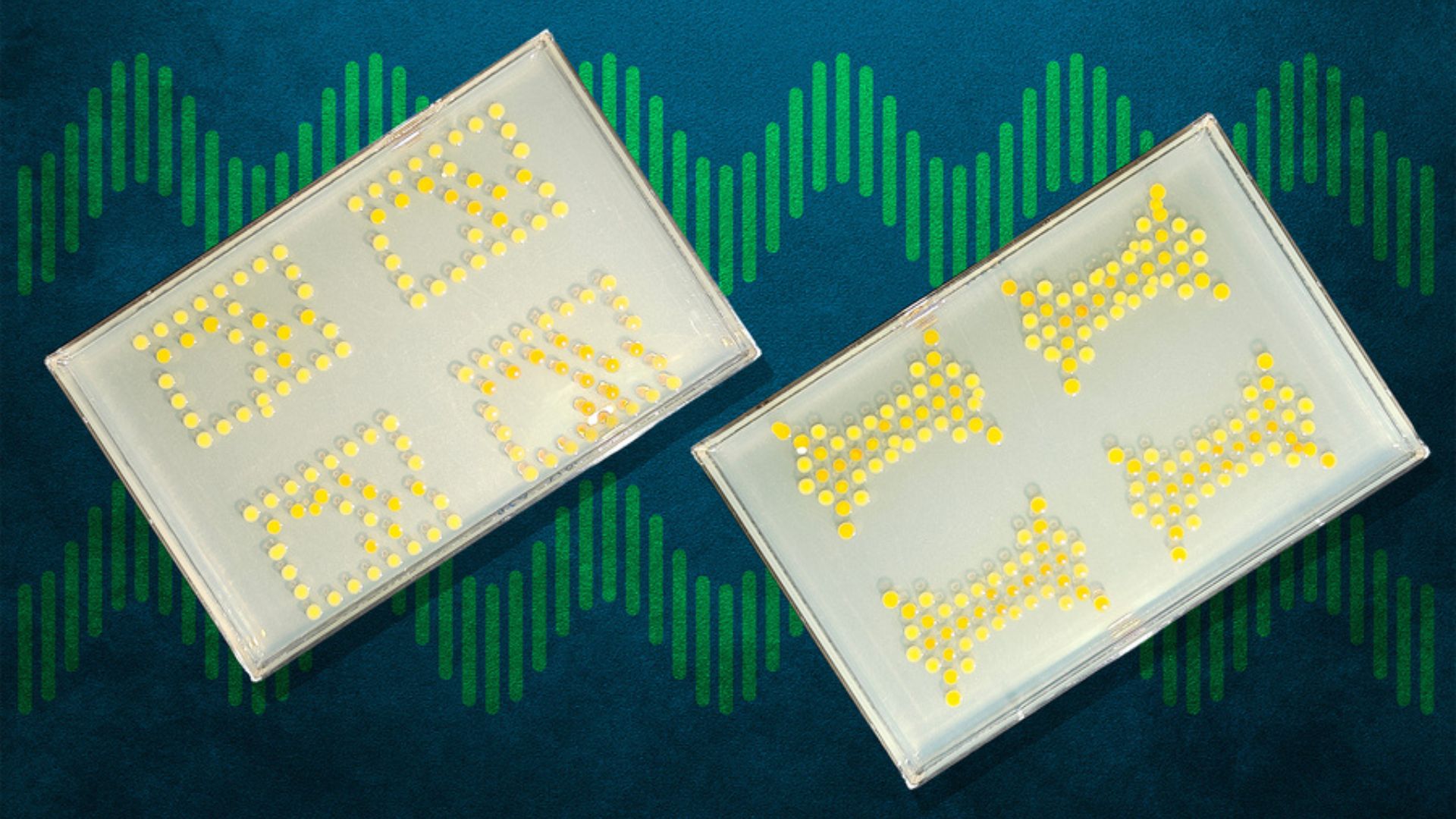
The parts list is short. One engineered strain switches on when it receives a chemical signal and the other does the opposite; both can detect a second molecule and produce a separate chemical output [5][6]. Three more strains act as relays, converting one chemical signal into another that the next component can recognise [7]. That is five engineered strains in total [8]. The colonies were printed onto agar in Petri dishes with about 5 millimetres between neighbours, spacing that helps a signal travel toward the intended downstream colony, and the layout can be rearranged without redesigning every component [9][10].
With that kit the team showed arithmetic and routing. One system adds two inputs using 24 bacterial colonies; other configurations perform OR and implication; a demultiplexer takes one incoming signal and directs it to different destinations depending on a control signal [11][12][13].
The argument for spreading functions across cells instead of packing them into one is a known ceiling in synthetic biology. Loading many functions into a single cell can eventually overload its protein-making machinery, and different biological components interfere with one another, so separation across cells is offered as another route to more complex biological computing [14][15].
Then there is the number that governs the whole idea. A bacterial circuit takes about eight hours to complete a calculation [16], which is three answers a day at best [17]. Against a microcontroller that is not a contest. Against the conditions MIT wants these circuits to detect on roots and leaves, namely drought, pests and disease, it may be adequate, because plants operate across hours, days and entire growing seasons [18][19]. "We're not trying to replace computers," said Christopher Voigt, head of MIT's Department of Biological Engineering; the goal, as he frames it, is to give biological systems their own computational control [20][21].
What to watch is whether any of this leaves the dish. Everything reported so far is colonies printed on agar, and deployment on roots or leaves is described as an ambition, along with a proposed application in which the circuit produces a fungicide after detecting plant stress [4][18][22]. Two checks when it moves outward. First, geometry: 5 millimetres on flat agar is a controlled diffusion path, and a root surface is not flat agar [9]. Second, cost per function: 24 colonies for a single addition means complexity is paid in colonies, so the colony count of the first circuit that does something a grower would pay for is the figure worth tracking [11].