Science2 publishers3 min readPublished Updated
Clay on Larissa and Galatea puts physical evidence under Triton's violent capture
JWST found water-altered clay minerals on two of Neptune's small inner moons and its rings, with no water ice. The likely source is the shattered interior of a much larger lost moon.
The Scientist · Science desk
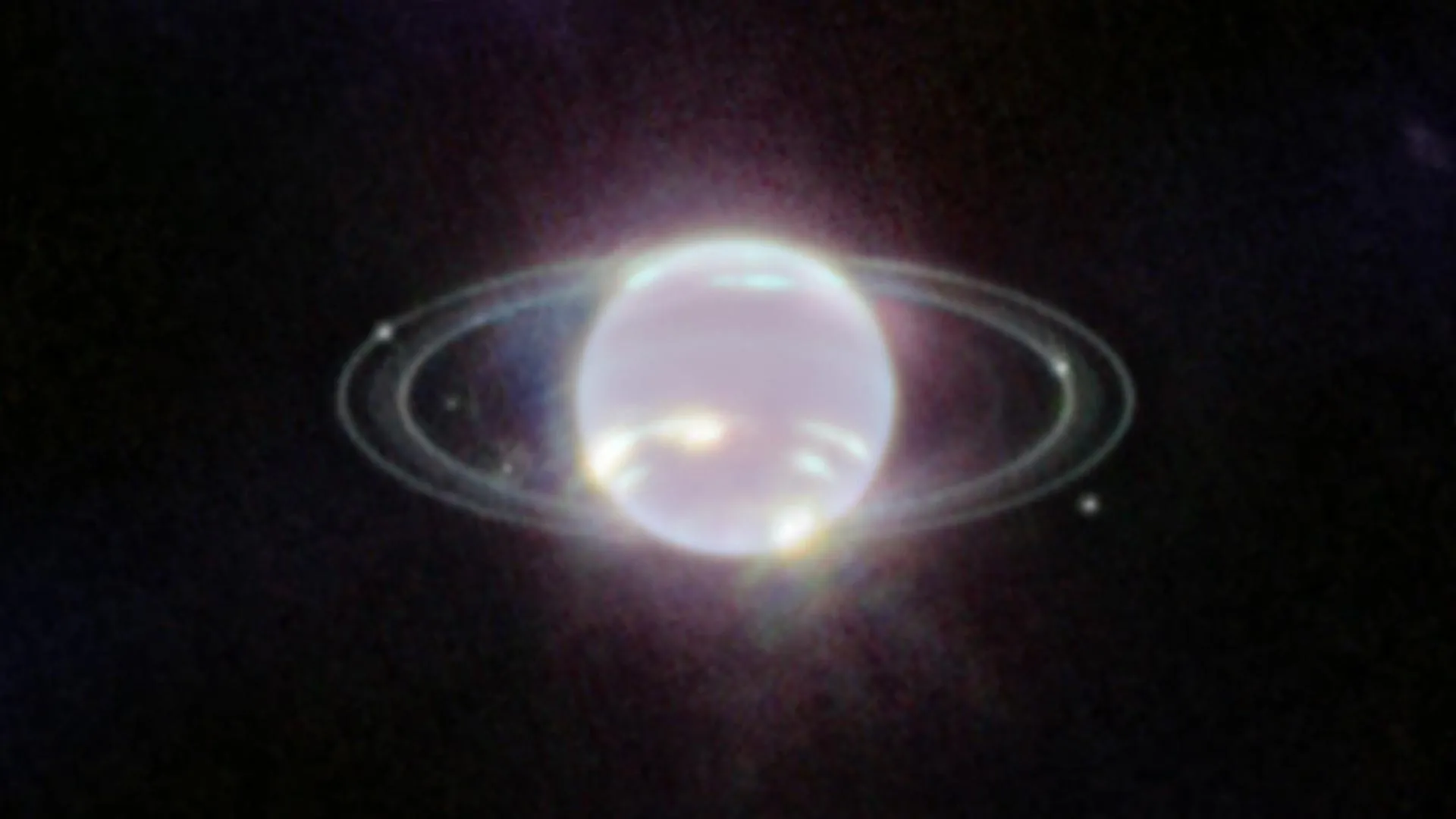
What happened
- Triton makes up more than 99% of the mass of all satellites orbiting Neptune.
- Triton orbits retrograde compared with Neptune's rotation.
- The predominant theory is that Triton is a captured Kuiper Belt object that caused a major disruption in Neptune's early moon system.
- All Neptunian satellites other than Triton together account for less than 1% of the system's satellite mass.
- Researchers analyzing JWST near-infrared spectrograph (NIRSpec) data found signs of clay-like minerals on two of Neptune's small moons and its rings; the team says no similar feature has ever been detected on any outer solar system bodies beyond Jupiter.
Compiled by The ScientistSomething wrong?How this is made
Why it matters
A Caltech-led team used JWST's near-infrared spectrograph on Neptune's rings and three inner moons, Larissa, Galatea and Proteus, and found magnesium-rich phyllosilicates, clay minerals that require liquid water to form, in the spectra of Larissa, Galatea and the rings [5][6][7]. Because those bodies are far too cold for liquid water near the surface and show no detectable water ice at all, the finding moves the long-standing argument that Triton's capture destroyed Neptune's original satellite system from orbital inference toward a mineral measurement [8][9].
The orbital case has always been circumstantial but strong. Triton holds more than 99% of the mass in Neptune orbit and travels retrograde relative to the planet's rotation, which is why the prevailing explanation is that it is a captured Kuiper Belt object rather than a moon formed in place [1][2][3]. That leaves everything else in the system with less than 1% of the satellite mass between them [4]. Voyager 2 found six unknown moons at Neptune in 1989, five of them small bodies orbiting just outside the main rings, and until this program there were no spectroscopy measurements of them [17][18][19].
What makes the clays load-bearing is where they cannot have formed. No phyllosilicate had previously been detected anywhere in the outer solar system beyond Jupiter [5]. Lead author Ryleigh Davis, a former Caltech graduate student now at UC San Diego, said the team was not looking for them and that the clays "had to come from objects that were much, much bigger than Neptune's small inner ring moons" [11][12]. The paper, published in Science Advances, argues the phyllosilicate component is broadly consistent with Ceres and the largest main-belt asteroids, pointing to differentiated parent bodies much larger than the present moons, where convecting interior melt raised the water-rock ratio [10][13]. The reading is that today's inner moons are reassembled rubble from the exposed interiors of larger primordial moons torn apart when Triton arrived, and that at least one of those bodies was big enough to have a heated, differentiated core [14][15].
The authors name an alternative: a different large Kuiper Belt object could have been shredded near Neptune and delivered phyllosilicate-bearing interior material into the system [16]. A companion study from the same JWST program, led by Matthew Belyakov, cuts against that. Nereid, Neptune's third-largest moon and historically classified as irregular, has a near-infrared spectrum dominated by crystalline water ice that the authors say is inconsistent with any observed KBO or irregular satellite, which they read as a survivor of the original regular system [20][21][22].
Two things to watch. First, Proteus: the reported clay detections cover Larissa, Galatea and the rings, and how Proteus fits the same story is the obvious next question for the data [23]. Second, the stronger claim in the paper, that these moons are the only place in the solar system where the interior of an icy satellite, or possibly a dwarf planet, can be probed directly [24]. That is the argument that would justify a Neptune probe, and it depends on the debris interpretation holding up against the single-impactor alternative [16][25].