Science1 publisher2 min readPublished
Two Ryugu grains pin nitrogen to the asteroid's last drying brine
Kyoto University's analysis of two grains puts nitrogen chemistry in the last fluid to dry inside Ryugu's parent body, and the team is careful to say it inferred that sequence rather than watched it happen.
The Scientist · Science desk
What happened
- A team led by Toru Matsumoto at Kyoto University reports in Nature Astronomy on nitrogen chemistry found inside dust grains returned from the near-Earth asteroid Ryugu.
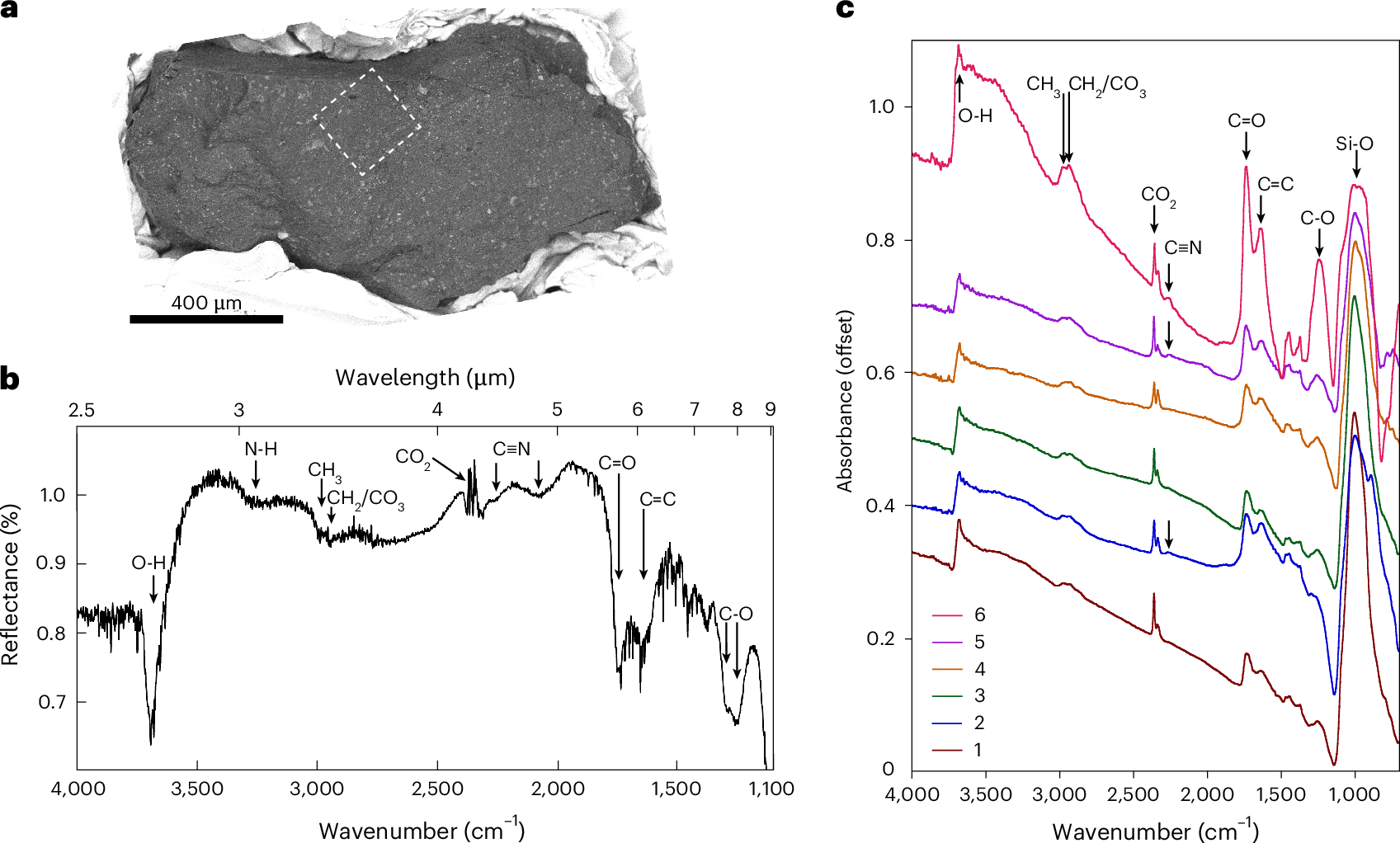
- The grains hold nitrogen in three forms: ammonium trapped inside clay minerals, molecules containing carbon-nitrogen bonds, and crystals of sodium nitrate.
- Every one of those phases clusters around sodium carbonate, a mineral known to form as the last of an asteroid's salty water freezes or evaporates away.
- The authors could not observe the reaction sequence directly, and say they are treating the slow-concentration reading as an interpretation for now.
Compiled by The ScientistSomething wrong?How this is made
Why it matters
- constraint An association between phases in two grains cannot put them in order, so the picture of asteroids as slow nitrogen concentrators remains a hypothesis awaiting a different class of evidence.
- capability Bond-level speciation on material that never met an atmosphere is something only a returned sample supports, which is a concrete answer to what a sample-return budget buys over a meteorite collection.
- decision Anyone feeding meteorite nitrogen contents into planet-formation or origin-of-life estimates has to decide whether those figures describe asteroids or describe the trip through the atmosphere.
- precedent With ammonium clays now reported from both Ryugu and Bennu, their absence in the next carbonaceous sample returned would be the result demanding an explanation.
Sodium carbonate is the useful part of this result, because it works as a clock. It precipitates when a salty fluid is nearly gone, at the end of a wet history rather than the start [9]. So finding ammonium locked inside clays, molecules carrying carbon-nitrogen bonds, and crystals of sodium nitrate all gathered around that carbonate [7][8] places nitrogen in the last and most concentrated brine inside Ryugu's parent body rather than in the early flood of water. Matsumoto's team reads the arrangement as nitrogen surviving millions of years of fluid flow and growing more concentrated as the water disappeared [10].
The design is a mapping argument, and it is worth being exact about what that buys. Two grains were measured with infrared and X-ray spectroscopy alongside electron microscopy, at a sensitivity that picks out individual chemical bonds and shows where in the rock they sit [6]. That yields an association between phases rather than an order of events, and the team holds back on the interpretation because the sequence was never seen directly [12].
The wider puzzle here is that ammonia looks common across the solar system, having been detected on Ceres and on several carbon-rich asteroids [3], while meteorites that land on Earth preserve very little nitrogen at all [4][18]. Ryugu answers that by provenance rather than by measurement. The Hayabusa2 material arrived in 2020 without passing through atmospheric heating or terrestrial weathering, which is why the phys.org account of the work describes it as a far more accurate picture of asteroid composition than meteorite fragments give [5][17]. Unweathered asteroid material holds the nitrogen, though how much a falling stone loses, and at which stage, nobody measured here.
How much nitrogen Ryugu's parent body carried, and whether the concentrating step actually built anything larger, remains unknown; the team offers that as a possibility, with icy salty bodies like Ceres as the analogue [11]. Bennu helps with one ingredient only. Samples returned by OSIRIS-REx independently show similar ammonium-bearing clays, which supports the general pattern and leaves the proposed order of events untested [13]. Six years separate the sample's arrival from this paper [15], which is about what bond-level chemistry on two grains costs.
Read narrowly, the paper is a claim about where three nitrogen phases sit relative to a salt that forms last [16][8]. At the scale of planet-building, it makes the meteorite nitrogen record look less like an inventory of what asteroids contain and more like a record of what survives entry and weathering [4][17].
What to watch
- A bulk nitrogen abundance for the Ryugu grains, which the published account of this work does not give.
- Textural or isotopic evidence that orders the phases in time, rather than mapping where they sit relative to each other.
- Further Bennu analyses testing whether carbon-nitrogen molecules and sodium nitrate accompany the ammonium clays there too.