Science1 publisher3 min readPublished
Neanderthals in the Nefud: stone flakes, a drying lake, and no bones at all
A statistical study of tool shapes puts Neanderthals in the Saudi desert about 55,000 years ago. The inference is careful, the climate story is tidy, and the skeletal evidence is nonexistent.
The Scientist · Science desk
Drafted by a language model from the sources cited here and checked against its claim ledger before publication. How we use AISend a correction
What happened
- A new study published online Aug. 12 in the journal Quaternary Science Reviews suggests, based on a study of stone tools, that Neanderthals may have trekked deep into the deserts of the Arabian Peninsula around 55,000 years ago; more evidence is needed to confirm the conclusion.
- Study co-lead author Huw Groucutt, an archaeologist at the University of Malta, told Live Science in an email: "Our findings extend the Neanderthal range much further south than had been known, and into the much more open environments of Arabia."
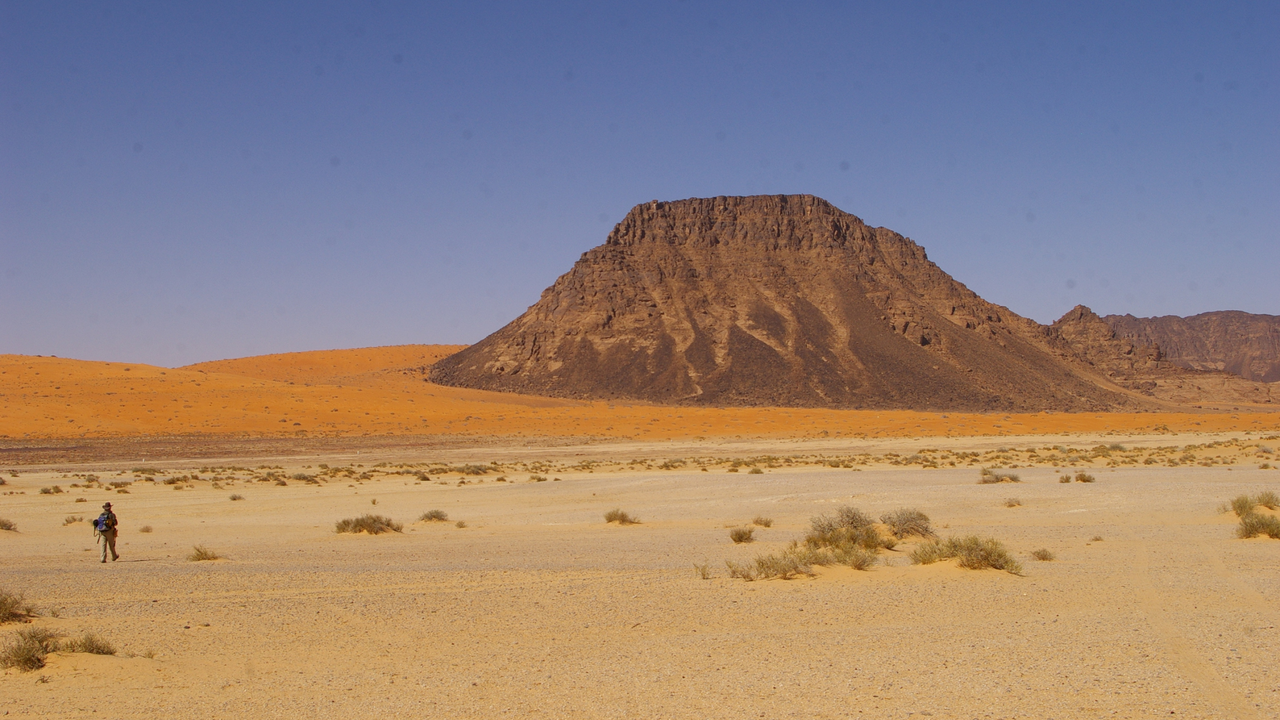
- The study focused on stone tools found at Jebel Katefeh-1 (JKF-1), an archaeological site beside an ancient lake near the city of Jubbah, in Saudi Arabia's Nefud Desert.
- No Neanderthal bones have ever been found in Arabia, so researchers wondered who was making tools there.
- Lacking bones or DNA, the researchers identified the tools as Neanderthal based on the unique shape of their stone flakes; the team measured hundreds of sharp pieces struck from carefully prepared stone cores from JKF-1 and other sites across Arabia, the Levant and northeast Africa.
Compiled by The ScientistSomething wrong?How this is made
Why it matters
A study published online on Aug. 12 in Quaternary Science Reviews argues that Neanderthals were in the deserts of the Arabian Peninsula around 55,000 years ago, based on the shape of stone tools rather than on any skeletal remains [1]. If it holds, it moves the plausible southern limit of the species out of the temperate zone and into open arid country [2].
The site is Jebel Katefeh-1, or JKF-1, next to an ancient lakebed near the city of Jubbah in Saudi Arabia's Nefud Desert [3]. No Neanderthal bones have ever been found anywhere in Arabia, which is the reason the question of who made the tools was open in the first place [4]. Co-lead author Huw Groucutt, an archaeologist at the University of Malta, told Live Science that the findings "extend the Neanderthal range much further south than had been known, and into the much more open environments of Arabia" [2].
The method is worth understanding before the conclusion. With no bones and no DNA, the team worked from the geometry of flakes struck from prepared stone cores, measuring hundreds of them from JKF-1 and from other sites across Arabia, the Levant and northeast Africa [5]. Using sites where the identity of the toolmakers is already well established, they built a statistical model to sort assemblages into Neanderthal or Homo sapiens, comparing flake shapes across time and space [6]. Applied to JKF-1 and a smaller nearby site called ALM-3, the model came out far more strongly for Neanderthals than for H. sapiens [7].
The dating is the more solid half. The team dug a new trench and used optically stimulated luminescence, which measures how long ago sand grains were last exposed to sunlight [8]. Earlier work had placed the tools somewhere between 90,000 and 50,000 years ago [9], a window of 40,000 years [10]. The new work put the artifacts in the layer where older desert sand gives way to younger lake sediment, indicating people at JKF-1 around 55,000 years ago, as the region was turning wetter [11]. That date does independent work: Neanderthals were the only group living in southwest Asia at that time, which is the second leg of the argument alongside tool shape [12].
Knut Bretzke, an archaeologist at the University of Tuebingen who was not involved, called the evidence for a Neanderthal presence in northern Arabia compelling [13]. Drawing on his own fieldwork in southern Arabia, he suggested the humid phase would have pulled grazing animals into the desert interior, with Neanderthals following them [14]. He also flagged a real weakness: several of the comparison sites feeding the model are surface sites, where artifacts can pile up over enormous stretches of time rather than representing one short occupation, though he still finds the paper's conclusion plausible [15].
The framing matters more than the headline. The cold-adapted, essentially European Neanderthal has been eroding for years, with finds putting the species in Siberia and the Middle East [16]. Arabia is the next increment, and it is being claimed on inference rather than anatomy. The authors and the outside reviewer agree the case for a more southerly range remains circumstantial [17].
What to watch: whether anyone recovers hominin bone or sediment DNA from Jubbah-area deposits, and whether the flake-shape classifier survives being retrained on stratified excavated assemblages instead of surface collections [15]. Until then this is a well-argued probability, not a range map.